











The 4 Rules of Gun Safety: A Complete Guide to Responsible Firearm Handling
Every year in the United States, hundreds of people die and thousands more are injured from preventable firearm incidents. According to the CDC, approximately 16,000 accidental firearm injuries occur annually, and unintentional child and adolescent gun deaths have increased by 42% between 2018 and 2024. Nearly every one of these tragedies can be traced back to a violation of one or more fundamental safety principles.
The 4 rules of gun safety, codified by Lt. Col. Jeff Cooper, the founder of the American Pistol Institute (now Gunsite Academy), are the bedrock of responsible firearms handling. Whether you are a first-time shooter picking out your first handgun or a seasoned competitor, these rules are non-negotiable. They apply every time you handle a firearm, in every setting, without exception.
What makes Cooper's system so effective is its layered design. Each rule provides one independent layer of protection. You would have to violate at least two rules simultaneously to cause an unintentional injury. Follow all four, and a negligent discharge becomes virtually impossible.
This guide breaks down each rule in depth, explores how they apply in different environments, covers the real-world consequences of violations, and adds essential practices that go beyond the four rules to keep you and everyone around you safe.
Rule 1: Treat Every Firearm as if It Is Loaded
Cooper's original phrasing is direct: "All guns are always loaded." This is not a statement of fact but a mindset. It means that every single time you pick up, handle, or are handed a firearm, you treat it with the same level of respect and caution you would give a loaded weapon, regardless of what you believe its condition to be.
Why This Rule Exists
The most common phrase heard after a negligent discharge is, "I didn't know it was loaded." According to a comprehensive study of 300 negligent discharges by Concealed Carry Inc., the overwhelming majority of incidents involved shooters who believed the firearm was unloaded. This rule exists to eliminate that assumption entirely.
When you treat every firearm as loaded, you naturally handle it with care. You keep the muzzle pointed in a safe direction. You keep your finger off the trigger. You don't hand it to someone casually or set it down without thought. The "loaded" mindset triggers all the other safety behaviors automatically.
How to Apply This Rule
- Every time you pick up a firearm, physically verify its condition. Lock the slide or bolt open, visually inspect the chamber, and physically feel inside to confirm it is empty. Do this even if someone just told you it is clear.
- When someone hands you a firearm, check it yourself. Never take another person's word for it. This is not rude; it is expected and respected in the firearms community.
- After cleaning, dry-fire practice, or storage retrieval, verify the chamber again before handling. Ammunition has a way of finding its way into firearms that people swore were empty.
- At gun shops or shows, apply the same protocol. Check the action, verify the chamber, and handle it as though a round is present.
Real-World Scenario
A friend invites you to see a new pistol they purchased. They pull it from a case, hand it to you, and say, "Don't worry, it's not loaded." The correct response is to accept the firearm while keeping it pointed in a safe direction, then immediately lock the slide back and visually and physically verify the chamber is empty. Only then do you proceed to examine it. This is not paranoia. This is discipline.
Rule 2: Never Point the Muzzle at Anything You Are Not Willing to Destroy
Cooper's phrasing: "Never let the muzzle cover anything which you are not willing to destroy." The word "cover" is deliberate. If the muzzle sweeps across something, even momentarily, that object or person has been "covered" by the barrel. If the firearm were to discharge at that instant, the bullet would strike whatever the muzzle was pointing at.
Why This Rule Exists
This rule is the physical safeguard. Even if Rule 1 is violated and someone handles a loaded firearm carelessly, keeping the muzzle in a safe direction means an unintentional discharge sends the bullet harmlessly into the ground, a berm, or a backstop rather than into a person. Muzzle discipline is the single most visible indicator of a shooter's competence and safety awareness.
What "Safe Direction" Means
A safe direction is one in which a bullet cannot possibly strike a person, taking into account the bullet's ability to penetrate walls, floors, ceilings, and other barriers, as well as the possibility of ricochets. This definition changes depending on your environment:
- At the range: Downrange toward the backstop or berm is the only safe direction. The muzzle stays pointed downrange at all times, whether the firearm is loaded, unloaded, holstered, or being set on the bench.
- At home: Generally, a safe direction means toward the ground floor. Be aware that bullets can penetrate interior walls, so pointing at a wall shared with another room occupied by family members is not a safe direction.
- In the field (hunting): Up or toward the ground, depending on terrain and the position of other members of your hunting party. Special awareness is needed when crossing fences, climbing tree stands, or moving through brush.
Common Muzzle Violations
- "Flagging" or "sweeping" other people when turning to talk at the range, which is one of the most frequent range etiquette violations.
- Resting a rifle muzzle on your foot or between your feet while standing.
- Passing a firearm across a table or vehicle with the muzzle pointed toward another person.
- Drawing from a holster improperly and sweeping your own leg, hand, or bystanders.
- Loading and unloading in a vehicle while the muzzle crosses the driver, passengers, or yourself.
Real-World Scenario
You are at an outdoor range and your shooting partner steps forward to check their target. They call back, "How does it look?" and you pick up your rifle to use the scope to check for them. In lifting the rifle, the muzzle sweeps across two other shooters at adjacent lanes. Even though the rifle is unloaded (as far as you know), you have just violated Rule 2. The correct action is to only raise the firearm with the muzzle pointed downrange first, then bring it up to your eye.
Rule 3: Keep Your Finger Off the Trigger Until Your Sights Are on the Target and You Have Made the Decision to Shoot
Cooper stated: "Keep your finger off the trigger until your sights are on the target." This is the rule of trigger discipline, and violating it is the single most common cause of negligent discharges.
Why This Rule Exists
Modern firearms do not fire by themselves. A trigger must be pulled. Poor trigger-finger discipline is identified as the primary cause of negligent discharges in study after study, including the USCCA's analysis of unintentional shootings. If your finger is not on the trigger, the gun cannot fire (barring an extraordinarily rare mechanical failure). It is that simple.
The Indexed Finger
The safe default position for your trigger finger is what instructors call the "indexed" position: your trigger finger is straight and rests along the frame of the firearm, above the trigger guard. This position should be your automatic, reflexive habit whenever you are:
- Picking up a firearm
- Drawing from a holster
- Moving with a firearm in any direction
- Loading or unloading
- Transitioning between targets
- Experiencing a malfunction
- Doing anything other than actively firing at a confirmed target
Your finger moves to the trigger only after three conditions are met: (1) the firearm is pointed at your intended target, (2) you have positively identified the target, and (3) you have made the conscious decision to fire.
Building Trigger Discipline as a Habit
Trigger discipline must become an unconscious reflex, not a conscious thought. This requires deliberate practice:
- Dry-fire practice: During safe dry-fire sessions (with a verified unloaded firearm and no ammunition in the room), practice drawing, presenting, and re-holstering while maintaining the indexed finger position throughout.
- Live-fire repetition: At the range, pay conscious attention to where your finger is between shots, during reloads, and during any pause in firing.
- Self-correction: If you ever catch your finger on the trigger when it should not be, stop immediately, correct the behavior, and make a mental note. Awareness is the first step to building the habit.
Real-World Scenario
You are at a shooting range and a malfunction occurs. Your firearm fails to eject a spent casing. In the moment of surprise, your instinct is to look at the ejection port while your finger remains on the trigger. As you tilt the firearm to inspect it, your grip shifts, and your finger applies pressure. This is how negligent discharges happen. The correct procedure is to immediately index your finger along the frame, keep the muzzle pointed downrange, and then address the malfunction.
Rule 4: Be Sure of Your Target and What Is Beyond It
Cooper's phrasing: "Always be sure of your target." The expanded version, commonly taught today, adds the critical element: and what is beyond it. A bullet does not stop just because it hits what you aimed at. Bullets can pass through targets, miss entirely, or ricochet. You are responsible for every round you fire until it comes to a complete stop.
Why This Rule Exists
This rule addresses two distinct failures. The first is target identification, meaning you must positively confirm what you are shooting at. The second is awareness of the backstop and surrounding environment, meaning you must know what your bullet will hit if it misses, passes through, or deflects.
Target Identification
Every year, hunters are shot by other hunters who failed to confirm their target. Homeowners have shot family members they mistook for intruders. Positive target identification requires more than seeing movement or hearing a sound. You must visually confirm and consciously identify the target before your finger moves to the trigger.
- In hunting: Never shoot at movement, sound, or color alone. Confirm the species, sex (where legally relevant), and ensure no other hunters or hikers are in the area.
- In home defense: Identify the person before taking any action. Use a weapon-mounted or handheld flashlight. Call out verbally. The consequences of shooting a family member who came home unexpectedly are irreversible.
- At the range: Confirm your target number or lane and ensure you are firing at the correct target. In competition, verify the stage setup and identify no-shoot targets.
What Is Beyond Your Target
Bullets travel at velocities ranging from 700 to over 3,000 feet per second depending on the caliber. Most handgun rounds can penetrate multiple layers of drywall. Rifle rounds can travel over a mile. Understanding what is behind and around your target is essential:
- At an indoor range: The backstop and bullet trap are designed to contain rounds, but angled shots or shots that hit the ceiling or floor can behave unpredictably.
- At an outdoor range: Ensure the berm is adequate for the caliber you are firing. Be aware of what exists beyond the berm: roads, homes, trails, or bodies of water that can cause ricochets.
- In the field: Before taking a shot, scan behind the animal. Is there a ridge that will stop the bullet? Is there a road, farmhouse, or other hunters on the far side of a hill?
- In a home-defense scenario: Consider what is on the other side of every wall. Family bedrooms, neighbors' homes, and public spaces must factor into your decision.
Real-World Scenario
You are hunting at dusk and see movement behind a thicket. The shape looks like a deer. You raise your rifle and begin to settle the crosshairs. But you have not positively identified the target. It could be another hunter in brown clothing, a hiker, or a dog. And behind that thicket is a county road that you crossed on the way in. Rule 4 requires you to hold your fire until you can visually confirm the species and ensure the backdrop is safe. If you cannot confirm both, you do not shoot. Period.
How the 4 Rules Work Together
The genius of Cooper's system is its redundancy. Each rule is an independent safety layer, and you would need to violate at least two simultaneously to create a dangerous situation. If the muzzle is in a safe direction (Rule 2) but the finger slips to the trigger (violating Rule 3), the discharge goes harmlessly into the berm. If muzzle discipline lapses momentarily (violating Rule 2) but the finger is indexed (Rule 3), no discharge occurs.
This layered protection is why every experienced shooter, instructor, and range safety officer insists on all four rules, all the time. There is no room for "just this once."
The 4 Rules at the Range vs. at Home vs. in the Field
The four rules are universal, but how you apply them shifts depending on your environment. Understanding these differences is part of being a competent, safety-conscious gun owner.
At the Shooting Range
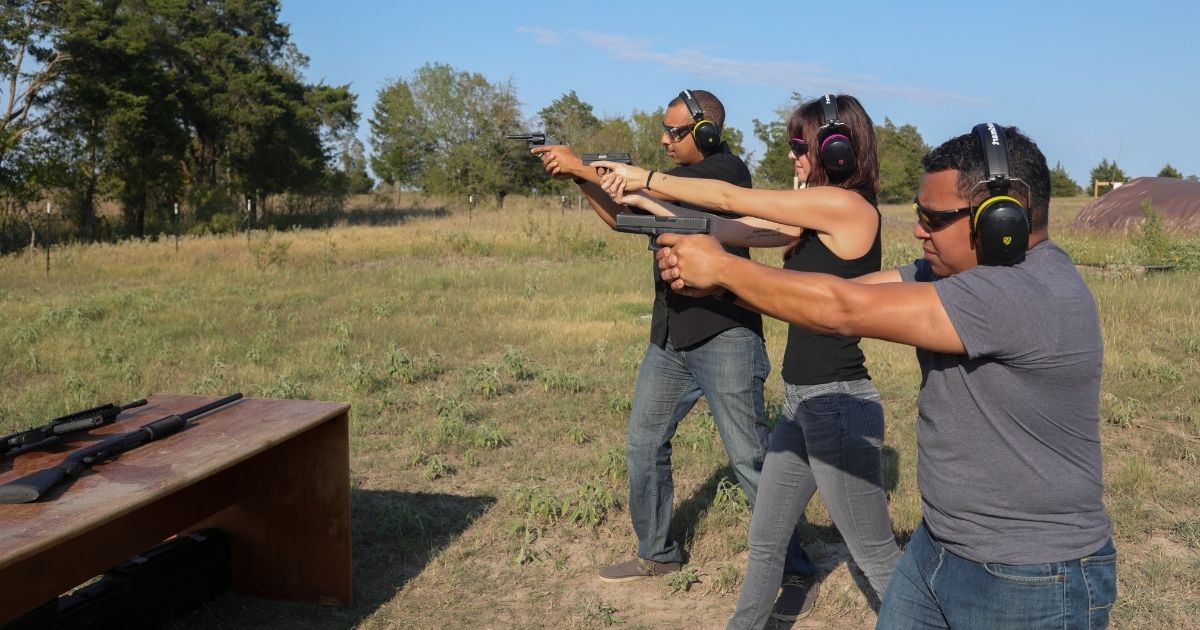
The range is the most structured environment for firearms use. Range etiquette and safety protocols are built directly around the four rules: firearms stay unloaded with actions open until the line is hot, muzzles point downrange at all times, fingers stay indexed until on target, and you fire only at your designated target. When a ceasefire is called, all firearms go down, actions open, and everyone steps back. No one touches a firearm during a ceasefire.
Always wear proper ear protection and ANSI-rated eye protection at the range. Gunshots produce 140 to 175 decibels depending on caliber, and a single shot above 140 dB can cause immediate, permanent hearing damage according to NIOSH research. TradeSmart Safety shooting kits include NRR 28 earmuffs, ANSI Z87.1+ certified safety glasses, and NRR 33 foam earplugs for doubled-up protection.
At Home
Home is where complacency is highest. Most negligent discharges happen during cleaning, dry-fire practice, or showing a firearm to someone. Before cleaning or dry-fire practice, remove all ammunition from the room and physically verify the chamber is empty. When showing a firearm, clear it first and hand it over with the action open. A loaded home-defense firearm must be kept in a quick-access safe or lockbox, accessible to you but completely inaccessible to unauthorized persons, especially children.
In the Field (Hunting and Outdoor Shooting)
The field introduces variables the range does not: uneven terrain, weather, fatigue, excitement, and the absence of a controlled backstop. Load only when you are actively hunting and ready to shoot. Unload before crossing fences, climbing tree stands, or entering vehicles. Establish "zones of fire" with your hunting party before heading out. Keep the muzzle pointed up or at the ground, never toward another person in your group. And if conditions prevent positive target identification (low light, fog, brush), you do not shoot.
Beyond the 4 Rules: Additional Safety Practices Every Gun Owner Needs
Cooper's four rules cover safe handling, but responsible gun ownership extends further. These additional practices are essential.
Safe Storage
According to the NSSF's Project ChildSafe initiative, more than 100 million gun locks have been distributed to American gun owners since 1998, yet preventable incidents still occur when firearms are stored improperly. Proper storage means:
- Storing all firearms unloaded, with the action open when possible, inside a quality gun safe or lockbox.
- Storing ammunition separately from firearms.
- Using cable locks, trigger locks, or lock boxes as additional layers of security.
- Ensuring storage locations are inaccessible to children and unauthorized users.
If you keep a firearm for home defense, use a quick-access safe with a biometric, keypad, or RFID lock. These allow rapid access for authorized users while preventing access by children, guests, or anyone else.
Safe Transport
When transporting firearms, follow both the four rules and applicable laws:
- Unload the firearm completely before placing it in a case.
- Use a hard-sided, lockable case for transport. The TradeSmart tactical backpack is designed for organized transport of range gear and accessories.
- Store ammunition separately from the firearm during transport.
- Know the transport laws for every jurisdiction you will pass through, as they vary significantly between states.
Children and Firearms Education
Unintentional child and adolescent gun deaths have increased by 42% from 2018 to 2024, and more than a third of all unintentional shootings of children take place in the homes of friends, neighbors, or relatives. Responsible gun owners must address this directly:
- Secure all firearms. This is the single most effective step. No amount of education replaces a locked safe.
- Teach the "Stop, Don't Touch, Leave, Tell an Adult" protocol. The NSSF and Project ChildSafe recommend teaching children that if they find a firearm, they should stop immediately, not touch it, leave the room, and tell a trusted adult.
- Demystify firearms age-appropriately. Children who understand what firearms are and why they are dangerous are less likely to treat them as toys. Supervised, age-appropriate education reduces curiosity-driven incidents.
- Ask about firearms in other homes. Before your child visits a friend's house, ask the parents whether firearms are present and how they are stored. This is not intrusive; it is responsible parenting.
Personal Protective Equipment
The four rules protect against negligent discharges, but shooting involves additional hazards that require dedicated protective equipment:
- Hearing protection: A single gunshot above 140 dB can cause immediate, permanent hearing damage. Recreational shooters are four times more likely to develop hearing loss than non-shooters. Doubling up with earmuffs and earplugs provides the most effective protection. TradeSmart Safety earmuffs are rated NRR 28, and the included foam earplugs are rated NRR 33, giving you layered defense against noise-induced hearing loss.
- Eye protection: Hot brass, unburned powder, and fragmentation are real hazards at the range. ANSI Z87.1+ certified lenses are required to withstand high-velocity impact from a quarter-inch steel ball at 150 feet per second. TradeSmart Safety glasses meet this standard with impact-resistant polycarbonate lenses and anti-fog coating.
The TradeSmart Range Kit includes everything you need in one package: NRR 28 earmuffs, ANSI Z87.1+ safety glasses, NRR 33 earplugs, and a hard-shell carrying case, all backed by a 10-year warranty and free shipping.
Consequences of Violating Gun Safety Rules
Understanding the consequences is not meant to create fear. It is meant to reinforce why the rules are absolute.
Physical Consequences
According to the CDC, approximately 500 Americans die from unintentional firearm injuries each year, and roughly 16,000 more are injured. A negligent discharge can result in death, permanent disability, loss of limbs, or chronic pain. These are not abstract statistics. They are preventable tragedies caused by broken rules.
Legal Consequences
A negligent discharge is a criminal offense in most jurisdictions. Penalties can include felony or misdemeanor charges, jail time (up to 3 years or more depending on the state), civil lawsuits from injured parties, and loss of firearm ownership rights following a felony conviction.
Personal Consequences
Beyond legal penalties, a negligent discharge that injures or kills someone carries a psychological burden that no court sentence can address. Relationships are destroyed, trust is lost, and the guilt of causing irreversible harm is a weight carried for life. Every one of these consequences is preventable by following four simple rules.
Building a Safety-First Mindset: Training and Education
Knowing the rules is the first step. Making them automatic requires practice, training, and ongoing reinforcement.
Formal Training
Every gun owner, regardless of experience level, benefits from professional instruction. A qualified instructor can identify unsafe habits you may not be aware of and provide structured practice to build safe reflexes. Look for NRA-certified instructors, USCCA courses, or reputable local programs.
The TradeSmart Range Confidence Course
For those building their foundation in firearms safety and handling, the TradeSmart Range Confidence Course covers firearms fundamentals including safety rules, range procedures, and the confidence to handle firearms responsibly. Every TradeSmart Safety kit includes free access to this course, giving new and experienced shooters alike a structured path to building safe, competent habits.
Ongoing Practice
Safety is not a one-time lesson. It is a continuous practice:
- Review the four rules before every range session, every hunt, and every time you handle a firearm at home.
- Practice dry-fire drills regularly to reinforce trigger discipline and muzzle awareness in a controlled environment.
- Hold yourself and your shooting partners accountable. If you see a safety violation, speak up immediately. A moment of awkwardness is infinitely preferable to a negligent discharge.
- Stay current with training. Take a refresher course annually. Skills and awareness can erode without practice.
Frequently Asked Questions About the 4 Rules of Gun Safety
Who created the 4 rules of gun safety?
The four rules of gun safety were codified by Lt. Col. Jeff Cooper, a United States Marine and founder of the American Pistol Institute (now Gunsite Academy) in Paulden, Arizona. Cooper is widely regarded as the father of modern pistolcraft. While variations of these principles existed before him, he distilled them into the concise, memorable format taught universally today.
What is the most important rule of gun safety?
All four rules are equally important because they function as a system. However, many instructors consider Rule 1 (treat every firearm as loaded) the foundational rule because it establishes the mindset that drives all other safe behavior. No single rule is sufficient on its own. All four must be followed simultaneously.
What is the difference between a negligent discharge and an accidental discharge?
A negligent discharge occurs when a firearm is unintentionally fired due to the handler's failure to follow safety rules, such as poor trigger discipline, improper holstering, or careless handling. The key distinction is that it was preventable through proper behavior. An accidental discharge refers to a mechanical failure of the firearm itself, where the weapon fires without the trigger being pulled. True accidental discharges are extremely rare with modern firearms. The vast majority of unintentional discharges are negligent, meaning they resulted from human error and were entirely preventable.
Do the 4 rules apply to unloaded guns?
Yes, absolutely. This is the entire point of Rule 1. You treat every firearm as loaded at all times, even after you have verified it is empty. The habit of safe handling must be constant and automatic. The moment you begin making exceptions for "unloaded" firearms, you create the conditions for a negligent discharge. Many of the most tragic incidents involve firearms that the handler was certain were unloaded.
How do I teach gun safety to children?
Start with the fundamentals appropriate to their age. Young children should learn the "Stop, Don't Touch, Leave, Tell an Adult" protocol recommended by the NSSF's Project ChildSafe program. As children mature, supervised, age-appropriate education can include explaining what firearms are, demonstrating safe handling under direct supervision, and eventually supervised shooting with proper safety gear. However, education is not a substitute for secure storage. All firearms must be locked and inaccessible to children at all times, regardless of their level of training.
What safety gear do I need at the shooting range?
At a minimum, you need hearing protection and eye protection rated for shooting environments. Gunshots produce 140 to 175 dB, and NIOSH recommends hearing protection at any exposure above 85 dB. Look for earmuffs with an NRR (Noise Reduction Rating) of at least 22, and consider doubling up with foam earplugs for maximum protection. Eye protection must be ANSI Z87.1+ certified to withstand high-velocity impact. TradeSmart Safety range kits include NRR 28 earmuffs, NRR 33 earplugs, ANSI Z87.1+ safety glasses, and a protective carrying case, covering all your essential range safety gear in one package with free shipping and a 10-year warranty.
The 4 Rules Are Not Suggestions
Lt. Col. Jeff Cooper's four rules of gun safety have saved countless lives since they were first codified. They are simple enough for a beginner to memorize in minutes and comprehensive enough to prevent virtually every type of negligent firearm incident. But they only work if you follow them every single time, with every firearm, in every situation.
Treat every firearm as loaded. Never point the muzzle at anything you are not willing to destroy. Keep your finger off the trigger until you are on target and ready to fire. Be sure of your target and what is beyond it.
These are not guidelines. They are not suggestions. They are rules, and they are the price of admission for responsible firearms ownership.
If you are building your safety foundation or gearing up for your first range trip, TradeSmart Safety has you covered. Every TradeSmart shooting kit includes professional-grade ear and eye protection plus free access to the Range Confidence Course, an online firearms fundamentals program that walks you through safety, handling, and range procedures step by step. All products ship free and are backed by a 10-year warranty. Gear up, train up, and shoot responsibly.




Leave a comment (all fields required)