








Passive vs Electronic Earmuffs: How to Choose the Right Hearing Protection for Shooting
Gunshots produce between 140 and 175 decibels depending on the caliber. A single shot above 140 dB can cause immediate, permanent hearing damage. According to the National Institute on Deafness and Other Communication Disorders (NIDCD), roughly 40 million Americans aged 20 to 69 already suffer from noise-induced hearing loss, and recreational shooters are four times more likely to develop it than non-shooters.
The good news: the right hearing protection eliminates that risk. The question most shooters wrestle with is whether to choose passive earmuffs or electronic earmuffs. Both block harmful noise. Both carry NRR (Noise Reduction Rating) certifications. But they work in fundamentally different ways, and the best choice depends on where you shoot, what you shoot, and what you need to hear while you do it.
This guide breaks down exactly how each type works, compares them head to head, and helps you decide which option fits your shooting style.
How Passive Earmuffs Work
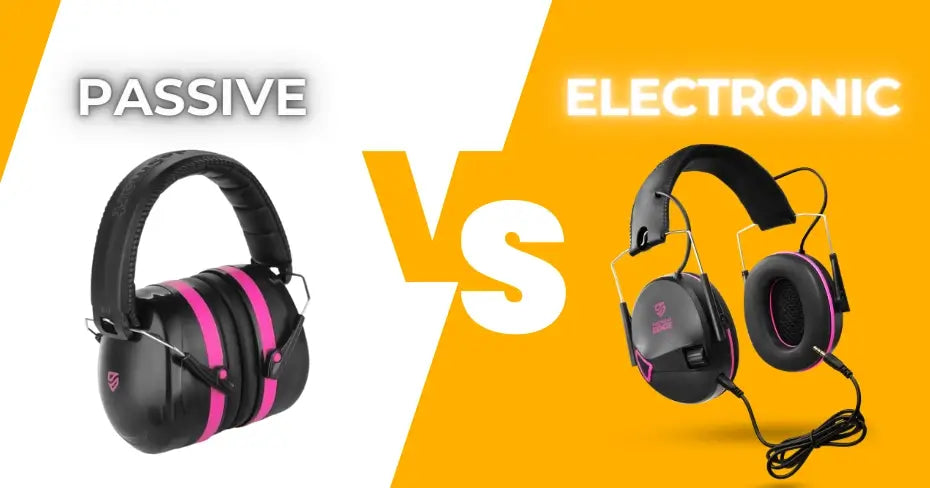
Passive earmuffs are the traditional form of over-ear hearing protection. They use no electronics, no batteries, and no amplification circuits. Instead, they rely entirely on physical materials to block and absorb sound energy before it reaches your eardrums.
Sound Absorption and Attenuation
Inside every passive earmuff is a layered system designed to reduce sound energy through three mechanisms:
- Reflection: The hard outer shell of each earcup reflects incoming sound waves away from the ear.
- Absorption: Dense acoustic foam inside the cups absorbs sound energy, converting it to a negligible amount of heat.
- Sealing: Cushioned ear pads create a tight seal around the ear, preventing sound from leaking through gaps between the cup and your head.
The combination of these three barriers is what gives passive earmuffs their NRR rating. A higher NRR means more sound energy is blocked. TradeSmart Safety passive earmuffs, for example, carry an NRR of 28, which means they reduce the sound reaching your ears by 28 decibels under laboratory conditions.
Understanding the NRR
The NRR is tested and certified under ANSI S3.19 or ANSI S12.6 standards. It represents the amount of noise reduction measured in a controlled lab environment. In real-world use, OSHA recommends a derating factor: subtract 7 from the NRR, then divide by 2, to estimate actual protection in the field.
For TradeSmart Safety's NRR 28 passive earmuffs, that real-world estimate works out to approximately 10.5 dB of actual reduction, though many users experience significantly better performance with a proper seal. The key takeaway: fit matters as much as the rating number itself.
Passive earmuffs are the workhorse of hearing protection. They are reliable, affordable, and require zero maintenance beyond keeping the ear cushions clean. For a detailed look at how they compare to other forms of hearing protection, check out our guide to the best ear protection for shooting.
How Electronic Earmuffs Work
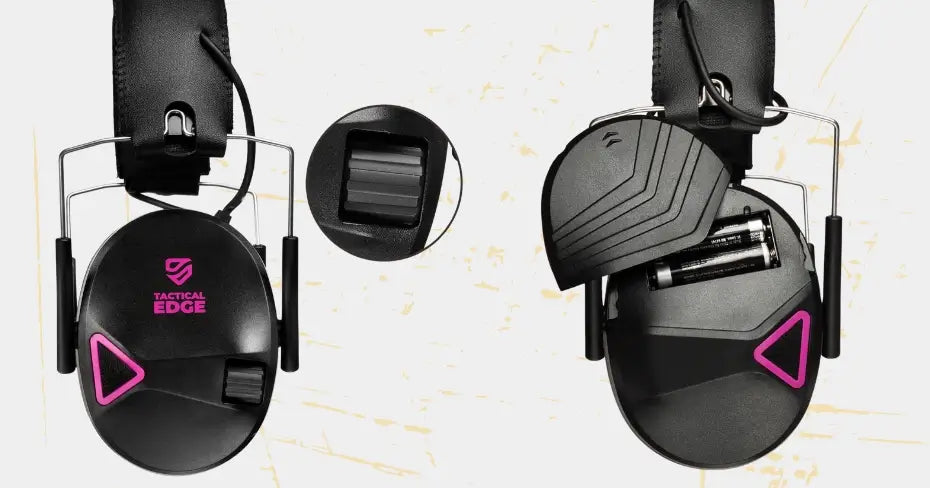
Electronic earmuffs start with the same passive protection shell, foam, and seal, but they add a layer of active sound management that gives shooters something passive earmuffs cannot: the ability to hear speech and environmental sounds at safe volumes while still blocking harmful noise.
Microphones and Amplification
Electronic earmuffs feature one or more external microphones, typically mounted on each earcup. These microphones pick up ambient sound from your surroundings, including voices, range commands, animal movement, and environmental cues, and feed that audio to an internal amplification circuit.
The amplifier boosts these quiet, safe sounds and plays them through small speakers inside the earcups. The TradeSmart TacticalEdge electronic earmuffs, for instance, amplify ambient sound by up to 5x, making range commands and conversation effortlessly audible even through sealed earcups.
Sound Compression and Limiting
The critical technology in electronic earmuffs is the compression circuit. When the microphones detect a sound above a safe threshold, typically around 82 to 85 dB, the circuit responds in milliseconds. It either compresses the incoming signal (reducing the volume of dangerous peaks while keeping safe sounds audible) or cuts amplification to the speakers entirely until the noise passes.
This happens fast. Quality electronic earmuffs have response times measured in fractions of a millisecond, which means the circuit reacts to a gunshot before the full pressure wave reaches peak intensity. The result is that you hear a muffled thump rather than the full concussive blast.
Directional Awareness
Many electronic earmuffs use stereo microphone configurations, with one mic on each cup. This preserves spatial audio cues, so you can tell which direction a voice or sound is coming from. For hunters tracking game or competition shooters monitoring their surroundings, this directional awareness is a significant advantage over passive earmuffs, which muffle all sound equally from every direction.
To learn more about what makes a quality set of electronic hearing protection, read our in-depth guide on the best electronic ear protection.
Side-by-Side Comparison: Passive vs Electronic Earmuffs
Here is how the two types of earmuffs stack up across the categories that matter most to shooters:
Noise Reduction Rating (NRR)
Passive earmuffs generally offer higher NRR values because there are no electronic components taking up space inside the earcup. TradeSmart Safety passive earmuffs are rated at NRR 28. Electronic earmuffs typically range from NRR 22 to NRR 26; the TradeSmart TacticalEdge carries an NRR 24.
That 2 to 6 dB gap may seem small, but on the decibel scale (which is logarithmic), every 3 dB represents a doubling of sound energy. If maximum raw noise reduction is your only priority, passive earmuffs have the edge.
Situational Awareness
This is where electronic earmuffs dominate. With amplified ambient sound, you can hear range safety officers, instructors, hunting partners, and approaching wildlife, all while wearing sealed hearing protection. Passive earmuffs block everything indiscriminately. If someone calls "cease fire" at the range, you may not hear it clearly with passive earmuffs on.
Comfort and Weight
Passive earmuffs tend to be slightly lighter because they contain no electronics, batteries, or speakers. That said, many modern electronic earmuffs, including slim-profile models like the TradeSmart TacticalEdge, are designed to minimize weight and bulk. For extended shooting sessions lasting several hours, both types should have padded headbands and cushioned ear pads to prevent fatigue.
Battery Dependency
Passive earmuffs need no batteries. They work every time, no exceptions. Electronic earmuffs require power, typically AAA batteries or rechargeable cells. If the batteries die, the electronic features stop working, though the passive shell still provides basic protection. The TradeSmart TacticalEdge uses replaceable AAA batteries and includes a 4-hour auto-shutoff to conserve power when you forget to turn them off.
Price
Passive earmuffs are more budget-friendly. A quality pair with a solid NRR rating costs less than electronic alternatives. Electronic earmuffs carry a premium for their amplification technology, microphones, and circuitry. However, if situational awareness is important to your shooting discipline, that premium pays for itself in safety and convenience.
Durability
Both types are durable when built well. Passive earmuffs have fewer components that can fail. Electronic earmuffs have microphones and circuits that could potentially be damaged by moisture or impact, though modern designs are increasingly rugged. TradeSmart Safety backs all its hearing protection products with a 10-year warranty, covering both passive and electronic models.
When to Choose Passive Earmuffs
Passive earmuffs are the right call in several common scenarios:
- Budget-conscious shooters: If you need reliable hearing protection without a significant investment, passive earmuffs deliver proven performance at a lower price point.
- Maximum NRR priority: When you want the highest possible noise reduction from earmuffs alone, passive models typically win on raw NRR numbers.
- Simplicity and reliability: No batteries to replace, no electronics to fail. Put them on and they work. This is especially valuable in wet or dusty environments.
- Industrial and workshop use: If you use hearing protection for power tools, lawn equipment, or shop work where communication is less critical, passive earmuffs are an excellent, low-maintenance choice.
- Doubling up: When used as the outer layer over foam earplugs (more on this strategy below), passive earmuffs add substantial protection without needing electronic features.
TradeSmart Safety's passive earmuff kits pair NRR 28 earmuffs with ANSI Z87.1+ safety glasses and a hard-shell carrying case, giving you complete range protection in one package.
When to Choose Electronic Earmuffs
Electronic earmuffs shine in situations where hearing your environment is as important as protecting your hearing:
- Shooting instruction and classes: If you are learning to shoot or taking a course, you need to hear your instructor clearly. Electronic earmuffs let you follow verbal coaching without removing your hearing protection.
- Competition shooting: Competitive disciplines often require shooters to respond to audible commands, timer signals, and range officer instructions. Electronic earmuffs keep you in the action.
- Hunting: Hearing approaching game, your hunting partner's communication, and environmental sounds is essential in the field. Electronic earmuffs amplify these quiet sounds while instantly compressing the noise of a gunshot.
- Busy public ranges: On a crowded range, hearing "cease fire" calls and other safety commands can be the difference between a safe outing and a dangerous one.
- Home defense preparation: If you train with home defense scenarios in mind, electronic earmuffs let you maintain awareness of your surroundings, simulating conditions where you would need to hear threats and family members simultaneously.

The TradeSmart electronic ear and eye protection kit pairs the TacticalEdge electronic earmuffs (NRR 24) with ANSI Z87.1+ safety glasses, giving you both hearing and eye protection with full situational awareness.
The Combination Strategy: Electronic Earmuffs + Foam Earplugs
For shooters who face the loudest environments, particularly indoor ranges, there is a strategy that delivers the best of both worlds: wearing foam earplugs underneath electronic earmuffs.
Why Double Up?
Indoor shooting ranges are among the loudest environments a recreational shooter will encounter. Concrete walls and ceilings reflect sound waves instead of absorbing them, amplifying the effective noise exposure. A 9mm handgun that produces roughly 160 dB outdoors can feel even more intense inside an enclosed range. According to NIOSH, any exposure above 140 dB poses an immediate risk of permanent hearing damage.
Doubling up with earplugs and earmuffs together does not simply add the two NRR ratings. Instead, OSHA's formula takes the higher NRR and adds 5 dB for the second layer. For example:
- TradeSmart NRR 33 foam earplugs (higher rating) + TacticalEdge NRR 24 electronic earmuffs = combined effective NRR of approximately 38 dB
- TradeSmart NRR 33 foam earplugs + TradeSmart NRR 28 passive earmuffs = combined effective NRR of approximately 38 dB
Why Electronic Earmuffs Work Best as the Outer Layer
Here is the key insight: when you wear foam earplugs under electronic earmuffs, the earplugs handle the heavy-duty noise blocking while the electronic earmuffs still amplify ambient sound through their speakers. You get maximum noise reduction and you can still hear range commands, conversation, and safety calls at safe amplified volumes.
This is the setup that experienced shooters, range safety officers, and firearms instructors overwhelmingly prefer for indoor ranges. It is also the recommended configuration for anyone shooting large-caliber rifles, shotguns, or firearms equipped with muzzle brakes.
For proper earplug insertion technique, which is critical for getting the full NRR benefit, see our guide on how to put in earplugs.
TradeSmart Safety's NRR 33 foam earplugs are designed specifically for this doubling-up strategy and pair perfectly with either our passive or electronic earmuffs.
TradeSmart Safety's Hearing Protection Options
TradeSmart Safety offers both passive and electronic hearing protection, each certified and backed by a 10-year warranty with free shipping on every order.
Passive Earmuffs (NRR 28)
- NRR 28 noise reduction, independently tested and certified
- Over-ear design with cushioned ear pads and padded headband
- Foldable for compact storage and transport
- No batteries or maintenance required
- Available in multiple kit configurations with ANSI Z87.1+ safety glasses and hard-shell case
- Every kit includes the free Range Confidence Course, an online firearms fundamentals program
Popular passive kits:
- Shooting Range Kit (earmuffs + glasses)
- Premium Kit (earmuffs + clear glasses + case + earplugs)
- Professional Kit (earmuffs + clear & tinted glasses + case + earplugs)
TacticalEdge Electronic Earmuffs (NRR 24)
- NRR 24 noise reduction with active sound management
- 5x sound amplification for speech and ambient awareness
- Directional microphones for stereo spatial awareness
- Sound compression circuit with millisecond response time
- Slim, low-profile design for comfortable extended wear
- Powered by replaceable AAA batteries with 4-hour auto-shutoff
- Certified in the USA
Available as:
How to Decide: A Quick Decision Framework
Ask yourself these questions to determine which type of earmuff is right for you:
1. Do you need to hear speech or commands while shooting?
Yes: electronic earmuffs. No: passive earmuffs will serve you well.
2. Do you shoot primarily indoors?
If so, consider the doubling-up strategy: foam earplugs underneath electronic earmuffs for maximum protection plus awareness. Understanding the risks of high-decibel exposure is critical; our article on how long hearing loss lasts after shooting explains why indoor protection matters so much.
3. Is budget a primary concern?
Passive earmuffs deliver excellent protection at a lower price. Start with a quality passive set and upgrade to electronic later as your needs evolve.
4. Do you hunt or shoot competitively?
Electronic earmuffs are strongly recommended for both. Hunters need environmental awareness; competitors need to hear range commands and timer signals.
5. Do you want a zero-maintenance solution?
Passive earmuffs require nothing beyond occasional cleaning. No batteries, no charging, no electronic components to worry about.
Frequently Asked Questions
What is the difference between passive and electronic earmuffs?
Passive earmuffs block sound using physical materials only: a hard outer shell, acoustic foam, and a cushioned seal around the ear. They reduce all sound equally and require no batteries. Electronic earmuffs include the same passive shell but add microphones, an amplification circuit, and speakers that let you hear safe-level sounds (like speech) while automatically compressing or blocking dangerous sounds (like gunshots). Electronic earmuffs require battery power to operate their active features.
Are electronic earmuffs better than passive earmuffs for shooting?
Neither type is universally "better." Electronic earmuffs are superior for situational awareness, allowing you to hear range commands, instructors, and conversation. Passive earmuffs typically offer higher NRR ratings and are more reliable since they have no electronic components. The best choice depends on your shooting environment and needs. Many experienced shooters own both.
Can I wear earplugs under electronic earmuffs?
Yes, and this is the recommended approach for indoor ranges and high-caliber firearms. Foam earplugs worn underneath electronic earmuffs provide dual-layer protection. OSHA's formula estimates the combined protection at the higher NRR plus 5 dB. The electronic amplification still lets you hear speech and commands through the outer earmuff speakers, even with earplugs inserted.
What NRR do I need for shooting?
NIOSH recommends hearing protection anytime noise exceeds 85 dB. Since gunshots range from 140 dB (a .22 rifle) to over 170 dB (large-caliber rifles with muzzle brakes), you want the highest NRR practical for your situation. For outdoor shooting, earmuffs rated NRR 25 or higher are a solid baseline. For indoor ranges, doubling up with earplugs (NRR 33) and earmuffs is strongly recommended to approach a combined NRR of 36 or higher. For more guidance, read our article on noise canceling earmuffs.
Do electronic earmuffs still protect if the batteries die?
Yes. When the batteries are depleted, the electronic amplification and compression features stop working, but the passive shell, foam, and ear seal continue to provide the rated NRR protection. You lose the ability to hear amplified ambient sound, but your hearing is still protected from loud noise. It is good practice to carry spare batteries in your range bag.
How loud is a gunshot in decibels?
Gunshot noise varies by caliber and firearm type. A .22 caliber rifle produces approximately 140 dB. A 9mm handgun generates around 160 dB. A 12-gauge shotgun reaches roughly 165 dB, and a .44 Magnum revolver produces about 164 dB. For context, OSHA's permissible exposure limit is 85 dB over eight hours, and any single exposure above 140 dB can cause immediate permanent hearing damage.
Are electronic earmuffs worth the extra cost?
For shooters who need communication on the range, take instruction, hunt, or compete, electronic earmuffs justify their higher cost through improved safety and convenience. Being able to hear a "cease fire" call without lifting your earmuffs is a genuine safety advantage. For casual range use where communication is not critical, passive earmuffs provide excellent protection at a lower cost.
How do I know if my earmuffs fit properly?
A properly fitted earmuff creates a complete seal around each ear with no gaps. The ear cushions should sit flat against your head, with no pressure points or spaces caused by glasses frames, hair, or jaw movement. If you can hear ambient noise almost as clearly with the earmuffs on as with them off, the seal is compromised. Try adjusting the headband tension and repositioning the cups. For what to wear to the gun range (including tips on eyewear and earmuff compatibility), see our dedicated guide.
Protect Your Hearing the Right Way
Whether you choose passive earmuffs, electronic earmuffs, or both, the most important thing is that you wear certified hearing protection every single time you shoot. Noise-induced hearing loss is permanent. According to the American Tinnitus Association, approximately 25 million Americans experience tinnitus, a condition closely linked to noise exposure, and it has no cure.
TradeSmart Safety builds hearing protection specifically for shooters, with NRR-certified earmuffs, ANSI Z87.1+ safety glasses, and complete range kits that include everything you need, including free access to the Range Confidence Course. Every product ships free and is backed by a 10-year warranty.
Ready to protect your hearing?




Lori Alama
May 06, 2024
Hi,
I was wondering, do all Electronic Earmuffs have a “one size fits all” rule or, are there different sizes for different ages and/or head sizes?
I’m a small-framed woman and I’m beginning to shoot at the range, and I want to be sure my hearing is properly protected.
Thank you for your help!