








Best Home Defense Guns: Shotguns, Handguns, and Rifles Compared
Choosing a firearm for home defense is one of the most consequential decisions a gun owner will make. According to FBI data, approximately 745,000 burglaries were reported in 2024 alone, with residential properties accounting for roughly 57% of incidents. That translates to about 1,300 home burglaries per day across the United States.
The right home defense gun depends on your living situation, your experience level, the people in your household, and the layout of your home. A shotgun that excels in a rural farmhouse may be a liability in a thin-walled apartment. A rifle that delivers devastating terminal performance might send rounds through multiple rooms and into a neighbor's home.
This guide breaks down the three major firearm platforms for home defense — shotguns, handguns, and rifles — covering their strengths, weaknesses, and the critical factors you need to consider before selecting one as your primary home defense tool.
Shotguns for Home Defense
Shotguns have been the default home defense recommendation for decades, and for good reason. A 12-gauge loaded with buckshot delivers devastating stopping power at close range, and the manual of arms for a pump-action shotgun is straightforward enough for most adults to learn quickly.
12-Gauge Shotguns
The 12-gauge remains the most popular shotgun choice for home defense. Models like the Mossberg 590A1 and Beretta 1301 Tactical are purpose-built for defensive use, with short barrels (typically 18.5 inches), extended magazine tubes, and robust construction.
Advantages:
- Devastating stopping power at typical home defense distances (3 to 15 yards)
- Wide ammunition selection — from reduced-recoil buckshot to specialty defensive loads
- Mechanical simplicity, especially pump-action models
- Intimidation factor — the sound of a pump-action racking is universally recognized
- Can be loaded with different shell types for different situations
Drawbacks:
- Significant recoil, especially with full-power 00 buckshot loads (25 to 30 pounds of recoil energy)
- Limited ammunition capacity (typically 5 to 8 rounds)
- Longer overall length can make maneuvering in hallways and around corners difficult
- Slower to reload compared to magazine-fed firearms
- Gunshot noise levels are extreme — a 12-gauge shotgun produces approximately 165 dB, well above the 140 dB threshold that can cause immediate permanent hearing damage
20-Gauge Shotguns
The 20-gauge is an increasingly popular alternative that deserves serious consideration, particularly for households where recoil sensitivity is a concern. A 20-gauge generates roughly 20 pounds of recoil energy with buckshot compared to 25 to 30 pounds for the 12-gauge — a meaningful difference when it comes to follow-up shots and overall control.
In practical testing, shooters have been able to fire four 20-gauge shells in the same time it takes to fire three 12-gauge rounds at seven yards. That faster shot-to-shot speed can be decisive in a home defense encounter.
Best for: Smaller-framed shooters, recoil-sensitive individuals, or anyone who wants a more manageable platform without sacrificing terminal effectiveness at indoor distances.
Key consideration: The defensive ammunition market for 20-gauge is more limited than for 12-gauge. Look for #3 buckshot or specialty home defense loads from major manufacturers. Number 1 buckshot pellets in 20-gauge still penetrate deep enough to reliably reach vital structures on a threat.
Shotgun Ammunition for Home Defense
Ammunition selection is critical for shotguns used in home defense. Your two primary considerations are stopping power and over-penetration risk.
- 00 Buckshot: The traditional standard. Delivers 8 to 9 pellets of .33-caliber projectiles. Extremely effective but significant over-penetration risk through interior walls.
- #4 Buckshot: A strong middle ground. Delivers more pellets with less individual mass, reducing wall penetration while maintaining adequate energy at close range. Many home defense experts recommend #4 buck over 00 buck for residential use.
- #1 Buckshot: Offers an excellent balance between pellet count, individual pellet energy, and reduced over-penetration risk. Often considered the optimal home defense buckshot load.
- Birdshot (#6 or larger): At contact distances inside a home (under 10 yards), birdshot can still cause serious injury. However, its effectiveness drops off rapidly beyond that distance, and it may not reliably stop a determined attacker.
- Reduced-recoil loads: Available from Federal, Hornady, and others. These loads bring recoil down to manageable levels while maintaining defensive effectiveness.
Handguns for Home Defense
Handguns offer distinct advantages for home defense that no long gun can match: they can be operated with one hand (freeing the other to hold a phone, open doors, or guide family members), they store compactly in a bedside safe, and most adults can learn to shoot them proficiently with regular practice.
9mm Handguns
The 9mm Luger is the dominant home defense handgun caliber in 2026, and that dominance is well earned. Modern 9mm hollow-point ammunition delivers reliable expansion and adequate penetration for defensive use, while producing far less recoil than larger calibers.
Why 9mm leads:
- Higher magazine capacity than larger calibers (typically 15 to 17+ rounds in full-size pistols)
- Manageable recoil that allows faster, more accurate follow-up shots
- Excellent selection of defensive hollow-point ammunition from Federal HST, Speer Gold Dot, Hornady Critical Defense, and others
- Most affordable centerfire defensive caliber for practice ammunition
- Adopted by the majority of U.S. law enforcement agencies and the U.S. military (the Sig Sauer M18 is the current Marine Corps sidearm)
Popular 9mm home defense options include the Sig Sauer P320/M18, Glock 19 or Glock 17, Smith & Wesson M&P 2.0, and CZ P-10 series. If you are new to handguns, our guide to the best beginner handguns covers how to choose your first pistol in greater detail.
.45 ACP Handguns
The .45 ACP has been a proven defensive cartridge since 1911. Its larger, heavier projectile creates a wider wound channel, and the slower bullet velocity (typically 830 to 950 fps) can actually reduce over-penetration compared to faster, lighter rounds — though this advantage depends heavily on ammunition selection.
Advantages:
- Larger bullet diameter (.452") for wider wound channels
- Proven track record spanning over a century of defensive use
- Slower velocity can mean less over-penetration with proper hollow-point loads
- Excellent performance in compact and full-size 1911-style pistols
Trade-offs:
- Lower magazine capacity (typically 7 to 10 rounds in most platforms)
- More felt recoil than 9mm, which can slow follow-up shots
- More expensive ammunition for both practice and defensive loads
- Heavier firearms overall
Bottom line: If you shoot a .45 ACP well and practice with it regularly, it remains an excellent home defense caliber. But for most shooters, especially those newer to firearms, 9mm offers a better combination of capacity, controllability, and terminal performance with modern ammunition.
Handgun Ammunition for Home Defense
Hollow-point ammunition is non-negotiable for home defense handguns. Full metal jacket (FMJ) rounds — the kind you typically buy for range practice — are designed to punch through targets rather than expand. In a home defense situation, FMJ rounds will pass through walls, furniture, and potentially people without stopping.
Quality hollow-point rounds are engineered to expand on impact with soft tissue, creating a larger wound channel and transferring energy more efficiently. This expansion also means the bullet is more likely to stop inside the threat rather than exiting and endangering bystanders.
Top defensive ammunition choices include:
- Federal HST: Consistent expansion, excellent weight retention, available in standard and +P pressures
- Speer Gold Dot: Used by hundreds of law enforcement agencies nationwide
- Hornady Critical Defense: Flex Tip design prevents hollow point clogging through barriers
- Federal Punch: Designed specifically for civilian self-defense at a lower price point
Important: Whatever defensive ammunition you choose, take at least 50 to 100 rounds to the range and run them through your home defense gun to verify reliable feeding and function. If you need guidance on choosing a carry gun that doubles for home defense, we have a dedicated guide for that as well.
Rifles for Home Defense
The AR-15 platform and pistol-caliber carbines (PCCs) have become increasingly popular home defense options, and both offer real advantages that complement or outperform traditional shotgun and handgun choices.
AR-15 Platform (5.56 NATO / .223 Remington)
The AR-15 is the most customizable, widely supported, and arguably most effective home defense firearm available to American civilians. It is simple to operate, inherently accurate, lightweight (typically 6 to 7 pounds), and offers minimal felt recoil despite firing an intermediate rifle cartridge.
Advantages:
- 30-round standard magazine capacity
- Minimal recoil — the buffer system absorbs much of the energy, making follow-up shots fast and accurate
- Highly accurate, even for less experienced shooters, thanks to four points of contact (shoulder, cheek, two hands)
- Extremely customizable with lights, optics, slings, and other accessories
- Wide aftermarket support means affordable parts and accessories
- Lightweight and easy to shoulder for extended periods
The over-penetration question: One of the most persistent myths in firearms discussions is that rifle rounds over-penetrate more than handgun or shotgun rounds inside a home. In reality, lightweight 5.56 NATO rounds (especially 55-grain and lighter projectiles) tend to fragment or tumble when striking drywall and structural barriers, often penetrating fewer layers of wall material than 9mm handgun rounds or 00 buckshot.
For home defense use, select ammunition designed to fragment or expand quickly:
- Hornady V-MAX or TAP: Polymer-tipped varmint rounds that fragment aggressively on barrier impact
- Federal Fusion or Power-Shok SP (64-grain): Soft-point designs that expand and shed energy quickly
- Frangible ammunition: Designed to disintegrate on hard surface contact, significantly reducing through-wall penetration risk
- Speer Gold Dot 75-grain: Purpose-built defensive rifle round with controlled expansion
Key consideration: An AR-15 chambered in 5.56 NATO produces approximately 165 dB at the muzzle. Firing one indoors without hearing protection will cause immediate, severe hearing damage. This is one of the strongest arguments for keeping quality hearing protection staged near your home defense firearm.
Pistol-Caliber Carbines (PCCs)
Pistol-caliber carbines — particularly those chambered in 9mm on an AR-style platform — have emerged as a compelling home defense option that bridges the gap between handguns and rifles.
Why PCCs are gaining traction for home defense:
- Superior accuracy over handguns: The longer barrel, stock, and additional points of contact make PCCs significantly easier to shoot accurately than a pistol, especially under stress
- Reduced over-penetration: 9mm hollow-point ammunition from a carbine-length barrel carries less energy than 5.56 NATO, striking a better balance between stopping power and reduced wall penetration risk
- Shared ammunition and magazines: Many PCCs accept the same magazines as popular handguns (Glock magazines are the most common compatibility standard), simplifying your logistics
- Lower noise and muzzle blast: Substantially quieter than a 5.56 rifle, reducing the disorientation of firing indoors
- Compact size: Most PCCs are shorter overall than shotguns or standard rifles, making hallway and doorway navigation easier
- Exceptionally low recoil: Even less felt recoil than an AR-15 in 5.56, making rapid follow-up shots effortless
Best for: Homeowners in apartments or shared-wall dwellings, shooters who want rifle-like handling with handgun-caliber penetration characteristics, and anyone who wants to simplify their ammunition inventory.
Over-Penetration: The Factor Most People Underestimate
Over-penetration — where a bullet passes through its intended target or through interior walls and continues with lethal energy — is the single most important and most frequently overlooked consideration in home defense firearm selection.
Standard residential construction uses half-inch drywall over wood or metal studs. A single layer of drywall does virtually nothing to stop any common defensive round. Even two layers (as you would find shooting through one wall into the next room) will not reliably stop most ammunition types.
Over-Penetration Risk by Platform
Shotguns:
- 00 buckshot penetrates multiple interior walls easily and retains lethal energy
- #4 buckshot is a significant improvement but can still penetrate 2 to 3 interior walls
- Birdshot has the lowest penetration risk but also the lowest effectiveness against a determined threat
Handguns:
- 9mm FMJ rounds penetrate more interior walls than almost any other common defensive round — never use FMJ for home defense
- 9mm and .45 ACP hollow points penetrate significantly fewer walls, but can still pass through 2 or more layers of drywall
- Frangible handgun rounds offer the best wall-penetration reduction but may compromise terminal effectiveness
Rifles:
- Lightweight 5.56 NATO rounds (55-grain and under) often fragment in drywall, reducing penetration depth
- Heavier rifle rounds (62-grain and above, steel-core, or FMJ) will penetrate many interior walls
- Frangible 5.56 rounds offer the best barrier-penetration reduction in the rifle category
What This Means for Your Home
Apartment dwellers and townhome residents should prioritize reduced over-penetration above all else. A PCC with 9mm hollow points or a shotgun with #4 buckshot are strong choices. Avoid rifle-caliber FMJ ammunition entirely.
Suburban homeowners with detached homes have more flexibility but should still consider the layout of bedrooms relative to defensive positions. Know what is behind every wall between your likely shooting position and the rooms where family members sleep.
Rural homeowners with significant distance between structures have the most flexibility in platform choice but should still practice responsible ammunition selection.
Home Layout Considerations
Your home's physical layout should directly influence your firearm selection and your defensive plan.
Hallways and Tight Corners
Long guns — shotguns and rifles — become increasingly difficult to maneuver in narrow hallways and around tight corners. A standard 18.5-inch barrel shotgun with a stock has an overall length of 38 to 40 inches, which means navigating a 36-inch-wide hallway while maintaining a ready position is challenging. Shorter-barreled AR pistols, PCCs, and handguns offer a distinct advantage in tight spaces.
Distances Inside Your Home
According to defensive firearms training experts, the vast majority of home defense encounters occur at distances between 3 and 15 yards. At these distances, all three platforms (shotguns, handguns, and rifles) are effective. However, the margin for error is smallest with handguns — they require the most skill to shoot accurately under stress.
Multiple Floors
In multi-story homes, consider where rounds will travel if they miss or pass through a target. Firing downward from an upper floor sends missed rounds into the floor/ceiling structure, which provides more stopping material than drywall walls. Firing upward sends rounds toward bedrooms and living spaces on floors above.
Defensive Position vs. Room Clearing
Unless you are trained in room-clearing tactics, the best home defense strategy is to establish a defensive position (typically your bedroom), call 911, and wait. Moving through your home to confront an intruder exposes you to ambush, friendly-fire risk (if family members are also moving), and legal complications. Your firearm choice should support a defensive posture, not a search-and-clear mission.
Essential Accessories for Home Defense Firearms
Weapon-Mounted Lights
A weapon-mounted light is arguably the single most important accessory on any home defense firearm. FBI statistics indicate that the majority of residential burglaries occur during evening and nighttime hours when homes are occupied. You cannot shoot what you cannot identify, and you are legally and morally obligated to confirm your target before pulling the trigger.
A quality weapon light (300+ lumens minimum) allows you to positively identify threats while keeping both hands on the weapon. Brands like Streamlight and SureFire offer reliable, proven options across all price points. Follow the four fundamental rules of gun safety — including always being sure of your target and what is beyond it — and a weapon light makes that possible in low-light conditions.
Red Dot Sights
Red dot optics speed up target acquisition significantly, especially in stressful situations where fine motor skills degrade. For rifles and PCCs, red dots are a near-universal recommendation — shouldering the weapon naturally aligns the dot with your line of sight.
For handguns, red dots require more training to use effectively. The optic must be precisely aligned with your eye to see the dot, and handguns require slide milling or optic-ready models to mount a sight. However, once proficiency is developed, a red dot on a handgun is a major advantage for accuracy, particularly for aging eyes or in low-light conditions.
Slings (For Long Guns)
A two-point sling on a shotgun, rifle, or PCC keeps the weapon secured to your body when you need to free your hands — to open doors, carry a child, or use a phone. It also prevents an attacker from easily taking the weapon away from you in a close-quarters struggle.
Hearing Protection Staged Nearby
This is a recommendation that rarely appears in home defense discussions, but it matters. Firing any unsuppressed firearm indoors will cause permanent hearing damage. A 9mm handgun produces approximately 160 dB. A 12-gauge shotgun can exceed 165 dB. According to NIOSH research, a single gunshot above 140 dB can cause immediate, permanent hearing damage.
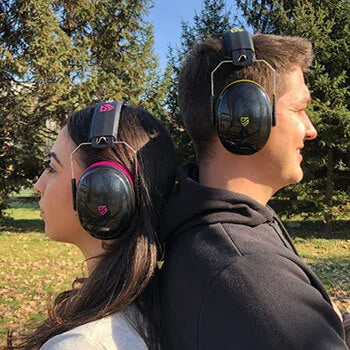
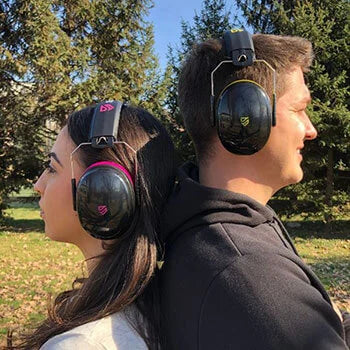
If your defensive plan allows even a few seconds of preparation — which it usually does if you hear an intruder before they reach your bedroom — putting on electronic earmuffs can protect your hearing while actually improving your situational awareness. Electronic earmuffs amplify ambient sounds (footsteps, voices, breaking glass) while blocking the damaging impulse noise of gunfire.
TradeSmart Safety's TacticalEdge Electronic Earmuffs feature NRR 24 protection with directional microphones and sound amplification, making them a practical choice for keeping staged with a home defense firearm. Pair them with NRR 33 foam earplugs for maximum protection during extended range training sessions where you practice with your home defense gun.
Legal Considerations for Home Defense Firearms
Owning a home defense firearm comes with serious legal responsibilities. The legal landscape varies dramatically by state, and ignorance of the law is never an acceptable defense.
Castle Doctrine
Castle Doctrine is a legal principle that removes the duty to retreat when you are in your own home. Under Castle Doctrine, you are entitled to use force — including deadly force — to defend yourself against an intruder who poses an imminent threat of serious bodily harm or death, without first being required to attempt escape.
The specifics vary significantly by state. As of 2025, 35 states have stand-your-ground statutes or expanded Castle Doctrine provisions that apply beyond the home. However, states like New York, New Jersey, Massachusetts, Maryland, and several others impose a duty to retreat in public spaces while still recognizing Castle Doctrine within the home.
What Castle Doctrine Does NOT Protect
- You cannot shoot someone simply for being on your property. There must be a reasonable belief of imminent serious injury or death.
- You cannot be the initial aggressor. Castle Doctrine protections do not apply if you provoked or initiated the confrontation.
- You must exercise proportional force. Shooting a fleeing, unarmed trespasser who poses no threat is not a justified use of deadly force in any jurisdiction.
- Booby traps and unattended weapons are not covered. Setting traps for intruders is illegal in every state.
Practical Legal Steps
- Research your specific state's self-defense statutes — not just what you have heard from friends or online forums
- Consider a self-defense legal protection plan (USCCA, CCW Safe, US LawShield, or similar)
- Understand that even a legally justified shooting will likely result in significant legal costs and emotional toll
- Take a defensive firearms course that includes legal use-of-force instruction
Storage and Quick-Access Safes
A home defense firearm that is not accessible when you need it is useless. A home defense firearm that is accessible to unauthorized users — children, visitors, or burglars — is a liability. The solution is a quality quick-access safe.
Types of Quick-Access Safes
Mechanical push-button (Simplex-style): These use a mechanical combination lock with push buttons. No batteries, no electronics to fail. The Simplex lock design has been in production since the 1960s and requires no power source. Simply enter the combination and turn the knob. This is the most reliable quick-access mechanism available.
Biometric (fingerprint): Fast access with a finger swipe. Modern biometric safes can store dozens of fingerprint profiles. The trade-off is battery dependency and the potential for fingerprint reader failure in high-stress situations (sweaty, dirty, or injured fingers may not register).
Electronic keypad: A middle ground between mechanical and biometric. Quick to access with a memorized code, but dependent on battery power. Always choose a model with a backup key override.
Safe Selection Tips
- Measure your firearm with accessories attached. A handgun with a weapon light and red dot takes up significantly more space than the gun alone. Some compact safes will not accommodate an AR-15 with a 30-round magazine and optic.
- Mount the safe to a permanent structure. A portable safe that is not bolted down is just a box an intruder can carry away.
- Test your access time. Practice opening the safe in the dark, under stress, and from your sleeping position. Your access method should become muscle memory.
- Stage the firearm loaded and ready. A home defense firearm in a quick-access safe should be loaded (magazine inserted, round chambered or not based on your training and comfort level) and ready to deploy immediately.
For a deeper comparison of gun safe options by type and budget, see our guide to the best gun safes.
Why Training Is the Most Important Investment
A firearm is only as effective as the person behind it. Under the extreme stress of a home invasion, your fine motor skills degrade, your vision narrows (tunnel vision), your heart rate spikes, and your decision-making ability drops dramatically. The only proven countermeasure to stress-induced performance degradation is realistic, repetitive training.
Essential Training for Home Defense
Basic firearms proficiency: Before anything else, you must be able to safely load, unload, clear malfunctions, and accurately fire your home defense firearm. Every member of your household who may need to use the gun should achieve this baseline.
Low-light shooting: Since most violent crimes occur after dark, training in low-light conditions is critical. According to NRA training resources, low-light training helps inoculate shooters against the adverse effects of reduced visibility, building the muscle memory and confidence needed to react effectively. This includes practicing with your weapon-mounted light and learning to use light to identify threats without illuminating yourself.
Defensive shooting: Train at realistic distances (3 to 15 yards, reflecting common home layouts), from defensive positions, using your actual home defense ammunition. Draw from your quick-access safe. Practice acquiring targets quickly, managing recoil, and making shoot/no-shoot decisions.
Dry-fire practice: You can build significant skill at home with dry-fire practice (always verify the firearm is unloaded first). Dry-fire drills build trigger control, sight alignment, draw speed, and weapon manipulation skills at zero cost.
Protecting Yourself at the Range
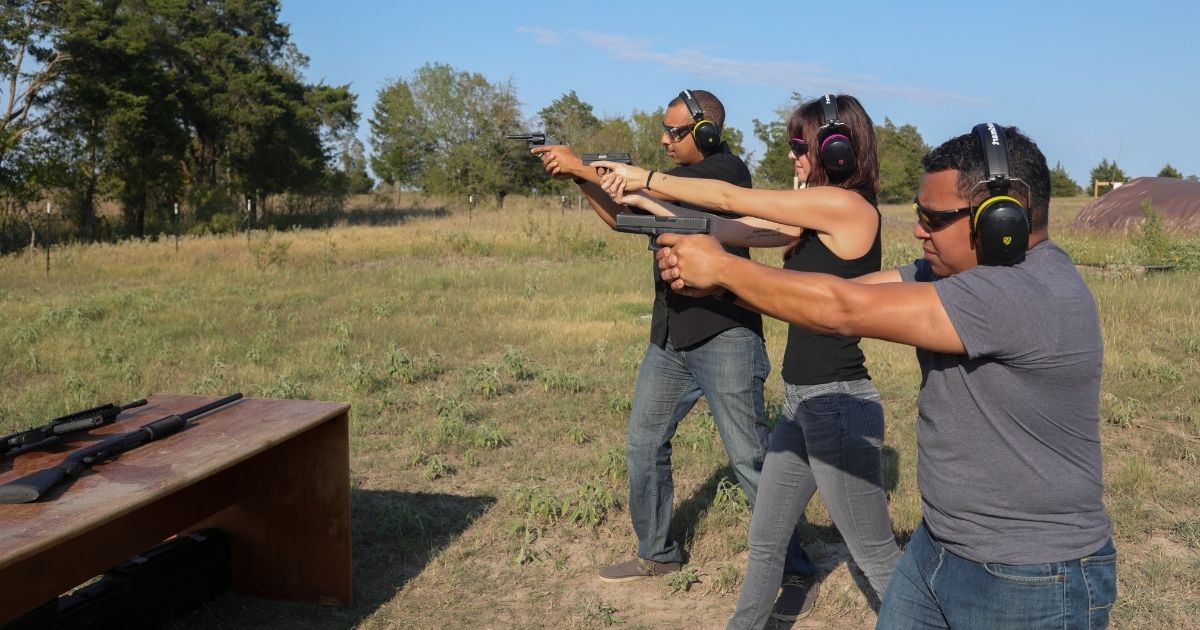
Regular range practice is essential, and proper safety gear makes that practice sustainable. Recreational shooters are four times more likely to develop hearing loss than non-shooters, according to audiology research. Approximately 40 million Americans aged 20 to 69 already have noise-induced hearing loss, per NIDCD data, and about 25 million experience tinnitus, according to the American Tinnitus Association.
Every range session should include proper ear and eye protection. TradeSmart Safety's shooting range kits include NRR 28 earmuffs and ANSI Z87.1+ certified safety glasses in a protective carrying case — everything you need for comfortable, protected range sessions. Every kit also includes access to TradeSmart's Range Confidence Course, an online firearms fundamentals course that covers safe handling, marksmanship basics, and range procedures.
For shooters who want enhanced situational awareness during training drills, electronic ear and eye protection sets allow you to hear range commands and conversations clearly while blocking harmful impulse noise from gunfire.
Choosing the Right Platform: A Quick Comparison
| Factor | Shotgun (12/20 ga) | Handgun (9mm/.45) | Rifle/PCC |
|---|---|---|---|
| Stopping power | Excellent | Good (with proper ammo) | Excellent (rifle) / Good (PCC) |
| Ease of use | Moderate | Requires most practice | Easiest (rifle/PCC) |
| Over-penetration risk | High (00 buck) / Moderate (#4) | Moderate (hollow point) | Low-Moderate (5.56 frangible) / Moderate (PCC) |
| Capacity | 5-8 rounds | 7-17+ rounds | 30 rounds (rifle) / 17-33 (PCC) |
| Maneuverability | Poor in tight spaces | Excellent | Moderate to Good |
| One-hand operation | Very difficult | Yes | Very difficult |
| Compact storage | Large safe needed | Bedside safe | Large safe needed |
| Noise level (indoor) | Extreme (~165 dB) | Severe (~160 dB) | Extreme (5.56) / High (PCC) |
| Cost to train | Moderate-High | Moderate | Moderate (5.56) / Low (PCC 9mm) |
Frequently Asked Questions
What is the best overall gun for home defense?
There is no single best home defense gun — the right choice depends on your experience level, home layout, household members, and local laws. For most people, a 9mm handgun with quality hollow-point ammunition and a weapon-mounted light offers the best balance of stopping power, maneuverability, capacity, and storability. An AR-15 with lightweight, fragmenting 5.56 ammunition is arguably the most effective option for experienced shooters with detached homes. A 20-gauge shotgun with #4 buckshot is an excellent choice for those who want maximum close-range stopping power with manageable recoil.
Is a shotgun or handgun better for home defense?
Shotguns deliver superior stopping power at close range and require less precision to score effective hits. Handguns offer better maneuverability in tight spaces, one-hand operation, compact storage in bedside safes, and higher capacity in most cases. If you live in a home with narrow hallways and tight corners, a handgun may be more practical. If you live in a more open-layout home and over-penetration into neighboring units is not a concern, a shotgun loaded with appropriate buckshot is devastating at indoor distances.
Does an AR-15 over-penetrate too much for home defense?
This is one of the most common misconceptions in home defense discussions. Lightweight 5.56 NATO rounds (55-grain and under), especially hollow-point, soft-point, and frangible designs, tend to fragment or tumble upon striking drywall and other residential barriers. In many controlled tests, 5.56 rounds penetrate fewer layers of interior wall material than 9mm handgun rounds or 00 buckshot. The key is ammunition selection: avoid heavy, steel-core, or FMJ rifle rounds for home defense, and choose loads specifically designed to fragment on barrier impact.
What ammunition should I use for home defense?
Always use expanding ammunition (hollow-point or soft-point) for home defense, never full metal jacket. For handguns, quality 9mm hollow points like Federal HST, Speer Gold Dot, or Hornady Critical Defense are proven performers. For shotguns, #4 or #1 buckshot offers a strong balance of stopping power and reduced wall penetration compared to 00 buckshot. For AR-15 rifles, lightweight frangible or polymer-tipped varmint rounds minimize over-penetration risk while maintaining terminal effectiveness. Whatever you choose, test at least 50 rounds through your firearm at the range to confirm reliable function.
Do I need a weapon light on my home defense gun?
Yes. A weapon-mounted light is one of the most critical accessories for any home defense firearm. You must positively identify a target before firing — both for legal and moral reasons. Shooting at an unidentified shape in the dark could mean firing at a family member, a neighbor, or a pet. A quality weapon light (minimum 300 lumens) allows target identification while keeping both hands on the firearm. You should also keep a handheld flashlight nearby as a backup and for searching areas without pointing your firearm at them.
How should I store my home defense gun for quick access?
Use a quick-access safe mounted to a permanent structure near your bed. Mechanical push-button (Simplex-style) safes are the most reliable because they require no batteries. Biometric safes offer fast access but depend on battery power and clean fingerprints. Whichever type you choose, practice accessing it in the dark until the process is second nature. The firearm inside should be loaded with defensive ammunition and staged with a weapon light attached. If you have children in the home, a quick-access safe is not optional — it is a fundamental responsibility. Read our best gun safes guide for detailed recommendations by budget and firearm type.
Final Thoughts: Gear Up, Train Hard, Stay Safe
Selecting a home defense firearm is just the first step. The gun you choose matters far less than your ability to use it effectively, safely, and within the law. Invest in professional training. Practice regularly at the range with proper ear and eye protection. Develop a home defense plan that your entire household understands. Know your state's self-defense laws. And store your firearm responsibly in a quick-access safe.
When you head to the range to train with your home defense gun, make sure you are protecting the hearing and vision you will rely on if that day ever comes. TradeSmart Safety's shooting protection kits — including NRR 28 earmuffs, ANSI Z87.1+ certified impact-resistant safety glasses, and a free Range Confidence Course — are built for exactly this purpose. Every product ships with free shipping and a 10-year warranty.



Leave a comment (all fields required)