



Best Beginner Handguns in 2026: A Complete Guide for New Shooters
Buying your first handgun is one of the most important decisions you'll make as a new shooter. The wrong choice can lead to frustration at the range, bad habits that are hard to break, and a firearm that ends up collecting dust in your safe. The right choice gives you a reliable tool you'll train with confidently for years.
This guide breaks down exactly what makes a handgun beginner-friendly, compares the two major action types, recommends the best calibers for learning, and identifies the top 5 beginner handguns available in 2026. We'll also cover the essential accessories you need and the training path that will take you from complete novice to confident shooter.
What Makes a Good Beginner Handgun?
Not every handgun is suitable for a first-time shooter. Before looking at specific models, you need to understand the five qualities that separate a good beginner handgun from one that will slow your progress.
Reliability
Your first handgun must go bang every single time you pull the trigger. A malfunction during your first range sessions will shake your confidence and create hesitation that's difficult to overcome. Stick with established manufacturers like Glock, Smith & Wesson, Ruger, and Sig Sauer that have decades of reliability data behind their most popular models.
Manageable Recoil
Recoil anxiety is the number one issue new shooters face. If a handgun kicks too hard, you'll develop a flinch reflex that destroys your accuracy and makes range time unpleasant. Heavier handguns absorb more recoil energy, and a full-size or compact 9mm pistol offers the best balance of stopping power and shootability for most beginners.
Easy Controls
Slide stops, magazine releases, and safeties should all be intuitive and easy to manipulate. If you struggle to rack the slide or load the magazine, you'll spend more time fighting the gun than learning to shoot it. Some models, like the Smith & Wesson M&P Shield EZ line, are specifically engineered with reduced spring tension and load-assist magazine tabs for shooters who lack hand strength or experience.
Good Ergonomics
The handgun should feel natural in your hand. A proper grip is the foundation of accurate shooting, and if the grip angle or circumference doesn't fit your hand, you'll never achieve the consistency you need. Many modern handguns come with interchangeable backstraps that let you customize the fit. Always handle a handgun before you buy it, and if possible, rent one at your local range first.
Affordable Ammunition
The best beginner handgun is one you can afford to practice with regularly. Ammunition cost directly determines how much trigger time you'll get. As of early 2026, 9mm ammunition runs approximately $0.20 to $0.25 per round, while .22 LR training ammunition costs just $0.05 to $0.08 per round. These two calibers give you the most affordable path to proficiency.
Semi-Automatic vs. Revolver: Which Is Better for Beginners?
This is one of the most debated questions in the firearms community, and the answer has shifted significantly over the past decade. Here's an honest comparison.
The Case for Semi-Automatics
Modern semi-automatic pistols offer several advantages that make them the better choice for most new shooters in 2026:
- Higher capacity: Semi-autos typically hold 10 to 17 rounds compared to a revolver's 5 or 6, giving you more shots between reloads and more practice per magazine.
- Softer felt recoil: The reciprocating slide and recoil spring system absorbs a significant portion of the recoil energy before it reaches your hand. This makes semi-autos more comfortable to shoot, especially during longer range sessions.
- Better ergonomics: The general shape of a semi-auto is more conducive to establishing a proper shooting grip, particularly for follow-up shots.
- Faster reloading: Dropping and inserting a magazine is substantially faster than loading individual rounds into a cylinder.
- Wider accessory support: Holsters, lights, lasers, optics, and aftermarket parts are widely available for popular semi-auto models.
The Case for Revolvers
Revolvers still have their place, and some new shooters may prefer them for these reasons:
- Simpler operation: Load the cylinder, close it, and pull the trigger. No slide to rack, no magazine to seat, and no manual safety to disengage.
- Easier maintenance: Cleaning a revolver is straightforward. Open the cylinder, clean the barrel and chambers, and you're done. Semi-autos require field stripping into multiple components.
- Malfunction handling: If a round doesn't fire in a revolver, you simply pull the trigger again to rotate to the next chamber. Semi-autos require you to perform a tap-rack-bang drill.
The Verdict
For most new shooters, a semi-automatic pistol in 9mm is the better starting point. The softer recoil, higher capacity, and broader ecosystem of accessories and training resources make it easier to build solid fundamentals. That said, if you have limited hand strength and struggle to rack a slide, a revolver in .38 Special or a purpose-built easy-rack semi-auto like the M&P Shield EZ may be the better option.
Best Calibers for Beginner Shooters
Caliber selection directly impacts your shooting experience. Here are the two calibers every new shooter should consider.
.22 LR: The Ultimate Training Caliber
If your primary goal is building marksmanship fundamentals, nothing beats .22 LR. The recoil is essentially nonexistent, the report is quieter than centerfire calibers, and the ammunition is dirt cheap. At roughly $0.05 to $0.08 per round, you can fire 500 rounds of .22 LR for the same cost as 100 rounds of 9mm. That volume of practice builds muscle memory faster than anything else.
A .22 LR pistol like the Ruger Mark IV is an excellent first handgun for shooters who want to focus purely on fundamentals before stepping up to a defensive caliber. Many experienced shooters keep a .22 LR in their rotation permanently for warm-up drills and skill maintenance.
9mm Luger: The Practical All-Rounder
For shooters who want a single handgun that works for training, home defense, and concealed carry, 9mm is the standard recommendation. It offers adequate stopping power for self-defense while remaining manageable for new shooters, especially in full-size and compact platforms. Ammunition is widely available and affordable, and nearly every major manufacturer offers multiple 9mm models.
According to FBI ballistic testing and industry data, modern 9mm defensive ammunition performs comparably to .40 S&W and .45 ACP in terminal ballistics while producing significantly less recoil. This is why the majority of law enforcement agencies and military units worldwide have adopted 9mm as their standard sidearm caliber.
Calibers to Avoid as a Beginner
Stay away from .40 S&W, .357 Magnum, .44 Magnum, and 10mm Auto as your first handgun caliber. These produce substantially more recoil and muzzle blast, which will reinforce bad habits like flinching and anticipating the shot. You can always add a larger caliber to your collection later once your fundamentals are solid.
Top 5 Best Beginner Handguns in 2026
After evaluating reliability, ease of use, recoil management, ergonomics, aftermarket support, and value, these are the five best handguns for new shooters right now.
1. Glock 19 Gen 5 (9mm) — Best Overall Beginner Handgun
The Glock 19 has been the default recommendation for first-time handgun buyers for good reason. It's the Goldilocks of handguns: not too big, not too small, and almost impossibly reliable. The Gen 5 version refines the platform with an ambidextrous slide stop, flared magwell for easier reloads, a match-grade GMB barrel, and the removal of the finger grooves that made earlier generations uncomfortable for some hand sizes.
Key Specs:
- Caliber: 9mm Luger
- Capacity: 15+1 rounds
- Barrel length: 4.02 inches
- Weight (unloaded): 23.63 oz
- Overall length: 7.28 inches
- MSRP: ~$550
Pros:
- Legendary reliability. The Glock 19 will function in conditions that would choke other pistols.
- The largest aftermarket ecosystem of any handgun. Thousands of holsters, lights, sights, and accessories are available.
- Compact enough for concealed carry while large enough for comfortable range shooting.
- Simple manual of arms with no external safety to forget under stress.
- Accepts full-size Glock 17 magazines (17 rounds) for added capacity at home.
Cons:
- The grip angle feels unnatural to some shooters, particularly those accustomed to 1911-style frames.
- The factory trigger, while functional, isn't as crisp as competitors like the Sig P320 or CZ P-10C.
- The polymer sights should be upgraded immediately. Budget an extra $30-60 for quality steel or fiber optic sights.
Why it's great for beginners: The Glock 19's simplicity is its superpower. There's no safety to disengage, no hammer to worry about, and no decocker to confuse. Point, press, and it fires. The enormous training community around Glock means you'll find more instructional content, classes, and guidance for this platform than any other.
2. Smith & Wesson M&P 9 Shield EZ (9mm) — Best for Shooters with Limited Hand Strength
Smith & Wesson designed the Shield EZ line specifically for new shooters and those with reduced hand strength due to age, arthritis, or physical limitations. The internal hammer-fired system allows the slide spring tension to be reduced by approximately half compared to conventional striker-fired pistols, making it dramatically easier to rack. This is a genuine game-changer for shooters who struggle with standard semi-auto slides.
Key Specs:
- Caliber: 9mm Luger
- Capacity: 8+1 rounds
- Barrel length: 3.675 inches
- Weight (unloaded): 23.2 oz
- Overall length: 6.8 inches
- MSRP: ~$480
Pros:
- The easiest slide to rack of any 9mm pistol on the market. If hand strength is a concern, this is the answer.
- Load-assist tabs on the magazine make loading rounds simple and painless.
- Both a grip safety and an optional thumb safety provide multiple layers of protection against accidental discharge.
- Excellent out-of-the-box accuracy with a smooth, consistent trigger.
Cons:
- Lower capacity (8+1) compared to competitors like the Glock 19 (15+1).
- The easy-rack design requires a firm, deliberate grip to cycle reliably. Limp-wristing can cause malfunctions.
- Fewer aftermarket accessories compared to the Glock or M&P 2.0 platforms.
Why it's great for beginners: No other handgun removes as many mechanical barriers to entry. If you've tried to rack the slide on a Glock or Sig and found it too difficult, the Shield EZ solves that problem completely. The tactile loaded-chamber indicator and grip safety add confidence for new shooters who are still developing their safety habits.
3. Ruger Mark IV 22/45 (.22 LR) — Best for Fundamentals Training
If you want to become the best shooter possible as quickly as possible, start with a .22 LR pistol and the Ruger Mark IV 22/45 is the gold standard. The grip angle mirrors a 1911 pattern, building muscle memory that transfers directly to centerfire handguns. The virtually nonexistent recoil lets you focus entirely on sight alignment, trigger control, and breathing without any flinch response.
Key Specs:
- Caliber: .22 LR
- Capacity: 10 rounds
- Barrel length: 5.5 inches (standard model)
- Weight (unloaded): 33.6 oz
- Overall length: 9.5 inches
- MSRP: ~$530
Pros:
- Nearly zero felt recoil. You can shoot hundreds of rounds without fatigue or developing a flinch.
- Extremely affordable to shoot. A 500-round brick of .22 LR costs $25-40, giving you five times the trigger time per dollar compared to 9mm.
- The one-button takedown system makes disassembly and cleaning effortless, a dramatic improvement over previous Mark series pistols.
- Outstanding accuracy that rewards proper technique and immediately punishes poor fundamentals.
Cons:
- Not suitable for self-defense. The .22 LR caliber lacks the stopping power required for a defensive role.
- Rimfire ammunition is inherently less reliable than centerfire. Expect occasional failures to fire even with quality ammo.
- The full-size profile makes it impractical for concealed carry.
Why it's great for beginners: Professional firearms instructors consistently recommend starting with .22 LR because it eliminates recoil as a variable. Every miss is your technique, not the gun fighting you. The skills you build on a Mark IV transfer directly to every other handgun you'll ever shoot.
4. Sig Sauer P320 Compact (9mm) — Best Modular Option
The Sig Sauer P320 is the handgun the U.S. military chose to replace the Beretta M9, and the civilian compact version brings that same engineering to a beginner-friendly package. What sets the P320 apart is its modular fire control unit: you can start with a compact frame and later swap to a full-size, carry, or subcompact grip module without buying a whole new gun. This grow-with-you flexibility is unmatched in the market.
Key Specs:
- Caliber: 9mm Luger
- Capacity: 15+1 rounds
- Barrel length: 3.9 inches
- Weight (unloaded): 25.8 oz
- Overall length: 7.2 inches
- MSRP: ~$580
Pros:
- One of the best factory triggers in the striker-fired category. Clean break, short reset, and roughly 6-7 pounds of pull weight.
- Full modularity. Swap grip modules, slide assemblies, and calibers using the same serialized fire control unit.
- Comfortable ergonomics with an undercut trigger guard that allows a higher grip for better recoil control.
- Optics-ready models available from the factory, eliminating the need for aftermarket slide milling.
Cons:
- Some early models were subject to a voluntary upgrade program. Ensure any P320 you purchase has the updated design.
- The lack of a manual safety on standard models may concern some new shooters, though a manual safety version is available.
- Slightly higher price point than competitors like the Glock 19 or Ruger Security-9.
Why it's great for beginners: The P320's modularity means your first handgun investment isn't locked into a single configuration. As your skills develop and your needs change, you can adapt the platform rather than buying entirely new firearms. The excellent trigger also makes it easier to learn proper trigger control from day one.
5. Ruger Security-9 (9mm) — Best Budget Option
Not every new shooter wants to spend $500+ on their first handgun, and the Ruger Security-9 proves you don't have to. Priced well under $300, it delivers Glock 19-comparable dimensions and capacity in a reliable, well-built package. Ruger's Secure Action trigger system provides a short, crisp pull that's easier to learn on than the longer, spongier triggers found on many budget pistols.
Key Specs:
- Caliber: 9mm Luger
- Capacity: 15+1 rounds
- Barrel length: 4.0 inches
- Weight (unloaded): 23.7 oz
- Overall length: 7.24 inches
- MSRP: ~$280
Pros:
- Outstanding value. At under $300, it costs roughly half of a Glock 19 while matching it in size, capacity, and weight.
- Ruger's reputation for reliability and customer service. The company stands behind its products.
- The integrated thumb safety provides an extra layer of security for new shooters still building safe handling habits.
- Manageable recoil in a package that's comfortable to shoot for extended range sessions.
Cons:
- The sights are basic and should be upgraded if you plan to keep this as a long-term carry gun.
- Smaller aftermarket ecosystem compared to Glock or Smith & Wesson M&P platforms.
- The trigger, while decent for the price, doesn't match the refinement of the Sig P320 or upgraded Glock triggers.
Why it's great for beginners: The money you save on the firearm itself can go directly toward ammunition, training, and essential accessories. A $280 handgun with $200 worth of range ammo will make you a better shooter than a $550 handgun with one box of 50 rounds. The Security-9 gets you to the range more often, and that matters more than anything else.
Essential Accessories for New Handgun Owners
Buying the handgun is only the first step. You need the right supporting gear to shoot safely, store responsibly, and train effectively. Here's what belongs on your shopping list before your first range trip.
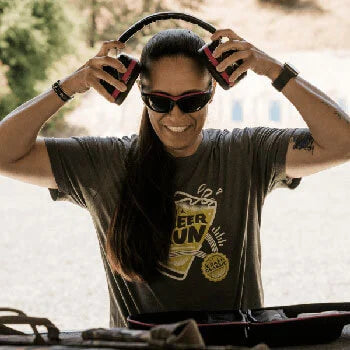
Hearing Protection
This is non-negotiable. A single gunshot produces 140 to 175 decibels depending on caliber and barrel length, according to the National Institute for Occupational Safety and Health (NIOSH). For context, OSHA's permissible exposure limit is 85 dB over an eight-hour period, and NIOSH research confirms that a single impulse noise above 140 dB can cause immediate, permanent hearing damage.
According to the National Institute on Deafness and Other Communication Disorders (NIDCD), approximately 40 million Americans aged 20 to 69 have noise-induced hearing loss. Recreational shooters are four times more likely to develop hearing loss than non-shooters. This is entirely preventable with proper ear protection.
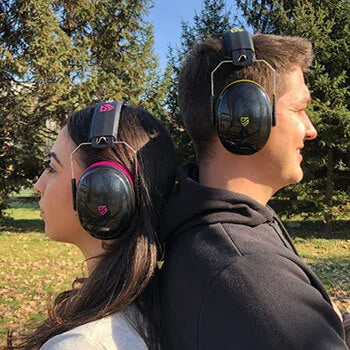
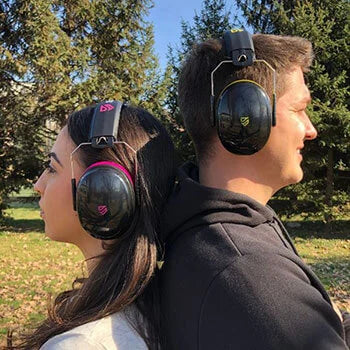
For new shooters, we recommend starting with a combination of over-ear earmuffs and foam earplugs for maximum noise reduction. The TradeSmart Shooting Earmuff and Eye Protection Kit provides NRR 28-rated earmuffs paired with ANSI Z87.1+ certified safety glasses in a single package. For indoor ranges where noise levels are especially intense, doubling up with NRR 33-rated foam earplugs underneath your earmuffs can achieve effective combined noise reduction of approximately NRR 36.
As you progress, consider upgrading to electronic ear and eye protection. Electronic earmuffs like the TradeSmart TacticalEdge amplify ambient sounds like range commands and conversation while instantly suppressing gunshot noise. This is particularly valuable during training courses and group range sessions where communication matters.
Eye Protection
ANSI Z87.1+ certified shooting glasses are mandatory at every reputable range. Standard sunglasses will not protect you. ANSI Z87.1 certification requires lenses to withstand a high-velocity impact test, where a quarter-inch steel ball is fired at the lens at 150 feet per second. Shooting-rated glasses protect against ejected brass, unburned powder particles, and potential fragmentation from catastrophic malfunctions.
Clear lenses are ideal for indoor ranges and low-light conditions, while tinted lenses reduce glare during outdoor shooting. The TradeSmart Premium Kit includes both clear and tinted ANSI Z87.1+ safety glasses along with NRR 28 earmuffs, a hard-shell carrying case, and foam earplugs, giving you everything you need in one purchase. Learn more about choosing the right ear protection for shooting.
A Quality Holster
Even if you don't plan to carry concealed immediately, you need a holster for safe range transport and to begin building holster draw fundamentals. Look for a rigid Kydex holster that fully covers the trigger guard and provides positive retention. Avoid cheap nylon universal holsters, which offer poor retention and can fold into the trigger guard during reholstering.
Match the holster to your specific handgun model. A holster made for a Glock 19 won't properly fit a Sig P320, and improper fit creates safety risks.
Ammunition
For your first range sessions, buy quality brass-cased, full metal jacket (FMJ) range ammunition from reputable manufacturers like Federal, Winchester, Sellier & Bellot, or Fiocchi. Avoid reloaded or remanufactured ammunition in a new gun until you understand what reliable function looks and feels like.
Buy in bulk when possible. A case of 1,000 rounds of 9mm FMJ will cost roughly $200-250 and last you several range sessions. Building proficiency requires volume, so budget for at least 200-300 rounds per range trip as a new shooter.
Range Bag
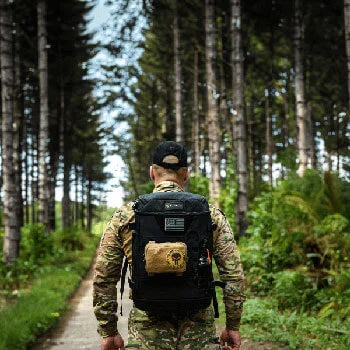
A dedicated range bag keeps your gear organized and protects your equipment during transport. The TradeSmart Tactical Range Backpack is designed specifically for this purpose, with padded compartments for your firearm, dedicated pockets for ammunition, and organized storage for your ear and eye protection. For a complete breakdown of what to pack, read our guide to range bag essentials.
Your Training Path: From Beginner to Confident Shooter
Owning a handgun without a training plan is like buying a guitar and never taking a lesson. Here's the progression that will build your skills efficiently and safely.
Step 1: Learn the Fundamentals
Before you ever load a round, internalize the four fundamental rules of gun safety. These rules are the foundation of everything else, and they apply every single time you handle a firearm. Every TradeSmart ear and eye protection kit includes free access to the Range Confidence Course, an online firearms fundamentals program that covers safety, grip, stance, sight alignment, trigger control, and range procedures. Complete this before your first range visit.
Step 2: Formal Instruction
Take an NRA Basic Pistol course or equivalent beginner class from a certified instructor. In-person instruction gives you feedback that no YouTube video or online article can provide. An instructor will identify and correct grip errors, stance issues, and trigger control problems that you literally cannot see yourself. Most introductory courses run four to eight hours and cost $100-200, making them one of the best investments you'll make.
Step 3: Structured Range Practice
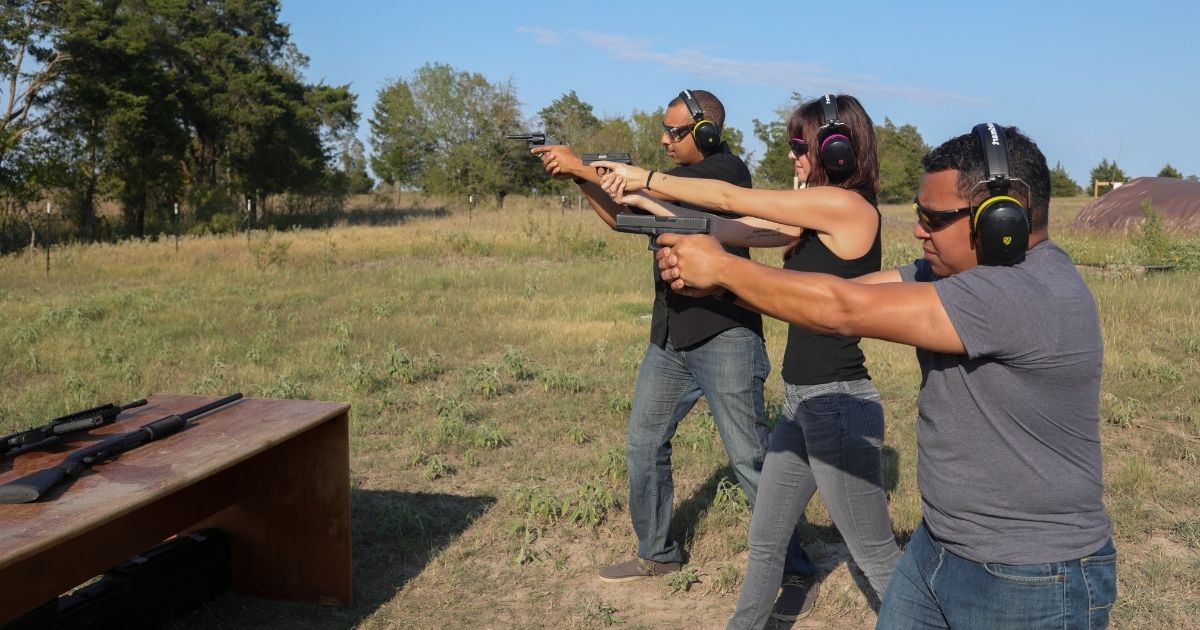
Visit the range regularly with a specific training plan. Don't just mag-dump into a target at seven yards. Work through structured drills that build specific skills:
- Slow fire at 5-7 yards: Focus on sight alignment and trigger press. One shot every 3-5 seconds.
- Ball and dummy drills: Mix snap caps with live rounds to diagnose and eliminate flinching.
- Reload drills: Practice magazine changes until they become automatic.
- Draw from holster: If your range permits, practice presenting the firearm from concealment.
Before your first visit, review our guide on gun range etiquette so you know what to expect and how to conduct yourself safely.
Step 4: Dry Fire Practice
Dry fire practice (pulling the trigger on an unloaded, verified-clear firearm pointed in a safe direction) is free, can be done at home, and builds trigger control faster than live fire alone. Fifteen minutes of focused dry fire three times per week will accelerate your progress dramatically. Modern snap caps protect your firing pin during dry fire sessions and provide a realistic trigger reset.
Step 5: Ongoing Development
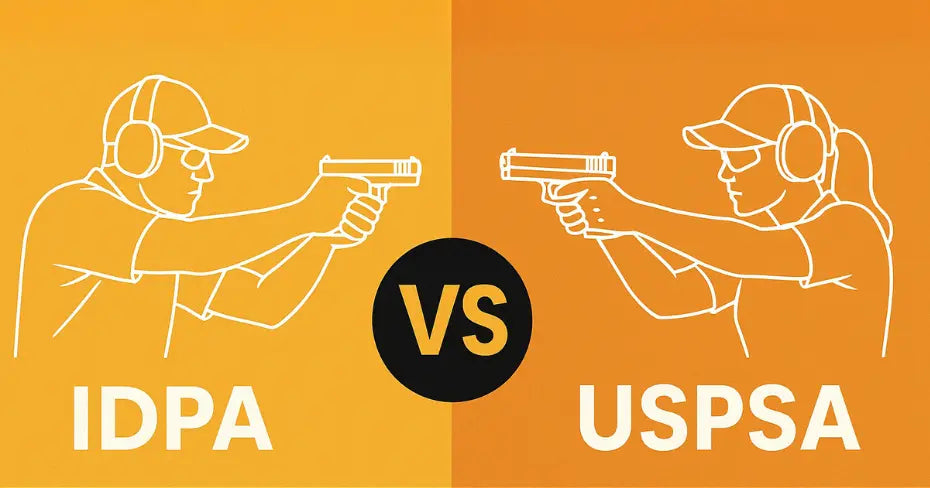
Once you're comfortable with the basics, explore defensive shooting courses, competition shooting (USPSA, IDPA, or Steel Challenge), and advanced marksmanship training. Competition shooting in particular will push your skills further and faster than any other training method, and the community is welcoming to new shooters.
Protect Your Hearing and Vision from Day One
According to the American Tinnitus Association, approximately 25 million Americans experience tinnitus, a persistent ringing in the ears that is often caused by noise exposure. Hearing damage is cumulative and irreversible. Every round fired without proper protection contributes to permanent hearing loss.
TradeSmart Safety builds American-certified shooting protection gear designed to keep you safe at the range for years to come. Every kit includes NRR-rated earmuffs, ANSI Z87.1+ impact-resistant safety glasses, and free access to the Range Confidence Course, backed by a 10-year warranty and free shipping on every order.
Start with the gear that matches your needs:
- Shooting Earmuff and Eye Protection Kit — The essentials for your first range trip
- Premium Kit with Clear + Tinted Glasses — Complete protection for indoor and outdoor ranges
- Electronic Ear and Eye Protection — Hear range commands clearly while blocking harmful noise
- Tactical Range Backpack — Keep all your gear organized and protected
Frequently Asked Questions
What is the best caliber for a first handgun?
For most new shooters, 9mm Luger is the best caliber for a first handgun. It offers manageable recoil, affordable ammunition (approximately $0.20-$0.25 per round), wide availability, and adequate stopping power for self-defense applications. If your primary goal is building marksmanship fundamentals before progressing to a defensive caliber, .22 LR is an excellent training option at roughly $0.05-$0.08 per round.
How much should I spend on my first handgun?
Plan to spend between $280 and $600 on the handgun itself, depending on the model. Budget models like the Ruger Security-9 offer excellent reliability and performance at under $300, while premium options like the Sig Sauer P320 and Glock 19 Gen 5 run $550-$600. Equally important, budget an additional $150-$300 for essential accessories: quality ear and eye protection, a proper holster, and your first case of ammunition. Don't buy a $600 gun if it means you can't afford to practice with it.
Is a revolver or semi-automatic better for a beginner?
For most new shooters in 2026, a semi-automatic pistol is the better choice. Modern semi-autos offer softer felt recoil (the slide and recoil spring absorb significant energy), higher ammunition capacity (15+ rounds versus 5-6), faster reloads, and better ergonomics for building a proper shooting grip. Revolvers are simpler to operate mechanically, but the long, heavy double-action trigger pull can be challenging for beginners to master accurately.
Do I need to take a class before buying a handgun?
While most states don't legally require a class before purchasing a handgun, taking a formal introductory course is strongly recommended. A certified instructor provides real-time feedback on your grip, stance, and trigger control that self-teaching cannot replicate. Many ranges offer beginner packages that include rental firearms, allowing you to try different models before committing to a purchase. At minimum, complete an online safety course like the TradeSmart Range Confidence Course before handling any firearm.
How often should a new shooter practice at the range?
Aim for at least two range sessions per month during your first six months, with 150-300 rounds per session. Consistent, focused practice builds skill faster than infrequent marathon sessions. Supplement range time with dry fire practice at home three to four times per week, which costs nothing and develops trigger control and sight alignment effectively. As your skills progress, even one quality range session per month supplemented by regular dry fire will maintain and improve your proficiency.
What hearing and eye protection do I need for the range?
At minimum, you need NRR-rated earmuffs or earplugs and ANSI Z87.1+ certified safety glasses. Since gunshots produce 140 to 175 decibels and NIOSH states that a single impulse above 140 dB can cause permanent hearing damage, adequate hearing protection is critical. For indoor ranges, doubling up with earmuffs over foam earplugs provides the best protection. The TradeSmart Premium Kit provides NRR 28 earmuffs, ANSI Z87.1+ safety glasses, NRR 33 foam earplugs, and a protective carrying case in a single, ready-to-go package. Learn more about why hearing protection matters in our guide on the best ear protection for shooting.



Leave a comment (all fields required)