



Shooting at a Moving Target: Master the Art of Hitting What Moves
Hitting a stationary target at the range is one thing. Connecting with a target that is actively moving across your field of view is an entirely different skill set, one that separates competent shooters from truly proficient ones. Whether you are preparing for hunting season, training for competitive shooting events like USPSA or IDPA, or simply pushing your marksmanship to the next level, learning to shoot at a moving target is essential.
This guide covers the lead calculation methods, body mechanics, footwork, eye dominance considerations, and practice drills that will help you consistently hit moving targets.
Understanding Lead: The Foundation of Moving Target Shooting
Lead is the distance you aim ahead of a moving target to compensate for the time it takes your projectile to reach the point of impact. The concept is simple. The execution requires practice, repetition, and a solid understanding of three primary methods.
The Swing-Through Method
The swing-through method is the most recommended technique for shooters learning to engage moving targets. Here is how it works: you start your muzzle behind the target, swing faster than the target is moving, pass through the target, and fire as the muzzle moves ahead of it. You continue your swing after pulling the trigger, which is known as follow-through.
This method works well because it creates natural momentum. Your body is already in motion, and you are building speed as you track the target. According to the National Rifle Association, the swing-through method is particularly effective for fast-moving targets like upland birds, rabbits, and crossing clay targets.
Key advantages of the swing-through method:
- Easier for beginners to learn because it relies on instinctive movement rather than precise distance estimation
- Naturally builds momentum and follow-through into the shot
- Effective for targets moving at moderate to high speed at shorter to medium distances
- Less tendency to stop the gun at the moment of firing, which is one of the most common mistakes in moving target shooting
The Sustained Lead Method
The sustained lead method requires you to establish and maintain a consistent lead distance ahead of the target as you track its movement. You mount the gun ahead of the target, match the target's speed, hold the gap steady, and fire while continuing your swing.
This technique demands more from the shooter. You must estimate the correct lead distance based on target speed, target distance, and projectile velocity, then maintain that distance as both you and the target move. The sustained lead is widely used by experienced shotgunners in sporting clays and by hunters engaging targets at known distances and predictable flight paths.
Where this method excels is at longer distances, where the required lead is substantial and the swing-through method may not generate enough forward offset. However, it is a more difficult skill to master because it requires continuous judgment about the correct lead distance.
The Ambush (Pull-Away) Method
The ambush method, also called the pull-away method, takes a different approach. You mount the gun directly on the target, match its speed, then accelerate ahead of it and fire as you reach the correct lead distance. Some shooters also use a true ambush approach where they position the gun on the target's predicted path and fire as it enters the zone.
This method combines elements of both the swing-through and sustained lead techniques, and it is particularly useful for targets with predictable, linear paths.
Which Lead Method Should You Use?
There is no universally correct answer. Many experienced shooters use all three methods depending on the situation:
- Swing-through for close, fast crossers and when reaction time is limited
- Sustained lead for longer-range targets with predictable flight paths
- Pull-away for medium-range targets where you can acquire the target early and have time to establish the correct lead
The important thing is to commit to one method per shot. Mixing techniques mid-shot creates hesitation, and hesitation means a miss.
Tracking vs. Snapping: Two Approaches to Target Engagement
Beyond lead calculation, shooters must decide between two fundamental approaches to engaging moving targets: tracking and snapping.
Tracking
Tracking involves following the target with your muzzle, matching its movement, and firing while maintaining continuous visual contact. This is the more controlled approach and aligns with the sustained lead and pull-away methods described above. Tracking gives you more time to assess the target's speed and direction, and it allows for corrections before you commit to the shot.
Tracking works best when:
- You have time to acquire and follow the target
- The target is moving on a predictable, consistent path
- You are shooting at longer distances where precision matters more than speed
- You are engaging targets in hunting scenarios where patience is available
Snapping
Snapping, sometimes called snap shooting, involves rapidly mounting the gun, acquiring the target, and firing in one fluid motion with minimal tracking time. This is an instinctive technique that relies on hand-eye coordination and muscle memory rather than calculated lead.
Snapping is essential for:
- Close-range, fast-moving targets that appear and disappear quickly
- Hunting scenarios with flushing birds or running game in heavy cover
- Competitive shooting stages where targets are only briefly exposed
- Self-defense situations where reaction time is critical
The best shooters develop proficiency in both. Start with tracking to build your understanding of lead and target movement, then gradually incorporate snap shooting as your instincts develop. For a deeper foundation on grip and control, see our guide on how to hold a handgun for maximum accuracy.
Body Mechanics and Footwork: Your Platform Determines Your Accuracy
Your stance and body mechanics are the foundation of accurate shooting, whether you are stationary or in motion. When engaging moving targets, your body must be a stable but mobile platform that allows smooth, controlled movement of the muzzle.
Stance and Weight Distribution
Start with a slightly wider-than-shoulder-width stance. Your feet should be offset, with your support-side foot slightly forward. Lean forward at the waist so your weight is distributed toward the balls of your feet, not back on your heels. This forward lean accomplishes two things: it helps manage recoil, and it enables you to rotate smoothly through your waist to track targets.
Your weight distribution should be approximately 60 percent on your front foot and 40 percent on your rear foot. This creates a stable base that still allows rotation. Think of your lower body as the turret base and your upper body as the turret, your legs stay planted while your torso rotates to follow the target.
Upper Body Mechanics
The key principle is that your upper body should remain as stable as possible relative to the firearm, even as your lower body manages movement and weight transfer. Keep your shoulders square to the gun, your cheek firmly welded to the stock (for long guns), and your arms in a consistent position.
Rotation should come from your hips and core, not from your arms swinging independently. When you rotate from the waist, the gun naturally follows a smooth, predictable arc. When you swing with your arms alone, the muzzle path becomes erratic and your accuracy suffers.
Footwork for Shooting on the Move
When you need to shoot while physically moving, as in competitive shooting stages, footwork becomes critical:
- Heel-to-toe walking: Land on your heel and roll to your toe. This reduces impact shock and keeps your muzzle from bouncing with each step.
- Small steps: Take shorter, more controlled steps when actively engaging targets. Use longer strides only when transitioning between positions without shooting.
- Bent knees: Keep your knees slightly bent to act as shock absorbers. Locked knees transmit every step directly to your upper body and the gun.
- Avoid crossing feet: Maintain a wide base and never cross your feet over each other. Crossed feet compromise your balance and create a tripping hazard.
- Forward lean: Lean slightly forward at the waist. This keeps your weight over your feet and helps you manage recoil while in motion.
A tight core is essential when shooting on the move. Engaging your abdominal muscles stabilizes your torso and creates a buffer between lower-body movement and upper-body stability.
Eye Dominance: The Overlooked Factor in Moving Target Accuracy
Eye dominance plays a significant role in your ability to track and lead moving targets accurately. Approximately 18 percent of shooters are cross-dominant, meaning their dominant eye is on the opposite side from their dominant hand. If you are right-handed but left-eye dominant, or vice versa, you may be fighting your own visual system every time you shoulder a gun.
How to Test Your Eye Dominance
Extend both hands in front of you and create a small triangular opening between your thumbs and forefingers. With both eyes open, center a small object across the room in that opening. Close your left eye. If the object stays centered, you are right-eye dominant. If it shifts, close your right eye instead. If the object stays centered with your left eye open, you are left-eye dominant.
Why Eye Dominance Matters More for Moving Targets
With stationary targets, cross-eye dominance is a manageable inconvenience. You can close your non-dominant eye and align your sights carefully. But moving targets require both eyes open for maximum depth perception, peripheral awareness, and target tracking ability. When both eyes are open and your dominant eye conflicts with your dominant hand, your brain receives competing visual signals about where the gun is pointed relative to the target.
This is why some shooters consistently miss to one side when engaging moving targets. Their dominant eye is pulling their perceived point of aim away from where the gun is actually pointed.
Corrections for Cross-Dominant Shooters
Several proven techniques can address cross-eye dominance:
- Head adjustment: For pistol shooting, tilt your head slightly toward your dominant hand side, bringing your dominant eye behind the sights while keeping both eyes open
- Translucent tape method: Place a small piece of translucent tape on your shooting glasses over your dominant eye. This blurs the dominant eye's input just enough to let your other eye take over for aiming while preserving peripheral vision
- Shooting with the non-dominant hand: Some shooters choose to shoulder the gun on their dominant-eye side, even if it means using their non-dominant hand. This is a bigger adjustment but eliminates the core problem
- Red dot sights: For rifle and pistol shooters, red dot optics dramatically reduce the impact of cross-eye dominance because the dot is visible from any eye position
Whichever correction you choose, make sure you are wearing proper ear protection and eye protection during every practice session. ANSI Z87.1-rated safety glasses are non-negotiable at the range, and they also serve as the platform for the translucent tape technique if you are working on cross-dominance correction.
Practice Drills for Moving Target Proficiency
Knowing the theory behind lead calculation, body mechanics, and eye dominance is necessary but not sufficient. Consistent accuracy on moving targets comes from structured, deliberate practice. Here are drills that build real-world competence.
Drill 1: The Progressive Clay Drill
If you have access to a portable clay thrower, set it up approximately 5 yards to your side. Engage clays until you can hit three consecutively. Then move the thrower farther away and deeper downrange. Continue increasing the angle and distance until the thrower launches clays at a full 90 degrees to your position. Work up to breaking five in a row at each distance before advancing.
This drill builds your ability to handle increasing crossing angles and develops your instinctive feel for lead at different distances.
Drill 2: The Ladder Drill
Start at a comfortable break point, say 25 yards. Shoot a series of targets at that distance until your hit rate is above 80 percent. Then move back to 30 yards and repeat. Continue extending to 35, 40, and 45 yards. This drill forces you to increase your lead as distance grows and teaches you how lead requirements change with range.
Drill 3: Walking and Engaging
Set up a line of stationary targets at varying distances. Practice walking toward them while engaging each target in sequence. Focus on your heel-to-toe footwork, keeping your upper body stable, and breaking clean shots while in motion. This drill is directly applicable to USPSA and IDPA stage shooting.
Drill 4: Direction Change Drill
If your range supports it, use a moving target system that changes direction unpredictably. Practice identifying the direction change and adjusting your lead accordingly. This builds the reactive shooting skills needed for hunting and real-world scenarios where targets do not move in straight lines.
Drill 5: Dry Fire Tracking
This drill requires no ammunition and no range. With an unloaded, verified-safe firearm, practice mounting and tracking objects in your environment: a car passing on the street, a bird in flight (from inside your home, looking through a window), or a friend walking across the room. Focus on smooth mount, cheek weld, follow-through, and maintaining your sight picture as you track. This builds the neural pathways for smooth tracking without the cost of ammunition.
The Importance of Protection During Practice
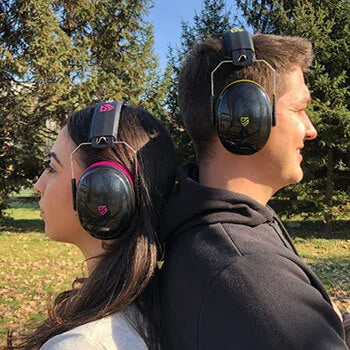
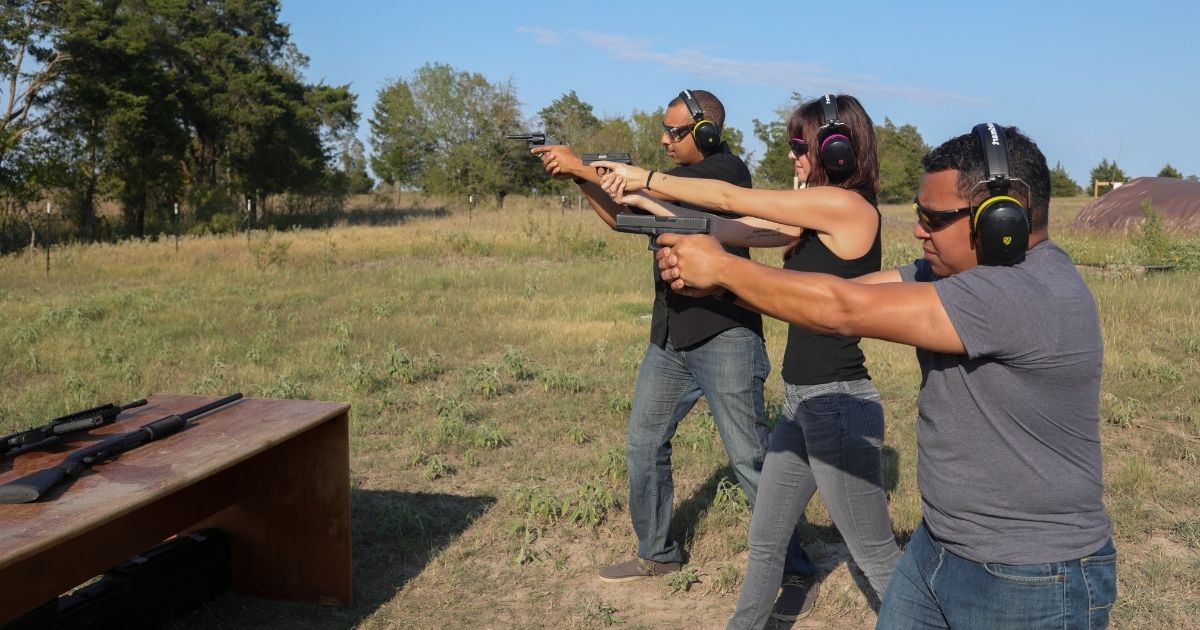
Moving target practice typically involves higher round counts and longer sessions than precision shooting. That means more cumulative noise exposure. Gunshots produce 140 to 175 decibels depending on caliber, and according to NIOSH, a single gunshot above 140 dB can cause immediate, permanent hearing damage. Recreational shooters are four times more likely to develop hearing loss than non-shooters, making consistent hearing protection critical.
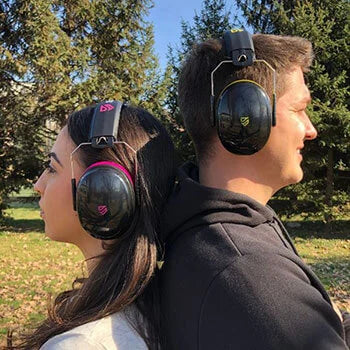
For extended practice sessions, consider doubling up with both NRR 33 foam earplugs and over-ear earmuffs for maximum protection. If you need to hear range commands or communicate with a training partner, electronic earmuffs like the TradeSmart TacticalEdge provide NRR 24 noise reduction while amplifying speech and environmental sounds through directional microphones.
Clay Shooting as Moving Target Training
Clay target sports are the single best training platform for developing moving target skills. The three primary disciplines, trap, skeet, and sporting clays, each develop different aspects of your moving target proficiency.
Trap Shooting
In trap, clay targets launch from a single house in front of the shooter at varying angles. The targets move away from you, requiring you to react quickly, establish lead, and fire before the clay reaches the edge of the effective range. Trap is excellent for developing quick target acquisition and building confidence with the swing-through method.
Skeet Shooting
Skeet involves shooting targets thrown from two houses (high and low) at opposite ends of a semicircular course. Shooters rotate through eight stations, engaging targets at different crossing angles, including simultaneous doubles. Skeet is outstanding for developing your ability to handle crossing targets, calculate different lead angles, and transition between targets quickly.
Sporting Clays
Often called "golf with a shotgun," sporting clays presents the most varied and realistic moving target scenarios. Courses feature multiple stations where targets simulate the flight paths of birds and the movement patterns of ground game. Targets may be incoming, outgoing, crossing, rising, falling, or rolling along the ground. No two stations are the same, and no two courses are identical.
Sporting clays is the most complete training discipline because it forces you to adapt your technique to each new presentation, reading the target's speed, angle, and distance before selecting the appropriate lead method.
The skills you build in clay shooting, smooth gun mount, target tracking, lead calculation, follow-through, and visual focus, transfer directly to hunting and handgun-based moving target shooting. The platforms differ, but the visual and motor skills are the same. Many competitive pistol shooters credit regular clay shooting with significantly improving their performance on moving target stages.
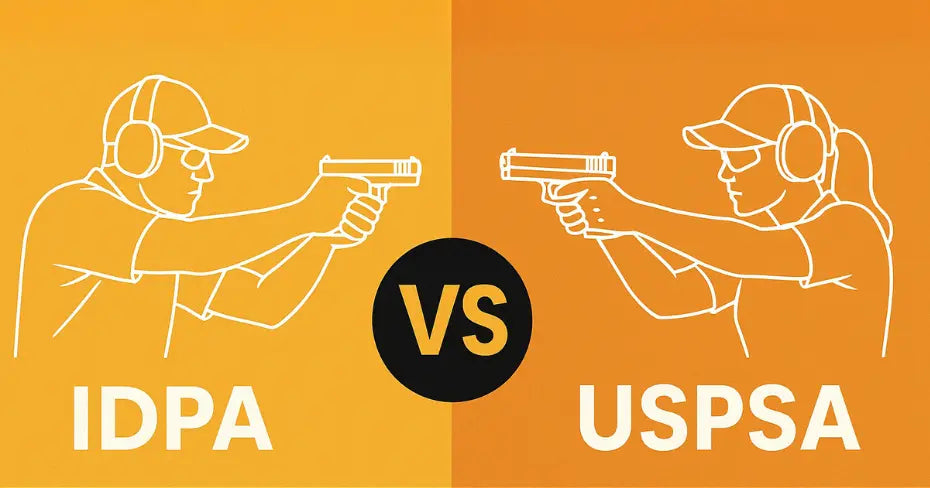
Competition Scenarios: USPSA and IDPA Moving Stages
Competitive shooting sports provide the most demanding test of moving target skills under pressure. If you want to accelerate your moving target development, competition shooting is the fastest path.
USPSA (United States Practical Shooting Association)
USPSA stages frequently incorporate moving targets, swingers (targets that swing on a pendulum), drop-turners (targets that appear briefly then disappear), and moving platforms that the shooter engages while in motion. Modern USPSA course design emphasizes dynamic, athletic shooting with complex movement patterns.
Key USPSA moving target skills include:
- Engaging swinging steel and paper targets with proper timing
- Shooting while moving between positions
- Transitioning between near and far targets at speed
- Managing recoil during rapid strings of fire on the move
IDPA (International Defensive Pistol Association)
IDPA stages simulate defensive scenarios and often include moving targets that represent threats. The format requires shooting from behind cover, engaging targets in specific sequences, and dealing with "non-threat" targets mixed in with valid targets. IDPA stages typically involve shorter distances but emphasize accuracy and decision-making under stress.
IDPA moving target skills include:
- Engaging drop-turners and swingers from behind cover
- Shooting while moving laterally to cover
- Accurate fire at close range on briefly exposed targets
- Target discrimination (threat vs. non-threat) while managing movement
If you are interested in getting started with competitive shooting, our guide on how to get into competitive shooting covers everything you need to know about equipment, match formats, and what to expect at your first competition.
Stage Planning and Walkthrough
Before any USPSA or IDPA stage, you get a walkthrough period. For stages with moving targets, observe the target's movement pattern and timing, identify the optimal engagement point in the target's arc, plan your foot positions for stable platforms, count steps between positions, and decide whether to engage on the move or from a static position at each point.
Gear Essentials for Moving Target Practice
Extended moving target practice sessions require reliable protective gear that will not shift, fog, or fail during high-round-count training days. Your safety equipment needs to stay in place during the dynamic movement that moving target shooting demands.
The essentials include:
- Hearing protection: NRR-rated ear protection is mandatory. For high-volume practice sessions, doubling NRR 33 foam earplugs with over-ear muffs provides the best protection. About 40 million Americans aged 20 to 69 already have noise-induced hearing loss according to the National Institute on Deafness and Other Communication Disorders, and every unprotected shot contributes to that statistic.
- Eye protection: ANSI Z87.1-rated shooting glasses protect against ejected brass, ricochets, and fragmentation. The Z87.1 standard requires lenses to withstand a quarter-inch steel ball traveling at 150 feet per second. Non-rated sunglasses do not meet this standard.
- Anti-fog performance: Moving target practice involves physical movement that generates body heat. Your safety glasses must have anti-fog coating to maintain clear vision throughout your session. Fogged lenses during a swinging target engagement are not just inconvenient, they are a safety hazard.
TradeSmart Safety's shooting range kits include NRR 28 earmuffs, ANSI Z87.1-certified safety glasses with anti-fog coating, and a hard-shell carrying case, covering all three essentials in a single package. Every kit also includes the free Range Confidence Course, an online firearms fundamentals program that covers grip, stance, and marksmanship basics that directly support moving target skill development. All products carry a 10-year warranty and ship free.
Frequently Asked Questions
How far ahead should I aim when shooting at a moving target?
The required lead depends on three factors: target speed, target distance, and projectile velocity. As a general principle, a target crossing at walking speed at 25 yards requires approximately one to two feet of lead with a handgun round. Faster targets or greater distances require proportionally more lead. Shotgun shooting at crossing clay targets typically requires one to four feet of visible lead depending on distance and target speed. The best way to develop accurate lead estimation is through repetitive practice with immediate feedback, which is why clay shooting is such an effective training method.
What is the best lead method for beginners?
The swing-through method is recommended for beginners. It is the most instinctive of the three primary lead methods because it relies on building momentum rather than estimating precise distances. Start behind the target, swing through it, and fire as your muzzle passes ahead. The sustained lead and pull-away methods require more experience with judging lead distances and should be added after you are comfortable with the swing-through technique.
Should I keep both eyes open when shooting at moving targets?
Yes. Keeping both eyes open provides better depth perception, wider field of view, and improved target tracking ability compared to closing one eye. This is especially important for moving targets because you need maximum visual information to judge speed, distance, and direction. The exception is if you have cross-eye dominance that has not been corrected, in which case the conflicting visual signals may cause you to miss consistently. Address cross-dominance first using the techniques described above, then transition to both-eyes-open shooting.
How does clay shooting help with handgun moving target skills?
Clay shooting develops the fundamental visual and motor skills that transfer to all moving target shooting: target tracking, lead calculation, smooth body rotation, follow-through, and visual focus on the target rather than the sights. While the platform and projectile characteristics differ, the underlying skills of reading target movement and timing your shot are identical. Many competitive pistol shooters regularly shoot clays to sharpen their performance on USPSA and IDPA moving target stages.
What protective gear do I need for moving target practice?
At minimum, you need NRR-rated hearing protection and ANSI Z87.1-rated eye protection for every practice session. Gunshots produce 140 to 175 dB depending on caliber, and a single exposure above 140 dB can cause permanent hearing damage. For extended practice sessions with high round counts, consider doubling hearing protection by wearing both foam earplugs and over-ear earmuffs. Electronic earmuffs are particularly useful for moving target practice because they allow you to hear range commands and communicate with training partners while still providing hearing protection.
How can I practice moving target shooting without a range?
Dry fire tracking drills are the most effective way to practice at home. With an unloaded, verified-safe firearm, practice mounting and tracking objects that move across your field of view: vehicles on a distant road, birds in flight through a window, or a training partner walking across a room. Focus on smooth mount, consistent cheek weld, tracking speed that matches the target, and follow-through after the trigger press. These drills build the neural pathways and muscle memory that translate directly to live fire performance. Many competitive shooters spend more time on dry fire tracking than live fire practice.



Leave a comment (all fields required)