





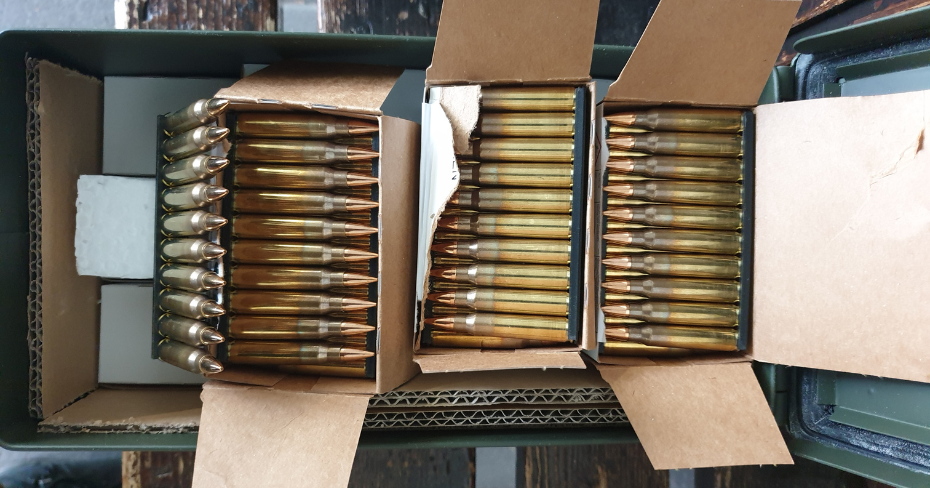

Does Expensive Ammunition Mean Better Performance?
Every shooter has faced this question at the ammunition counter: the box of premium self-defense rounds at $1.50 per round, the mid-tier training ammunition at $0.50 per round, and the budget steel-cased imports at $0.25 per round. The price difference is dramatic. But is the expensive ammunition actually three to six times better? Is the budget ammunition secretly just as good? Or is the truth — as it usually is — somewhere in between?
This article provides a straightforward, evidence-based analysis of what you actually pay for when you buy expensive ammunition, when cheap ammunition is perfectly adequate, and when spending more genuinely matters. We will break down the cost components, test methodology, and real-world performance differences so you can make informed purchasing decisions.
What You Actually Pay For: The Cost Components of Ammunition
To understand whether expensive ammunition is "worth it," you need to understand what drives ammunition cost. Every cartridge consists of four components: the case, primer, propellant (powder), and projectile (bullet). The quality and engineering of each component contributes to the final price.
Brass Quality and Case Construction
The cartridge case is the foundation. Premium ammunition uses thicker, more uniform brass with tighter dimensional tolerances. This matters for several reasons:
- Chamber seal: Uniform brass expands more consistently under pressure, creating a better gas seal in the chamber. This translates to more consistent velocities.
- Extraction reliability: Properly dimensioned cases extract smoothly. Out-of-spec cases can stick in chambers or cause failures to extract.
- Reloadability: Premium brass lasts through more reload cycles before case heads thin or necks crack. Lapua brass, for instance, may last 10 or more reloads. Budget brass may survive 3 to 5.
- Case weight uniformity: Match-grade ammunition uses cases sorted by weight, ensuring consistent internal volume and therefore consistent powder capacity. This is one of the most significant factors in shot-to-shot velocity consistency.
Budget ammunition saves money here by using thinner brass, wider dimensional tolerances, or steel cases. For range practice, these savings are perfectly acceptable. For precision shooting, they are not.
Primer Consistency
Primers are the most overlooked component, but they play a critical role in ignition consistency. Premium ammunition uses primers that ignite with consistent brisance (explosive force), producing uniform flame patterns that light the propellant charge evenly. This affects both velocity consistency and accuracy.
Budget ammunition typically uses primers that meet basic reliability requirements — they go bang when struck — but may have wider variation in ignition characteristics. The result is slightly more velocity variation, which matters for precision shooting but is largely irrelevant for training.
Propellant (Powder) Selection and Charge Weight
Premium ammunition manufacturers invest heavily in propellant selection. The ideal powder for a given load burns consistently across a range of temperatures, produces appropriate pressure curves, and leaves minimal fouling. The charge weight (measured in grains of powder) is held to extremely tight tolerances in match-grade ammunition — often within +/- 0.1 grains.
Budget ammunition uses powder that meets basic performance specifications but may not be optimized for the specific cartridge. Charge weight tolerances are wider, which is the single largest contributor to velocity variation. A 0.5-grain powder charge variation might produce a 20 to 30 fps velocity spread, which translates directly to vertical shot dispersion on target.
Projectile Design and Manufacturing
This is where the biggest price differences emerge, especially in self-defense and hunting ammunition. A simple full metal jacket (FMJ) bullet is inexpensive to manufacture — it is a lead core pressed into a copper cup. A bonded hollow point with a precision-machined cavity, engineered jacket thickness profile, and controlled expansion geometry costs significantly more.
Premium projectile features include:
- Bonded construction: The jacket is chemically or mechanically bonded to the core, preventing jacket separation on impact. This ensures the bullet stays together and retains its weight through barriers. Federal HST, Speer Gold Dot, and Hornady InterBond all use bonding technology.
- Controlled expansion: The hollow point cavity and jacket scoring are engineered to produce consistent expansion to a specific diameter. Federal HST, for example, is designed to expand to approximately 1.5 times its original diameter across a wide velocity range.
- Match-grade ogive: The bullet's nose profile (ogive) is manufactured to tighter tolerances in match ammunition, producing more consistent ballistic coefficients and therefore more predictable trajectories.
- Weight sorting: Premium match bullets are sorted by weight to within 0.1 or 0.3 grains. Budget FMJ bullets may vary by 1 to 2 grains. For precision shooting, this variation matters.
When Cheap Ammunition Is Perfectly Fine
Here is the good news: for the majority of shooting that most people do, budget and mid-tier ammunition is entirely adequate. Specifically:
Range Practice and Training
If you are at the range working on fundamentals — grip, trigger control, sight alignment, draw stroke, reloads — you do not need premium ammunition. You need ammunition that fires reliably and hits within a reasonable group size. Any ammunition from a reputable manufacturer meets this standard.
For a typical training session at 7 to 25 yards, the accuracy difference between premium match ammunition and mid-tier range ammunition is smaller than most shooters' skill-based error. Your trigger press introduces more variation than the ammunition does. A shooter who flinches will produce 4-inch groups with match ammunition and 4-inch groups with budget ammunition. The ammunition is not the limiting factor — the shooter is.
Best range practice options by value:
- Federal American Eagle — brass-cased, consistent, widely available
- PMC Bronze — excellent quality for the price, military-grade QC
- Sellier & Bellot — slightly above-average accuracy, quality brass for reloaders
- Blazer Brass — CCI-manufactured (same parent company as Speer and Federal), reliable and affordable
- Winchester USA (White Box) — the baseline standard for range ammunition
At current 2026 prices, you can expect to pay $0.25 to $0.40 per round for 9mm range ammunition from these brands. Over a 200-round practice session, that is $50 to $80 — compared to $200 to $300 if you shot premium match or self-defense ammunition for the same session. The saved money is better spent on more range time.
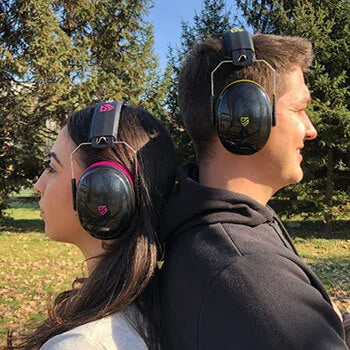
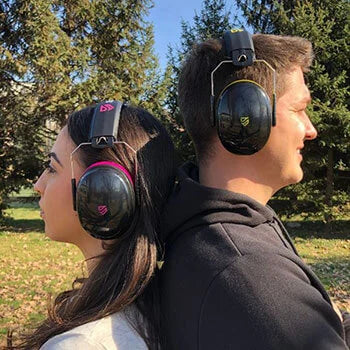
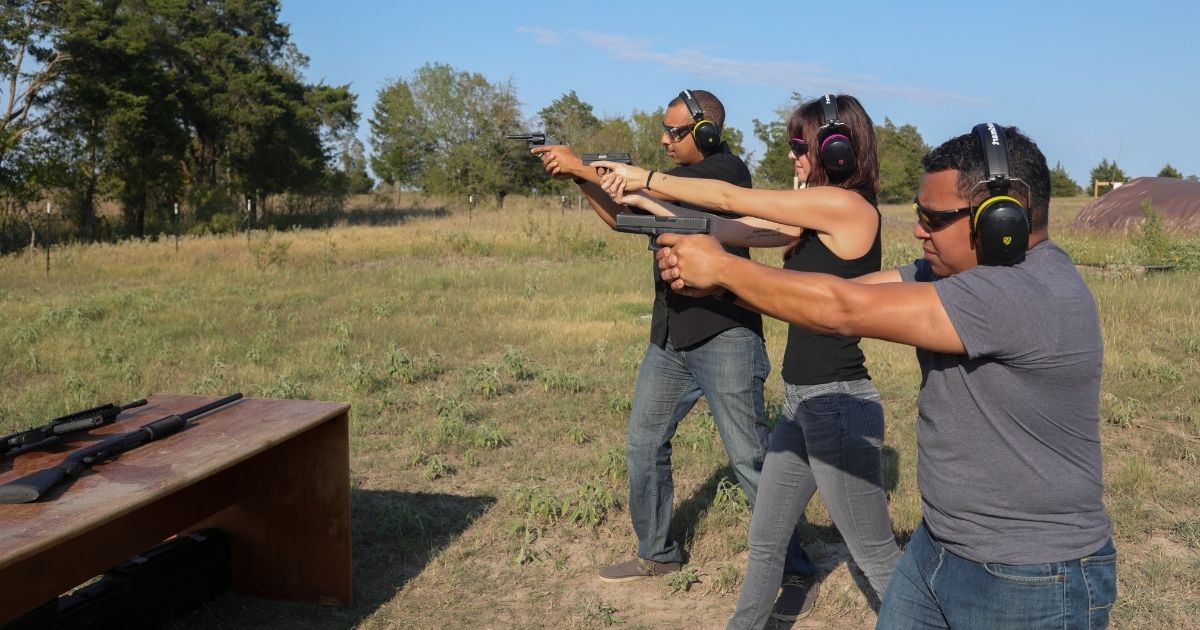
Of course, saving money on ammunition does not mean cutting corners on safety. Every range session requires proper ear protection and eye protection. A single gunshot produces 140 to 175 dB depending on caliber — well above the 140 dB threshold for immediate, permanent hearing damage identified by NIOSH. TradeSmart Safety's earmuff kits with NRR 28-rated earmuffs and ANSI Z87.1+ safety glasses provide reliable protection at a reasonable price, backed by a 10-year warranty.
Informal Target Shooting and Plinking
If you are shooting steel targets, paper plates, or soda cans at a safe backstop, ammunition quality is the least of your concerns. Use whatever runs reliably in your firearm. Steel-cased ammunition from brands like Tula or Wolf is fine for this purpose and can save you 30 to 50 percent per round compared to brass-cased options.
Breaking In a New Firearm
Many shooters put 200 to 500 rounds through a new firearm to break it in and verify reliability. There is no reason to use premium ammunition for this. Mid-tier brass-cased range ammunition is ideal — you want to confirm function, not win a match.
When Premium Ammunition Genuinely Matters
There are specific applications where spending more on ammunition provides real, measurable benefits that justify the price difference.
Self-Defense and Carry Ammunition
This is the most important application for premium ammunition, and it is not close. When your life may depend on a round performing correctly, the engineering behind a Federal HST or Speer Gold Dot is not a luxury — it is a necessity.
Premium self-defense ammunition delivers:
- Reliable expansion through barriers: The FBI protocol tests ammunition through heavy clothing, drywall, plywood, sheet metal, and auto glass. Premium defensive rounds are specifically engineered to expand reliably after passing through these barriers. Budget FMJ ammunition does not expand at all — it just punches through, creating a narrow wound channel and posing a greater over-penetration risk.
- Consistent penetration depth: The FBI standard is 12 to 18 inches in calibrated ballistic gelatin. Premium defensive ammunition is designed to fall within this window consistently. Too shallow means insufficient wound depth. Too deep means the bullet exited the target and poses a risk to bystanders.
- Weight retention: Bonded bullets retain 90 to 100 percent of their weight on impact. Non-bonded budget hollow points can shed 30 to 50 percent of their weight, reducing penetration and wound effectiveness.
- 100 percent ignition reliability: Premium defensive ammunition undergoes rigorous quality control. Failure-to-fire rates are essentially zero. Budget ammunition may have occasional primer failures — tolerable at the range, unacceptable in a defensive situation.
At $1.00 to $1.50 per round for 9mm defensive ammunition, a full magazine of 15 to 17 rounds costs $15 to $25. Two full magazines for carry (one loaded, one spare) costs $30 to $50. This is not a significant investment when measured against what it protects.
Hunting Ammunition
Hunting ammunition demands controlled terminal performance — the bullet must expand to create a lethal wound channel while penetrating deep enough to reach vital organs and retaining enough weight to pass through heavy bone if necessary. Premium hunting bullets (Federal Terminal Ascent, Hornady ELD-X, Barnes TTSX, Nosler AccuBond) are engineered for exactly these requirements.
Budget FMJ or basic soft-point ammunition may work for some game in some circumstances, but it introduces risk. An FMJ bullet may pencil through a deer without expanding, leading to a wounded animal and a long, difficult tracking job. A basic cup-and-core soft-point may fragment on a shoulder bone, failing to reach vital organs. Premium hunting bullets virtually eliminate these failure modes.
At $2.00 to $4.00 per round for premium hunting ammunition, a box of 20 rounds costs $40 to $80. Most hunters fire one to three rounds per hunt. The cost of premium ammunition is trivial compared to the time, effort, travel, and licensing costs of a hunting trip.
Competition and Match Shooting
In precision rifle competition, ammunition quality directly translates to score. The difference between 0.5 MOA ammunition and 1.5 MOA ammunition is the difference between X-ring hits and dropped points at distance. At 600 yards, a 1 MOA accuracy difference equals 6 inches of dispersion — more than enough to drop from a 10 to an 8 on a standard target.
Match-grade ammunition (Hornady Match, Federal Gold Medal Match, Lapua, Black Hills Match) typically produces velocity standard deviations under 10 to 15 fps and groups under 0.75 MOA from a quality rifle. Budget range ammunition may produce velocity SDs of 30 to 50 fps and groups of 1.5 to 3 MOA.
For practical shooting sports (USPSA, IDPA), the accuracy requirements are less stringent, but consistency still matters. Many competitive practical shooters reload their own ammunition for the best combination of consistency, appropriate power factor, and cost efficiency.
Testing Methodology: How to Compare Ammunition Yourself
Rather than relying solely on marketing claims or internet opinions, you can test ammunition performance yourself. Here is a practical methodology:
Accuracy Testing
- Control your variables. Use the same firearm, shoot from a rest (a sandbag or Caldwell rest), and shoot on a day with minimal wind.
- Shoot 5-shot groups. A single 5-shot group is not statistically significant. Shoot at least three to five 5-shot groups per ammunition type.
- Measure group size. Measure center-to-center distance of the two farthest shots. Average your group sizes across all groups for each ammunition type.
- Use the same distance. 25 yards is standard for handgun testing. 100 yards is standard for rifle testing.
- Let the barrel cool. Shoot one group, wait 3 to 5 minutes, shoot the next. A hot barrel changes point of impact and group size.
Velocity Testing
If you have access to a chronograph (devices like the Caldwell Ballistic Precision Chronograph or the LabRadar Doppler unit), measuring velocity across a 10-round string provides two important numbers:
- Average velocity: Does it match the manufacturer's claim? (Factory velocities are measured from test barrels that may differ from yours.)
- Standard deviation (SD): This measures consistency. An SD under 15 fps is excellent. Under 20 fps is good. Over 30 fps indicates significant variation that will affect accuracy at distance.
Reliability Testing
Function test each ammunition type by firing at least 50 rounds through your firearm. Note any failures to feed, failures to fire, failures to extract, or failures to eject. Calculate the reliability percentage. For self-defense ammunition, anything less than 100% reliability across 100 rounds should disqualify that load from carry consideration.
Cost-Per-Round Analysis: What Are You Actually Spending?
Here is a practical cost comparison for common 9mm ammunition tiers as of early 2026:
Budget Tier ($0.22 to $0.30 per round)
- Tula 115gr FMJ (steel case): ~$0.22/round
- Wolf 115gr FMJ (steel case): ~$0.24/round
- Winchester Forged 115gr FMJ (steel case): ~$0.25/round
Best for: High-volume practice, plinking, new shooter instruction
Trade-offs: Not reloadable, wider velocity spreads, some ranges prohibit, bimetal jackets may damage steel targets
Mid Tier ($0.28 to $0.42 per round)
- Federal American Eagle 124gr FMJ: ~$0.32/round
- PMC Bronze 115gr FMJ: ~$0.30/round
- Sellier & Bellot 124gr FMJ: ~$0.30/round
- Blazer Brass 115gr FMJ: ~$0.28/round
- Winchester USA 115gr FMJ: ~$0.32/round
Best for: General range practice, training classes, function testing, reloading brass supply
Trade-offs: Moderate cost, but no real performance trade-offs — this is the sweet spot for most shooters
Premium Range/Match ($0.45 to $0.80 per round)
- Federal Gold Medal Match 147gr: ~$0.65/round
- Hornady Match 147gr: ~$0.55/round
- Black Hills 124gr JHP: ~$0.70/round
Best for: Competition, accuracy testing, precision work
Trade-offs: Significant cost increase for marginal accuracy gain at typical handgun distances — primarily worth it for competition or load development benchmarking
Premium Self-Defense ($0.90 to $1.50 per round)
- Federal HST 124gr JHP: ~$1.00/round
- Speer Gold Dot 124gr JHP: ~$1.05/round
- Hornady Critical Duty 135gr FlexLock: ~$1.10/round
- Winchester PDX1 Defender 124gr JHP: ~$1.00/round
Best for: Concealed carry, home defense, duty use
Trade-offs: High per-round cost, but you are not burning through boxes at the range — you carry 15-17 rounds and rotate every 6-12 months
Annual Cost Comparison
For a shooter who fires 200 rounds per month at the range and carries a full magazine plus one spare (32 rounds, rotated twice per year):
- All budget steel-case: $528/year (range) + $16 (carry rotation) = $544/year
- Mid-tier brass range + premium carry: $768/year (range) + $64 (carry rotation) = $832/year
- All premium match: $1,560/year (range) + $64 (carry rotation) = $1,624/year
The mid-tier-plus-premium-carry approach costs roughly $290 more per year than all-budget — about $24 per month. For that modest premium, you get reloadable brass, better range reliability, and proven defensive ammunition. For most shooters, this is the optimal strategy.
The Smart Approach: Match Your Ammunition to the Task
The most cost-effective ammunition strategy is not "always buy cheap" or "always buy premium." It is matching your ammunition to the specific task:
- Range practice: Mid-tier brass-cased FMJ from a reputable manufacturer ($0.28 to $0.35/round for 9mm)
- Self-defense carry: Premium bonded hollow point — Federal HST, Speer Gold Dot, or Hornady Critical Duty ($1.00 to $1.50/round). Function test at least 50 rounds in your carry gun.
- Competition: Match-grade factory or custom handloads, depending on your discipline and skill level
- Hunting: Premium hunting ammunition with controlled-expansion bullets — this is not the place to save $20
- Plinking: Whatever runs reliably and is cheapest — including steel case if your range allows it
This approach gives you the best performance where it matters most while keeping your overall ammunition budget reasonable.
Do Not Forget Your Safety Gear
While we are on the subject of smart spending, investing in quality hearing and eye protection is at least as important as choosing the right ammunition. Hearing damage is permanent and cumulative. According to NIOSH, a single gunshot above 140 dB can cause immediate hearing damage, and recreational shooters are four times more likely to develop hearing loss than non-shooters according to research cited by the NIDCD.
TradeSmart Safety's shooting range kits bundle NRR 28 earmuffs with ANSI Z87.1+ safety glasses and a protective carrying case — quality protection that will last for years under their 10-year warranty. For electronic hearing protection that lets you hear conversation and range commands while blocking harmful impulse noise, their TacticalEdge electronic earmuffs offer NRR 24 protection with directional sound amplification. Both options ship free and include TradeSmart's Range Confidence Course.
For more on preparing for the range, check out our guides on range bag essentials, what to wear to a gun range, and gun range etiquette.
Frequently Asked Questions
Is expensive ammunition more accurate?
Generally yes, but the degree depends on context. Match-grade ammunition typically produces groups 30 to 50 percent tighter than budget ammunition from a bench rest in a quality firearm. However, at typical handgun distances (7 to 25 yards), the accuracy difference between mid-tier and premium ammunition is smaller than most shooters' skill-based error. The accuracy advantage of premium ammunition becomes significant at longer ranges (50+ yards for handguns, 200+ yards for rifles) where small velocity variations compound into meaningful point-of-impact shifts.
Can cheap ammunition damage my gun?
Ammunition from reputable manufacturers — even budget brands like Tula, Wolf, PMC, and Blazer — will not damage a modern firearm. These brands manufacture to SAAMI or CIP pressure specifications. The concern about steel cases wearing extractors faster is technically valid but practically insignificant for most shooters — you would need to fire tens of thousands of rounds before the difference became measurable. Avoid ammunition from completely unknown or unbranded sources, and never use remanufactured ammunition from uncertified reloaders.
Why is self-defense ammunition so much more expensive than range ammunition?
Self-defense ammunition costs more because of three factors: projectile engineering (bonded hollow points with controlled expansion cost significantly more to manufacture than simple FMJ bullets), tighter quality control (every round is inspected to higher standards), and lower production volume (self-defense ammunition sells in boxes of 20-25, not cases of 1,000). The R&D investment in bullet design — including extensive ballistic gelatin testing, barrier testing, and real-world validation — is also amortized across a smaller production run than range ammunition.
Should I use the same ammunition for practice that I carry for self-defense?
Ideally, your practice ammunition should match your carry ammunition as closely as possible in bullet weight and velocity. This ensures your point of aim and point of impact are the same. For example, if you carry Federal HST 124gr (rated at 1,150 fps), practice with Federal American Eagle 124gr FMJ (rated at 1,150 fps). Speer takes this approach explicitly with their Lawman training line, which is designed to match Gold Dot carry ammunition in feel and point of impact. You do not need to practice with your carry ammunition itself — just match the weight and velocity profile.
Does ammunition go bad over time?
Modern factory ammunition stored in a cool, dry environment remains reliable for decades. Military surplus ammunition from the 1950s and 1960s still fires reliably when it has been stored properly. The enemies of ammunition longevity are moisture (which can degrade primers and powder) and extreme heat (which can alter propellant chemistry). Store ammunition at stable temperatures between 55 and 85 degrees Fahrenheit in sealed containers with desiccant. Avoid attics, garages, car trunks, and any location with significant temperature swings or humidity.
Is reloading ammunition worth it financially?
Reloading typically reduces per-round cost by 40 to 60 percent for centerfire ammunition. For a shooter firing 200 rounds per month of 9mm, reloading saves approximately $300 to $500 per year. However, the initial equipment investment (a quality single-stage press, dies, scale, calipers, and components) runs $400 to $700. Most reloaders break even within 6 to 12 months. The financial case for reloading becomes overwhelming for expensive calibers like .300 Win Mag, .45-70, or magnum handgun cartridges where factory ammunition costs $1.50 to $4.00 per round. Beyond cost savings, reloading allows you to develop custom loads tuned to your specific firearm for optimal accuracy.



Leave a comment (all fields required)