



The Most Powerful Handgun: A Breakdown of High-Powered Handguns
The question "what is the most powerful handgun in the world?" has fueled range debates, forum arguments, and barroom conversations for decades. Dirty Harry told us it was the .44 Magnum. Modern ballistics tell a different story. Today's most powerful production handguns produce muzzle energies that would have seemed absurd just a few decades ago — we are talking about handgun cartridges that generate more energy than some rifle rounds.
This article ranks the most powerful handguns by muzzle energy, examines the practical trade-offs of shooting these heavy hitters, discusses their real-world applications (especially hunting), and offers guidance on range etiquette for anyone brave enough to bring one to the firing line.
How We Measure "Power" in Handguns
Before diving into the rankings, it is worth clarifying what "power" means in this context. The most common metric is muzzle energy, measured in foot-pounds (ft-lbs). Muzzle energy is calculated using the formula: (bullet weight in grains x velocity in fps squared) / 450,240. This gives a standardized way to compare the kinetic energy a projectile carries as it leaves the barrel.
However, muzzle energy alone does not tell the whole story. Terminal performance depends on bullet construction, sectional density, and what the projectile does on impact. A 500-grain hard-cast lead bullet at 1,500 fps behaves very differently from a 300-grain hollow point at 1,800 fps, even if their muzzle energies are similar. For this ranking, we use muzzle energy as the primary metric because it provides the most objective comparison across different cartridges and platforms.
The Most Powerful Handguns Ranked by Muzzle Energy
1. Smith & Wesson Model 500 (.500 S&W Magnum)
The Smith & Wesson Model 500, chambered in .500 S&W Magnum, holds the crown as the most powerful production handgun currently available. Introduced in 2003, the .500 S&W Magnum was specifically designed to be the most potent handgun cartridge in commercial production.
- Muzzle energy: Up to 2,877 ft-lbs (with 700-grain Underwood loads)
- Standard loads: 350-grain bullet at 1,975 fps producing approximately 2,254 ft-lbs
- Platform: Smith & Wesson X-Frame double-action revolver
- Weight: 56 ounces (3.5 lbs) with 8.375-inch barrel
- Capacity: 5 rounds
- Barrel options: 4-inch, 6.5-inch, 8.375-inch, and 10.5-inch
To put that energy figure in perspective, a standard 5.56 NATO rifle round produces approximately 1,300 ft-lbs of muzzle energy. The .500 S&W Magnum nearly doubles that — from a handgun. The recoil is, predictably, tremendous. Even with the compensated barrel and the revolver's considerable weight, shooting full-power .500 S&W loads is a physical experience that leaves most shooters' hands tingling after a cylinder's worth of rounds.
2. BFR (.460 S&W Magnum and .45-70 Government)
Magnum Research's BFR (Biggest Finest Revolver) deserves a spot near the top because of the sheer variety of powerful cartridges it chambers. The .460 S&W Magnum version is the standout performer.
- Muzzle energy (.460 S&W): Up to 2,400 ft-lbs (with 300-grain bullet at 2,060 fps)
- Muzzle energy (.45-70 Gov't): Up to 2,270 ft-lbs (with hot handloads)
- Platform: Single-action revolver
- Weight: Approximately 4.36 lbs (varies by barrel length and caliber)
- Capacity: 5 rounds
The .460 S&W Magnum has a notable versatility advantage: it can also fire .454 Casull and .45 Colt ammunition. This means you can practice with milder .45 Colt loads and step up to full-power .460 when hunting — a genuinely practical feature that the .500 S&W does not offer.
3. Ruger Super Redhawk Alaskan / Freedom Arms Model 83 (.454 Casull)
The .454 Casull predates both the .500 S&W and .460 S&W by decades. Developed by Dick Casull and Jack Fullmer starting in 1957 (with the finalized cartridge appearing in 1983 via Freedom Arms), the .454 Casull was the undisputed king of handgun cartridges for nearly 20 years before Smith & Wesson upped the ante.
- Muzzle energy: Up to 1,900 ft-lbs (with 300-grain bullet at 1,650 fps)
- Standard loads: 260-grain bullet at 1,800 fps producing approximately 1,700 ft-lbs
- Platforms: Freedom Arms Model 83, Ruger Super Redhawk, Taurus Raging Bull
- Weight: 47-53 ounces depending on model
- Capacity: 5 rounds
The .454 Casull operates at very high pressures — 65,000 PSI, compared to 60,000 PSI for the .500 S&W and 35,000 PSI for the .44 Magnum. This demands extremely robust firearms. The Freedom Arms Model 83, built to watchmaker-level tolerances, remains the gold standard for .454 Casull revolvers and is often cited as the finest production revolver ever manufactured.
4. Desert Eagle (.50 Action Express)
The Desert Eagle in .50 AE holds the distinction of being the most powerful semi-automatic production handgun. While it falls short of the top revolvers in raw muzzle energy, its semi-auto action makes it unique at this power level.
- Muzzle energy: Up to 1,500 ft-lbs (with 300-grain bullet at 1,475 fps)
- Standard loads: 325-grain bullet at 1,400 fps producing approximately 1,414 ft-lbs
- Platform: Gas-operated semi-automatic pistol
- Weight: 72 ounces (4.5 lbs) unloaded
- Capacity: 7 rounds
The gas-operated system absorbs a meaningful portion of the recoil impulse, making the Desert Eagle .50 AE more manageable than its energy figures might suggest. It is still a handful, but the shooting experience is different from — and many would argue more pleasant than — shooting equivalent energy levels from a revolver. The semi-auto action also allows for faster follow-up shots.
5. Smith & Wesson Model 29 / Ruger Super Redhawk (.44 Remington Magnum)
The .44 Remington Magnum — the cartridge that Clint Eastwood's Dirty Harry called "the most powerful handgun in the world" in 1971 — is no longer anywhere near the top of the power list. But it remains one of the most important and widely used magnum handgun cartridges ever developed.
- Muzzle energy: Up to 1,150 ft-lbs (with 300-grain loads from a 7.5-inch barrel)
- Standard loads: 240-grain bullet at 1,350 fps producing approximately 971 ft-lbs
- Platforms: Smith & Wesson Model 29/629, Ruger Super Redhawk, Ruger Super Blackhawk, Desert Eagle, Taurus Model 44
- Weight: 42-53 ounces depending on model
- Capacity: 6 rounds (revolvers), 8 rounds (Desert Eagle)
The .44 Magnum's enduring popularity stems from its exceptional balance of power and shootability. It produces enough energy for any North American game at handgun distances, ammunition is widely available and relatively affordable (compared to .454 Casull or .500 S&W), and the recoil — while stiff — is manageable for experienced shooters. For many handgun hunters, the .44 Magnum remains the most practical big-bore handgun cartridge. According to the CDC, gunshot noise from a .44 Magnum reaches approximately 164 dB, which underscores the importance of proper hearing protection with these calibers.
6. .500 Linebaugh
The .500 Linebaugh is a wildcat-turned-commercial cartridge developed by John Linebaugh in 1986. It occupies a niche space — more powerful than the .44 Magnum but designed for slightly lighter, more packable revolvers than what the .500 S&W Magnum demands.
- Muzzle energy: Up to 1,300 ft-lbs (with 440-grain bullet at 1,150 fps)
- Standard loads: 400-grain bullet at 1,200 fps producing approximately 1,185 ft-lbs
- Platforms: Custom-built 5-shot revolvers (typically on Ruger Bisley frames), Freedom Arms Model 83
- Weight: Varies by custom builder
- Capacity: 5 rounds
What makes the .500 Linebaugh special is its emphasis on heavy, large-diameter bullets at moderate velocities. This design philosophy prioritizes deep, straight-line penetration — exactly what you want for dangerous game. Linebaugh revolvers are often hand-built by custom gunsmiths and can cost $3,000 to $5,000 or more. They are tools for serious handgun hunters, not range toys.
Practical Considerations for High-Powered Handguns
Recoil Management
Raw power means raw recoil. Shooting full-power .500 S&W Magnum generates approximately 40 to 50 ft-lbs of free recoil energy — roughly equivalent to shooting a 12-gauge slug from a lightweight shotgun, but concentrated in a smaller grip area. Even the .44 Magnum produces around 18 to 22 ft-lbs of recoil energy, compared to approximately 5 ft-lbs for a 9mm.
Practical recoil management strategies include:
- Grip: A high, firm two-handed grip is essential. Let the revolver roll in your hands rather than fighting the recoil — trying to hold it completely rigid increases the shock transmitted to your hands and wrists.
- Gloves: Padded shooting gloves can reduce the stinging sensation during extended sessions.
- Stance: A forward-leaning stance with your weight on the balls of your feet gives you the best platform for absorbing rearward force.
- Session length: Be honest with yourself about fatigue. Shooting 50 rounds of .500 S&W in one session is not practical (or affordable). Many magnum shooters limit themselves to 20-30 rounds per range visit with the heaviest calibers.
Ammunition Cost
The financial reality of shooting high-powered handguns is significant and often overlooked:
- .44 Magnum: $0.80 to $1.50 per round
- .454 Casull: $1.50 to $2.50 per round
- .50 AE: $1.50 to $2.50 per round
- .460 S&W Magnum: $2.00 to $3.50 per round
- .500 S&W Magnum: $2.50 to $4.00 per round
- .500 Linebaugh: $3.00 to $5.00+ per round (limited availability)
Compare that to 9mm at $0.25 to $0.40 per round. A 50-round range session with the .500 S&W can cost $125 to $200 in ammunition alone. This is why many magnum handgun owners also reload their own ammunition — it cuts costs by 40 to 60 percent and allows for custom load development.
Use Cases: Where Do These Handguns Belong?
High-powered handguns are not solutions looking for problems. They fill specific roles:
- Hunting: This is the primary practical application. Handgun hunting is legal in most states, and cartridges like the .44 Magnum, .454 Casull, and .460 S&W are capable of taking any North American game including elk, moose, and the large bears. The handgun hunting discipline requires getting closer to game (typically under 100 yards), which many hunters find more challenging and rewarding than rifle hunting.
- Wilderness defense: In grizzly bear and polar bear country, a magnum revolver serves as a last-resort backup. The .44 Magnum is the minimum generally recommended for bear defense, with many guides preferring the .454 Casull or larger. Hard-cast lead bullets with flat noses are the standard choice for maximum penetration through heavy bone and muscle.
- Silhouette and long-range handgun competition: The inherent accuracy of cartridges like the .44 Magnum makes them popular in metallic silhouette competition where steel targets are engaged at distances out to 200 meters.
- Recreational shooting: Sometimes the answer to "why?" is simply "because it is fun." Shooting a powerful handgun is a visceral, memorable experience — and there is nothing wrong with enjoying that.
Hunting with High-Powered Handguns
Handgun hunting is a growing discipline that demands more skill and discipline than rifle hunting. The limited range of handgun cartridges (even the most powerful ones are practically limited to 150 to 200 yards maximum, with most ethical shots taken under 100 yards) requires closer stalking, better woodcraft, and steadier shooting fundamentals.
Cartridge Selection for Game
- Deer and antelope: .44 Magnum is more than adequate, and many states set it as the minimum for handgun deer hunting. A 240-grain JSP or JHP at 1,350 fps will cleanly take whitetail and mule deer at reasonable distances.
- Elk and moose: Step up to the .454 Casull or .460 S&W Magnum. These larger animals require more energy and deeper penetration. Hard-cast lead or bonded jacketed bullets in the 300 to 360-grain range are standard choices.
- Dangerous game (bears): The .454 Casull, .460 S&W, and .500 S&W are all capable bear cartridges. Penetration is paramount — use hard-cast lead bullets with gas checks. The .500 S&W with a 440-grain hard-cast bullet provides over 30 inches of penetration in ballistic testing, enough to reach vital organs from any angle on a large bear.
Optics and Accuracy
Serious handgun hunters typically mount optical sights — either red dot sights or 2x to 4x pistol scopes — to maximize the practical accuracy of their magnum revolvers. Iron sights work for close-range applications, but a scope extends the ethical range of a handgun significantly. Magnum Research's BFR and Ruger's Super Redhawk come with integral scope mounting systems, making them popular choices for dedicated hunting handguns.
Range Etiquette for Magnum Revolvers and High-Powered Handguns
Bringing a magnum handgun to a public range comes with responsibilities beyond basic range etiquette. The noise, muzzle blast, and concussion from these cartridges affect everyone on the firing line.
Sound Levels and Hearing Protection
According to NIOSH research, a .44 Magnum produces approximately 164 dB, and the .500 S&W Magnum can reach 170 dB or higher. For reference, OSHA's permissible exposure limit is 85 dB over 8 hours, and a single impulse above 140 dB can cause immediate, permanent hearing damage. About 40 million Americans aged 20-69 already have noise-induced hearing loss according to the National Institute on Deafness and Other Communication Disorders (NIDCD).
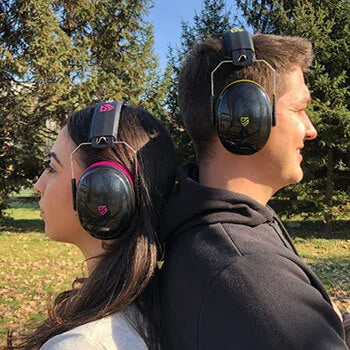
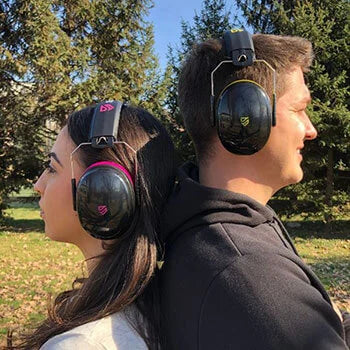
When shooting magnum handguns, doubling up on hearing protection is not optional — it is essential. This means wearing both earplugs (ideally NRR 33 rated) and over-ear earmuffs (NRR 28 or higher). This combination can achieve an effective NRR of approximately 36, bringing peak noise exposure down to a safer level. TradeSmart Safety's earmuff and eyewear kits provide NRR 28 earmuffs along with ANSI Z87.1+ safety glasses — a solid foundation. Pair them with TradeSmart's NRR 33 foam earplugs worn underneath for maximum protection during magnum shooting sessions.
For detailed guidance on choosing the right hearing protection for different calibers, read our guide on the best ear protection for shooting.
Muzzle Blast Courtesy
The muzzle blast from a .500 S&W Magnum or .454 Casull with a short barrel generates a pressure wave that neighboring shooters can feel physically. At indoor ranges, this effect is amplified by the enclosed space. Some practical courtesies include:
- Choose an end lane when possible to minimize the number of adjacent shooters affected
- Alert shooters on neighboring lanes before your first shot — a simple "I'm about to shoot something loud" goes a long way
- Be mindful of timing — do not fire your .500 Magnum the moment someone on the next lane is trying to carefully aim their pistol
- If the range is crowded and every lane is occupied, consider whether it is the right time for a magnum session
- Check with range staff about any caliber restrictions — some indoor ranges prohibit certain magnum calibers due to damage to target retrieval systems and backstops
Safety With Powerful Handguns
The four fundamental rules of gun safety apply to every firearm, but they take on added weight with high-powered handguns where the consequences of a negligent discharge are amplified. Beyond the basics:
- Start with the cylinder or magazine empty when handling or showing the revolver to others
- Be aware of over-penetration risk: Magnum cartridges can penetrate multiple interior walls, vehicles, and other barriers. Know what is beyond your target — and beyond the backstop
- Secure your grip before every shot. Fatigue from heavy recoil can cause grip to weaken over a session, increasing the chance of the gun twisting in your hands
- Never hand a loaded magnum revolver to a novice shooter without thorough instruction first. Videos of unsupervised first-time shooters struggling with magnum recoil are unfortunately common online — they represent genuine safety failures, not entertainment
What You Need Before Heading to the Range
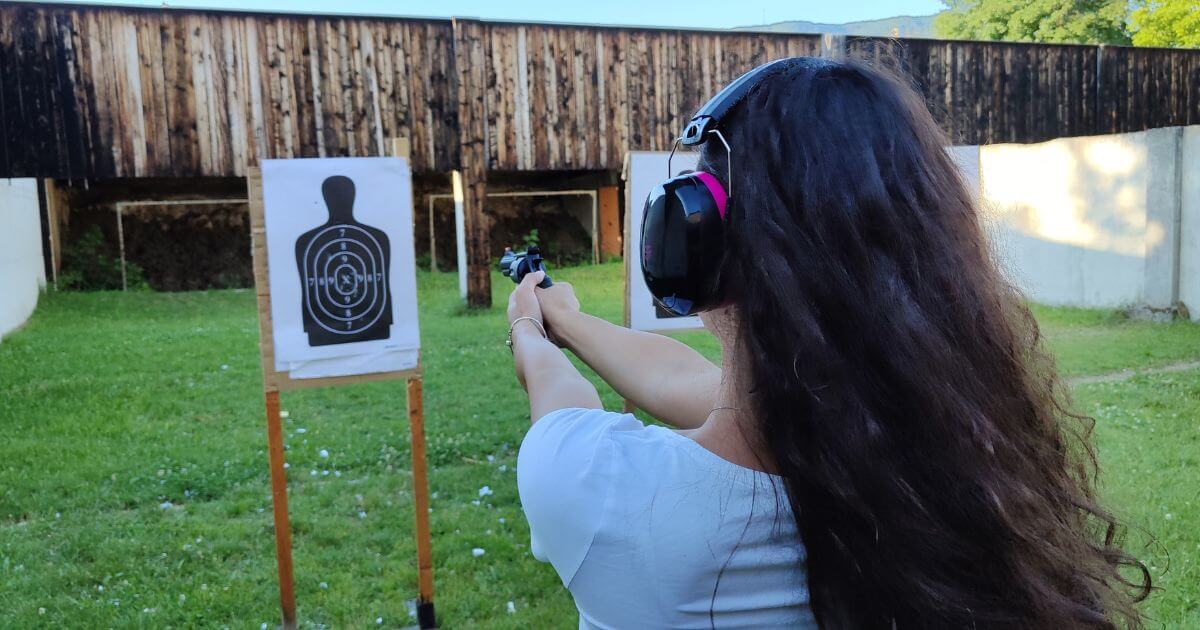
Whether you are shooting a .44 Magnum or a .500 S&W, proper preparation makes the experience safer and more enjoyable. Your range bag should include doubled-up hearing protection, ANSI-rated eye protection, and a first aid kit. TradeSmart Safety's premium shooting kits include NRR 28 earmuffs, ANSI Z87.1+ safety glasses, a hard-shell carrying case, and foam earplugs — essentially everything you need for hearing and eye protection in one package. Every TradeSmart product ships with free shipping, is backed by a 10-year warranty, and includes a free Range Confidence Course covering firearms fundamentals.
For shooters who want electronic hearing protection that allows them to hear range commands while still blocking impulse noise, the TacticalEdge electronic earmuffs with NRR 24 are worth considering — especially when paired with foam plugs underneath for magnum caliber sessions. Read more in our comparison of passive vs. electronic earmuffs.
Frequently Asked Questions
What is the most powerful handgun you can buy in 2026?
The Smith & Wesson Model 500, chambered in .500 S&W Magnum, remains the most powerful commercially produced handgun as of 2026. With heavy 700-grain loads, it produces nearly 2,900 ft-lbs of muzzle energy — more than double the energy of a 5.56 NATO rifle round. Custom single-shot handguns chambered in rifle cartridges (like the Thompson Center Encore in .308 Winchester) can exceed this, but the S&W 500 is the most powerful repeating handgun available.
Is the .44 Magnum still the most powerful handgun?
No. When "Dirty Harry" claimed the .44 Magnum was the most powerful handgun in the world in 1971, it was accurate (or close to it). Today, the .44 Magnum ranks below the .454 Casull, .460 S&W Magnum, .500 Linebaugh, .50 Action Express, and .500 S&W Magnum in terms of muzzle energy. However, the .44 Magnum remains arguably the most practical big-bore handgun cartridge, offering an excellent balance of power, ammunition availability, and manageable recoil.
Can you hunt with these high-powered handguns?
Yes, handgun hunting is legal in most states and is a growing discipline. The .44 Magnum is considered the minimum for deer-sized game, while the .454 Casull and larger are suitable for elk, moose, and bears. Handgun hunting requires closer range (typically under 100 yards), better stalking skills, and steadier marksmanship than rifle hunting. Many hunters find the additional challenge rewarding. Check your state's regulations, as requirements for minimum cartridge energy, barrel length, and whether scopes are permitted vary by jurisdiction.
What hearing protection do I need for magnum handguns?
Magnum handguns produce noise levels between 160 and 175 dB, which is significantly above the 140 dB threshold for immediate hearing damage established by NIOSH. Doubling up on hearing protection is strongly recommended: wear NRR 33 rated foam earplugs under NRR 28 rated earmuffs for a combined effective NRR of approximately 36. Single-layer protection is insufficient for extended magnum shooting sessions. According to the NIDCD, approximately 40 million Americans already suffer from noise-induced hearing loss, and recreational shooters are four times more likely to develop hearing loss than non-shooters.
How much does it cost to shoot these powerful handguns?
Ammunition costs vary significantly by caliber. As of 2026, expect to pay approximately $0.80 to $1.50 per round for .44 Magnum, $1.50 to $2.50 for .454 Casull and .50 AE, $2.00 to $3.50 for .460 S&W Magnum, and $2.50 to $4.00 for .500 S&W Magnum. A 50-round session with .500 S&W can cost over $150 in ammunition alone. Many magnum handgun owners reload their own ammunition to reduce costs by 40 to 60 percent. Compare these costs to 9mm at $0.25 to $0.40 per round.
What is the best high-powered handgun for a first-time magnum shooter?
The .44 Magnum is the best entry point into magnum handgun shooting. It offers serious power (approximately 1,000 ft-lbs of muzzle energy) while remaining controllable for most adult shooters with proper technique. The Ruger Super Blackhawk and Smith & Wesson Model 629 are excellent starter platforms. Both are well-made, widely available, and can also fire .44 Special ammunition for reduced-recoil practice. Start with .44 Special loads to learn the platform, then transition to full-power .44 Magnum as your recoil management improves.





TradeSmart Safety
May 08, 2024
Hi Isaac,
It’s great to hear about your interest in handguns. However, owning a firearm, especially for security purposes, comes with significant responsibilities and requires proper training and understanding of safety protocols.
Before deciding to own a handgun, we would strongly recommend taking several steps:
1. Educate Yourself: Learn about different types of handguns, how they operate, and the laws regarding firearm ownership and usage in your area. 2. Get Trained: Enroll in a reputable firearms training course. This will not only teach you how to handle a handgun safely but also help you make an informed decision about whether owning a gun is the right choice for you. 3. Assess Your Readiness: Consider whether you are prepared to take on the legal, ethical, and safety responsibilities that come with owning a firearm.If after training and careful consideration you feel confident and understand the responsibilities, then it might be appropriate to own a handgun for security. Remember, owning a firearm is a serious commitment to safety and responsible handling at all times.