



Guns for Women: Top 7 Firearm Choices Handpicked by Women Shooters
Women are the fastest-growing demographic in shooting sports, and the industry has taken notice. According to the National Shooting Sports Foundation (NSSF), women now account for roughly 30% of target shooting participants in the United States, with over 6 million women actively engaged in target shooting alone. That number continues to climb year over year.
Yet despite this growth, much of the advice about "guns for women" still misses the mark. Too many guides default to recommending the smallest, lightest pistol available, or worse, suggest something pink and call it a day. The reality is more nuanced: the best gun for any woman is the one she shoots accurately, carries comfortably, and trusts completely.
This guide was built from real-world feedback from women shooters, certified instructors, and range professionals. We cover grip considerations, recoil management, the most popular calibers, seven specific firearm recommendations, and practical advice on holsters, training, and what to expect at the range.
Why "Guns for Women" Is the Wrong Frame (and the Right Starting Point)
Let's address this directly: there is no such thing as a "woman's gun" in the way the marketing world sometimes implies. Firearms are tools, and the best tool is the one that fits the user. That said, there are legitimate physical considerations that affect many women shooters and deserve honest discussion.
Hand size and grip circumference matter significantly. The average woman's hand is smaller than the average man's hand, which means a full-size duty pistol with a wide double-stack grip can be difficult to wrap around properly. A poor grip leads to poor control, which leads to poor accuracy and increased felt recoil. Many women find that single-stack or slim-profile pistols give them the grip purchase they need.
Hand strength and slide manipulation are real considerations. Racking a semi-automatic pistol's slide requires a firm grip and deliberate technique. Some slides are stiffer than others, and for shooters with less hand strength, whether due to arthritis, injury, or simply biomechanics, this matters. Manufacturers like Smith & Wesson have responded with models specifically engineered for easier slide manipulation.
Recoil sensitivity varies from shooter to shooter regardless of gender, but it becomes especially relevant when pairing a lightweight carry gun with a snappy caliber. A 12-ounce .380 pocket pistol can actually feel sharper in recoil than a 25-ounce 9mm compact. Gun weight and caliber interact, and understanding that relationship is key to finding a firearm you'll actually practice with.
Understanding Calibers: .380 ACP, 9mm, and .38 Special
Before diving into specific models, it helps to understand the three calibers most commonly recommended for women who carry. Each has distinct characteristics that affect shootability, stopping power, and recoil.
.380 ACP
The .380 ACP fires a lighter bullet (85 to 100 grains) at lower pressure, roughly 21,500 psi Maximum Average Pressure. In practical terms, recoil from a .380 ACP is approximately half that of a comparable 9mm. This makes it a popular choice for shooters who prioritize manageable recoil and fast follow-up shots. Modern .380 defensive ammunition has improved dramatically, closing some of the performance gap with 9mm.
Best for: New shooters building confidence, those with hand strength limitations, or anyone who wants a lightweight pocket-carry option with minimal recoil.
9mm Luger
The 9mm is the most popular handgun caliber in the world for good reason. It offers an excellent balance of stopping power, capacity, and controllability. Bullet weights typically range from 115 to 147 grains, operating at approximately 35,000 psi. Modern micro-compact 9mm pistols hold 10 or more rounds in remarkably slim packages, and advances in recoil spring design have made the 9mm manageable even in sub-compact frames.
Best for: Shooters who want the best all-around balance of capacity, performance, and widespread ammunition availability.
.38 Special
The .38 Special remains a strong choice, particularly in revolvers. It produces moderate recoil in a steel-framed revolver and offers simplicity of operation: load, point, squeeze. There are no slides to rack, no magazines to fumble with under stress, and no safeties to disengage. Standard-pressure .38 Special loads are mild, though +P loads increase velocity at the cost of more felt recoil.
Best for: Shooters who prefer revolver simplicity, home defense applications, or those who want a bedside gun with straightforward operation.
Top 7 Guns for Women: Chosen by Women Shooters
These seven firearms consistently earn top marks from women who shoot, carry, and train regularly. Each one was selected based on real-world feedback about ergonomics, reliability, recoil management, and everyday carry comfort.
1. Smith & Wesson M&P Shield EZ 9mm
Caliber: 9mm | Capacity: 8+1 | Weight: 23.2 oz | Barrel: 3.675"
The Shield EZ earns the top spot for a reason: it was designed from the ground up to solve the most common complaints women have about semi-automatic pistols. The slide requires significantly less force to rack than nearly any other 9mm on the market. The magazines feature load-assist tabs that make loading effortless. The grip safety and optional thumb safety provide additional layers of security for new shooters.
The "EZ" in the name is not marketing fluff. Women with arthritis, smaller hands, or limited grip strength consistently report that this is the first semi-auto they've been able to operate independently and confidently. It shoots 9mm, so you're not sacrificing terminal performance, and it's accurate enough for defensive distances and beyond.
Why women choose it: Easy slide, easy magazines, easy to shoot accurately. It removes the mechanical barriers that frustrate many new shooters.
2. Sig Sauer P365
Caliber: 9mm | Capacity: 10+1 (standard) / 12+1 (extended) | Weight: 17.8 oz | Barrel: 3.1"
The Sig P365 redefined what a micro-compact 9mm could be when it launched, and it remains the benchmark. At under 18 ounces unloaded, it carries like a subcompact but holds 10+1 rounds of 9mm in its flush-fit magazine, matching or exceeding many larger pistols. The grip is slim enough for smaller hands but textured aggressively enough for a confident purchase.
The P365's recoil is notably tame for its size, thanks to Sig's engineering of the recoil spring system and slide mass. The XMacro variant adds a 17+1 capacity with a compensator for even less felt recoil, making it one of the most versatile carry platforms available.
Why women choose it: Incredible capacity-to-size ratio, comfortable all-day carry, and a proven track record of reliability.
3. Glock 43X
Caliber: 9mm | Capacity: 10+1 | Weight: 18.7 oz | Barrel: 3.41"
The Glock 43X takes everything that made the original Glock 43 popular and adds a longer grip that accommodates all three fingers for most hand sizes. This seemingly small change dramatically improves control and recoil management. The slim slide and frame make it concealable under nearly any clothing, and Glock's legendary reliability means this gun will fire every time you press the trigger.
With aftermarket Shield Arms S15 magazines, the 43X can hold 15+1 rounds, rivaling full-size pistols in capacity while maintaining its slim profile. The trigger is typical Glock: consistent, predictable, and easy to learn.
Why women choose it: Full grip for better control, Glock reliability, slim enough to conceal under fitted clothing, and a massive aftermarket for customization.
4. Ruger LCR .38 Special
Caliber: .38 Special +P | Capacity: 5 | Weight: 13.5 oz | Barrel: 1.87"
For women who prefer revolvers, the Ruger LCR remains one of the best options available. At 13.5 ounces, it's featherweight in a purse or ankle holster, and its snag-free design means it draws cleanly from any concealment method. The Hogue Tamer Monogrip includes a rubber backstrap insert that noticeably reduces felt recoil, a clever engineering choice that makes this ultralight revolver more shootable than its weight would suggest.
Ruger also engineered a friction-reducing cam inside the trigger group, resulting in a smoother double-action trigger pull than most competitors in this class. The simplicity of a revolver, with no slide to rack, no magazine to insert, and no safety to disengage, appeals to many women who want a grab-and-go defensive tool.
Why women choose it: Revolver simplicity, ultra-lightweight, improved trigger and grip design, and no mechanical barriers to operation under stress.
5. Smith & Wesson M&P9 M2.0 Compact
Caliber: 9mm | Capacity: 15+1 | Weight: 27.2 oz | Barrel: 4"
When a woman wants a gun she can train seriously with and still carry comfortably, the M&P9 M2.0 Compact delivers. The four interchangeable palmswell inserts let you customize the grip circumference to your hand, a feature that makes a real difference for shooters whose hands fall between standard sizing. The aggressive texturing provides grip without being abrasive, and the flat-face trigger is crisp and consistent.
At 27.2 ounces, this gun absorbs 9mm recoil better than any micro-compact, making range sessions more pleasant and training more productive. The 15+1 capacity means you spend less time reloading and more time shooting. Many women use this as their primary range and home defense gun while carrying something smaller daily.
Why women choose it: Customizable grip, excellent shootability, high capacity, and it bridges the gap between a range gun and a carry gun.
6. Walther PDP F-Series
Caliber: 9mm | Capacity: 15+1 | Weight: 24.1 oz | Barrel: 3.5"
The Walther PDP F-Series deserves special mention because it's one of the few firearms explicitly engineered around the female hand. The grip circumference is reduced, the trigger reach is shortened, and the slide serrations are deeper and more aggressive to aid in manipulation. These are not cosmetic changes; they're functional engineering decisions based on ergonomic research.
The PDP's trigger is widely regarded as one of the best factory striker-fired triggers on the market, breaking cleanly with minimal take-up and a short, positive reset. Combined with the optics-ready slide and performance-oriented design, this is a gun that grows with the shooter, equally suitable for a new shooter's first pistol or a competition shooter's carry gun.
Why women choose it: Purpose-built for smaller hands, outstanding trigger, and it performs at a level that experienced shooters appreciate.
7. Springfield Armory Hellcat Pro
Caliber: 9mm | Capacity: 15+1 | Weight: 21.5 oz | Barrel: 3.7"
The Hellcat Pro packs 15+1 rounds of 9mm into a frame that's barely larger than most 10-round micro-compacts. The adaptive grip texture adjusts to your grip pressure, becoming more aggressive as you squeeze harder, which is a genuine advantage under stress. The U-Dot sight system is intuitive and fast to acquire, and the optics-ready slide accepts popular micro red dots without adapter plates.
Springfield's engineering keeps the Hellcat Pro's recoil manageable despite its compact dimensions, and the extended beavertail protects against slide bite, a common complaint among women with a high grip technique.
Why women choose it: Maximum capacity in a compact size, intuitive sights, and ergonomics that work for a wide range of hand sizes.
Grip Size and Hand Strength: What Actually Matters
The single most important factor in choosing a firearm is how it fits your hand. A proper grip means your dominant hand wraps fully around the grip with your trigger finger reaching the trigger face comfortably at the first pad of your fingertip. If you're straining to reach the trigger or your fingers overlap awkwardly, the gun is too large.
How to Evaluate Grip Fit
- Trigger reach: With the gun pointed safely, place the web of your hand high on the backstrap. Your index finger should reach the trigger face naturally without shifting your grip. If you have to rotate your hand to reach the trigger, the grip is too wide.
- Three-finger contact: Your middle, ring, and pinky fingers should all contact the grip. If your pinky dangles below the grip, consider a model with a longer grip frame or a magazine with a finger extension.
- Slide manipulation: Grip the slide with your support hand using an overhand technique (palm over the top, fingers curled over the serrations) and push the frame forward with your dominant hand. This "push-pull" method uses larger muscle groups and is far more effective than trying to pull the slide back with finger strength alone.
- Magazine loading: Can you load rounds into the magazine without excessive thumb pain? If not, look for models with load-assist features or invest in a universal magazine loader like the Maglula UpLULA.
Building Hand Strength for Shooting
Grip strength directly affects recoil control, follow-up shot speed, and overall shooting performance. Simple exercises can make a significant difference:
- Stress ball squeezes: Three sets of 15 repetitions daily builds forearm and grip endurance.
- Dead hangs: Hanging from a pull-up bar for 20-30 seconds strengthens the entire grip chain.
- Rubber band extensions: Wrap a rubber band around your fingertips and spread your fingers against the resistance. This strengthens the opposing muscles and improves overall hand stability.
- Dry-fire practice: Safely practicing trigger pulls at home builds the specific finger strength and muscle memory needed for shooting.
Recoil Management: Technique Over Muscle
Recoil management is less about brute strength and more about technique and body mechanics. Women who apply proper fundamentals often outshoot men who rely on grip strength alone. Here's what matters most.
Grip Technique
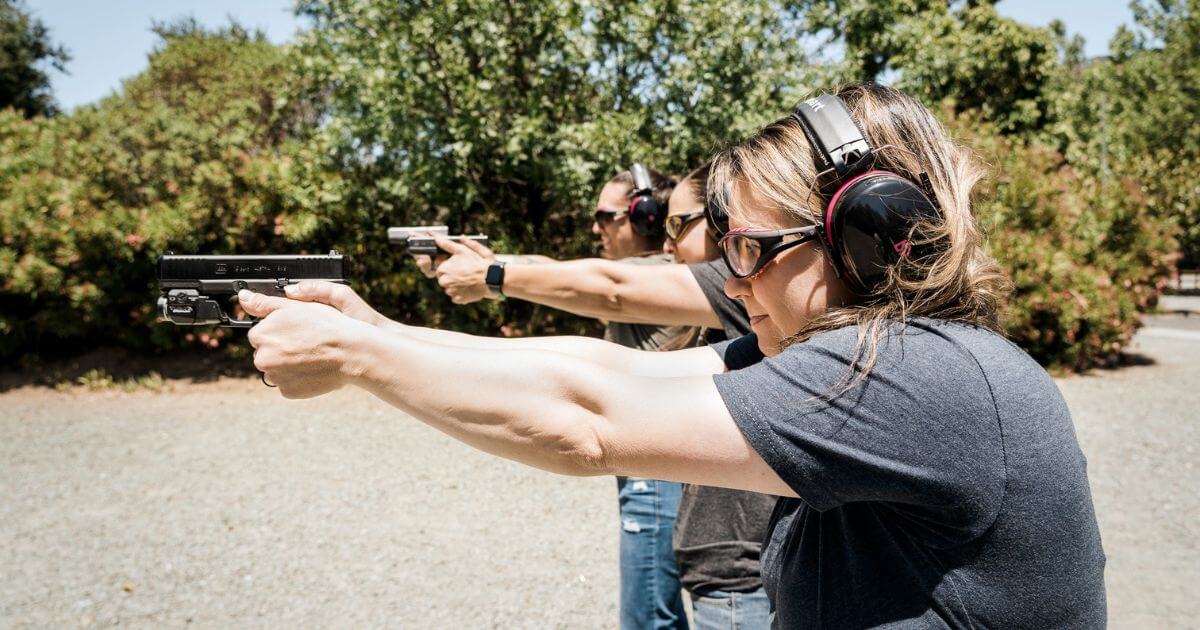
A high, firm, two-handed grip is the foundation. Your dominant hand sits as high on the backstrap as possible without interfering with the slide. Your support hand fills the remaining grip space, with the support-side thumb pointing forward along the frame. Both thumbs point toward the target. Apply 60% of your grip pressure with your support hand and 40% with your dominant hand.
Stance and Body Weight
Lean slightly forward with your weight on the balls of your feet. This forward stance allows your skeleton and body mass to absorb recoil rather than relying solely on arm and hand strength. Many women instinctively lean back when shooting, which amplifies felt recoil and muzzle rise. A slight aggressive lean forward makes a dramatic difference.
Matching Gun Weight to Caliber
Heavier guns produce less felt recoil. A 27-ounce 9mm compact will feel considerably milder than a 17-ounce 9mm micro-compact firing the same ammunition. If recoil sensitivity is a concern, consider starting with a slightly heavier gun for range training and working your way down to a lighter carry gun as your technique improves.
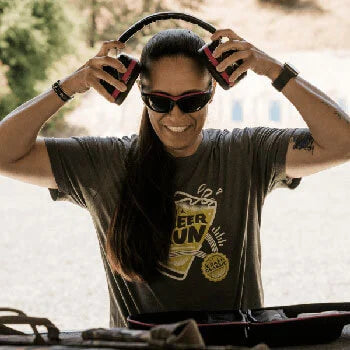
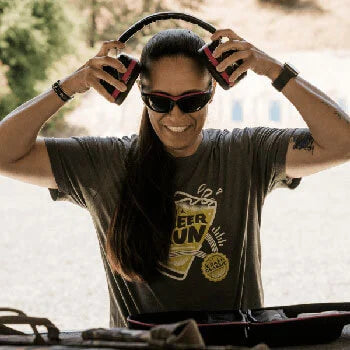
Remember that firearm report is also part of the shooting experience. Gunshots produce between 140 and 175 decibels depending on caliber, and according to the National Institute for Occupational Safety and Health (NIOSH), a single gunshot above 140 dB can cause immediate, permanent hearing damage. Proper ear protection for shooting is non-negotiable. Doubling up with earmuffs and earplugs, as recommended by audiologists and range safety officers, provides the best hearing protection available.
Range Training Tips for New Women Shooters
Walking into a gun range for the first time can be intimidating, but preparation eliminates most of that anxiety. Here's how to set yourself up for a productive and enjoyable first experience.
Before Your First Range Visit
- Take a fundamentals course. A structured firearms course teaches you safe handling, basic marksmanship, and range procedures before you ever step onto a firing line. TradeSmart Safety's Range Confidence Course covers these fundamentals in a self-paced online format, giving you the knowledge foundation before your first live-fire session.
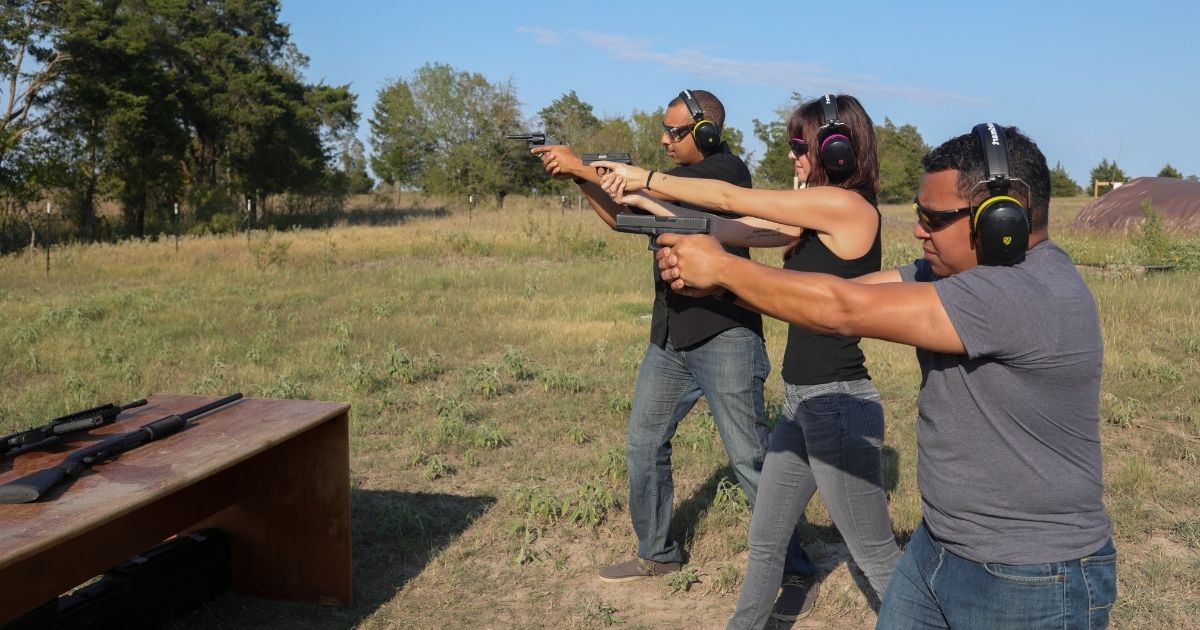
- Invest in your own ear and eye protection. Range rental gear is often worn, ill-fitting, and uncomfortable. Your own properly rated protection, including NRR-rated earmuffs and ANSI Z87.1-certified safety glasses, ensures you're focused on shooting, not on adjusting borrowed equipment. ANSI Z87.1 certification requires lenses to withstand a quarter-inch steel ball traveling at 150 feet per second, providing genuine impact protection for your eyes.
- Dress appropriately. Closed-toe shoes, a high-neckline shirt (hot brass can bounce in unexpected directions), and range-appropriate clothing are essential. Avoid loose scarves or dangling jewelry that could snag on equipment.
At the Range
- Start close. Set your target at 3 to 5 yards initially. This builds confidence through visible success and lets you focus on fundamentals without straining to see hits.
- Use a rest if needed. There's no shame in resting your hands on a bench or sandbag while you learn trigger control and sight alignment. Remove the variables one at a time.
- Take breaks. Fatigue erodes technique quickly. Shoot 20 to 30 rounds, then rest, hydrate, and assess. Quality repetitions beat high round counts every time.
- Try before you buy. Many ranges rent handguns by the session. Shoot three or four different models before making a purchase decision. What feels right in the display case may feel wrong on the firing line, and vice versa.
Finding the Right Instructor
A good instructor makes all the difference, particularly for women entering a traditionally male-dominated space. Look for:
- NRA-certified, USCCA-certified, or state-certified instructors with verifiable credentials
- Women-only classes if you'd be more comfortable learning in that environment, as many ranges and training organizations now offer them
- Instructors who explain the why behind each technique, not just the what
- Patient teaching styles that build on success rather than correcting through criticism
Organizations like A Girl & A Gun (AG&AG) and The Well Armed Woman (TWAW) offer women-specific shooting chapters nationwide with regular meetups, training events, and mentorship.
Holster and Carry Considerations for Women's Clothing
Concealed carry presents unique challenges for women. Men's clothing, with its belt loops, loose fits, and structured waistbands, was practically designed for carrying a holstered firearm. Women's clothing was not. But with the right holster and a few wardrobe adjustments, comfortable and concealed carry is absolutely achievable.
Holster Types That Work for Women
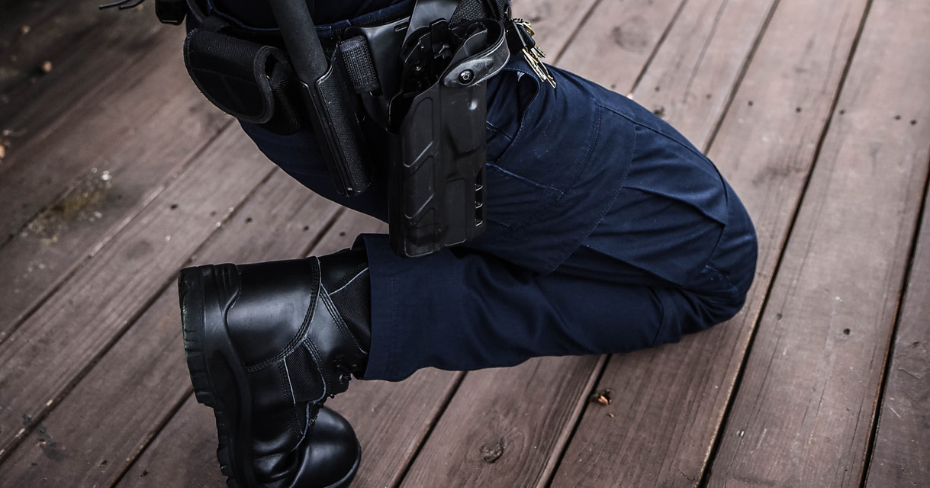
Inside-the-Waistband (IWB): The most popular carry method. The holster clips to your waistband and the pistol rides between your body and your pants. Works well with jeans, pants with belt loops, and sturdy skirts. Appendix IWB (AIWB) positioning, just forward of the hip bone, is especially concealable for women.
Belly Bands: An elastic band that wraps around your midsection, holding the firearm against your body. Works with virtually any clothing, including leggings, athletic wear, skirts, and dresses. No belt required. The Crossbreed Belly Band and Can Can Concealment are popular options.
Enigma-Style Chassis Systems: The PHLster Enigma uses its own belt and leg leash system to carry a Kydex holster completely independent of your clothing. This is a game-changer for women who wear dresses, skirts, or clothing without belt loops. It's the closest thing to a universal concealment solution currently available.
Thigh Holsters: Inner-thigh carry under skirts and dresses provides deep concealment. The firearm sits high on the inner thigh, secured by an elastic band. Works best with A-line or flared skirts that provide room for a clean draw. Consider the Flashbang Holsters Thigh Holster or similar purpose-built options.
Bra Holsters: Mounted to the center gore of a sports bra or dedicated carry bra, these position the firearm between the breasts. Draw requires lifting the garment, which can be slower, but concealment is excellent. Best suited to revolvers or very compact pistols.
Clothing Tips for Concealed Carry
- Patterns break up printing. Floral, plaid, and geometric patterns disguise the outline of a pistol far better than solid colors.
- Layering is your friend. A cardigan, blazer, or open flannel over a fitted top conceals an IWB holster without adding bulk.
- Structured fabrics conceal better. Denim, canvas, and heavier cotton drape over a holster without clinging. Avoid thin, clingy fabrics for your cover garment.
- High-waisted pants provide more waistband real estate and keep the holster from digging into your hip.
- Seasonal adjustments: Winter allows for larger guns and OWB (outside-the-waistband) carry under jackets. Summer may require downsizing to a smaller pistol or switching to a belly band or chassis system.
For a deeper dive into women's concealed carry strategies and finding the best concealed carry gun for your needs, we've covered those topics extensively.
Essential Safety Gear for Every Woman Shooter
Your firearm is only one piece of the equation. Proper safety gear is what allows you to train consistently, comfortably, and without risking permanent injury. According to the National Institute on Deafness and Other Communication Disorders (NIDCD), approximately 40 million Americans aged 20 to 69 have noise-induced hearing loss, and recreational shooters are four times more likely to develop hearing loss than non-shooters.
Here's what every woman should have in her range bag:
Hearing Protection
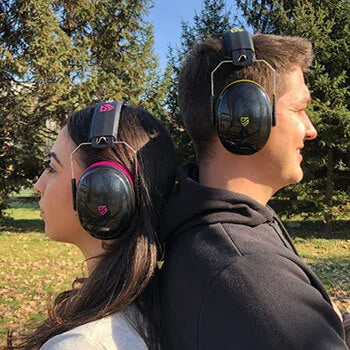
This is not optional. Gunshots range from 140 dB for a .22 rifle to 165+ dB for a 12-gauge shotgun. NIOSH recommends hearing protection for any exposure above 85 dB. Double up with NRR-rated earmuffs over foam earplugs for maximum protection. NRR-rated earmuffs typically provide 20 to 30 dB of noise reduction, while high-performance earplugs add up to NRR 33. Combined, you can achieve an effective NRR approaching 36 dB.
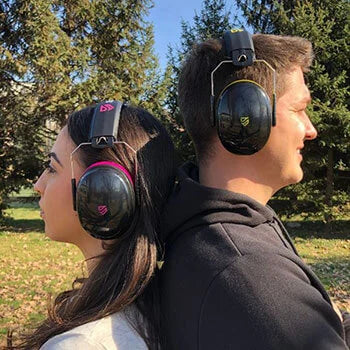
Electronic earmuffs are worth considering for training environments. They amplify ambient sound, including range commands and conversation, while instantly compressing harmful gunshot noise. TradeSmart Safety's TacticalEdge Electronic Earmuffs provide NRR 24 protection with directional microphones, letting you hear your instructor clearly while protecting against impulse noise.
Eye Protection
ANSI Z87.1-certified safety glasses protect against ejected casings, powder residue, lead particles, and the unlikely but possible event of a catastrophic firearm failure. Impact-resistant polycarbonate lenses with anti-fog coating ensure clear vision throughout your range session. Clear lenses work best for indoor ranges, while tinted options reduce glare for outdoor shooting.
Complete Range Kits
TradeSmart Safety's shooting range kits combine NRR 28 earmuffs, ANSI Z87.1+ safety glasses, NRR 33 foam earplugs, and a hard-shell carrying case in one package. Every kit includes the Range Confidence Course, which covers firearms fundamentals, range safety, and marksmanship basics. It's a practical starting point for women who want reliable, certified gear without piecing together components separately.
All TradeSmart Safety products are backed by a 10-year warranty and include free shipping, making them a low-risk investment in your long-term hearing and eye health. If you're exploring your first set of range gear, our guide to the best ear protection for shooting breaks down the options in detail.
Choosing Your First Gun: A Decision Framework
With seven strong options above and countless more on the market, here's a practical framework for narrowing down your choice. If you're completely new to firearms, also check out our guide to the best beginner handguns for additional recommendations.
Step 1: Define Your Primary Use
- Concealed carry: Prioritize compact size, light weight, and reliability. The Sig P365, Glock 43X, or Springfield Hellcat Pro are strong choices.
- Home defense: You can go larger. The S&W M&P9 M2.0 Compact or Walther PDP F-Series offer higher capacity and better shootability.
- Range training and skill development: Start with something you enjoy shooting. The M&P9 M2.0 Compact or PDP F-Series are excellent training platforms.
- Simplicity above all: The Ruger LCR offers point-and-shoot simplicity with no mechanical complexity.
Step 2: Handle Before You Buy
Visit a well-stocked gun shop and handle as many models as possible. Check grip fit, trigger reach, and slide manipulation. If the shop has a range, rent your top two or three choices and put 50 rounds through each.
Step 3: Factor in Ongoing Costs
The purchase price is just the beginning. Budget for:
- Quality holster: $50 to $120
- Practice ammunition: $15 to $20 per box of 50 (plan for at least 200 rounds per month if training regularly)
- Defensive ammunition: $25 to $40 per box of 20
- Range fees: $15 to $30 per session at most indoor ranges
- Ear and eye protection: Starting at around $30 for a quality kit
- Training courses: $75 to $250 depending on the instructor and course length
Step 4: Commit to Training
A firearm you don't train with is a liability, not an asset. Plan for at least one range session per month, supplemented by regular dry-fire practice at home. Training builds the competence that builds confidence, and confidence is what makes the difference if you ever need to use your firearm in a defensive situation.
Frequently Asked Questions
What is the best caliber for a woman's first handgun?
The 9mm offers the best balance of performance, capacity, and controllability for most women. It produces manageable recoil in modern compact pistols, ammunition is widely available and affordable for practice, and defensive loads are proven effective. If recoil sensitivity is a significant concern, the .380 ACP provides a softer-shooting alternative with adequate defensive performance using modern hollow-point ammunition. The key is choosing a caliber you will actually practice with regularly.
Are smaller guns easier for women to shoot?
Not necessarily. Smaller, lighter guns often produce more felt recoil because there is less mass to absorb the energy. A compact or mid-size 9mm pistol weighing 22 to 27 ounces is often easier to shoot accurately and more comfortable to train with than an ultra-light pocket pistol. Smaller guns are easier to carry but not always easier to shoot. The best approach is to find the smallest gun you can shoot well and carry comfortably.
Do I need to carry a "pink" or "women's" model gun?
No. Color and marketing labels have zero effect on performance. What matters is grip fit, trigger reach, slide ease of manipulation, recoil characteristics, and reliability. Some models, like the Walther PDP F-Series, are engineered with genuinely different ergonomics for smaller hands, and that functional design difference is valuable. Choose a firearm based on how it shoots and how it fits, not how it looks.
Should I choose a revolver or a semi-automatic?
Both are valid defensive tools. Revolvers offer mechanical simplicity, with no slides to rack, no magazines to load under stress, and no safeties to disengage. They're reliable and intuitive. Semi-automatics offer higher capacity, faster reloads, slimmer profiles for concealment, and generally less felt recoil per shot. Most instructors recommend semi-automatics for everyday carry due to capacity advantages, but a .38 Special revolver remains a perfectly effective choice for home defense or as a backup gun.
How can I improve my hand strength for racking a slide?
Use the "push-pull" technique: grip the slide firmly with your support hand and push the frame forward with your dominant hand, rather than trying to pull the slide back with one hand. This uses your larger chest and shoulder muscles rather than relying on finger strength. For long-term improvement, grip-strengthening exercises like stress ball squeezes, dead hangs, and hand gripper tools will build the specific strength needed. In the meantime, models like the S&W M&P Shield EZ are specifically designed with reduced-force slides.
What hearing and eye protection should women shooters use?
At minimum, wear NRR-rated earmuffs and ANSI Z87.1-certified safety glasses every time you shoot. For best results, double your hearing protection by wearing foam earplugs (NRR 33) underneath over-ear earmuffs (NRR 28). This combination provides maximum noise reduction and is especially important at indoor ranges where sound reflects off walls and ceiling. Women with smaller heads should look for earmuffs with adjustable headbands to ensure a snug, gap-free seal over the ears. TradeSmart Safety's shooting range kits include both earmuffs and safety glasses sized and designed for a comfortable fit, backed by a 10-year warranty.
Start Your Shooting Journey with Confidence
The best gun for a woman is the one she's trained with, comfortable carrying, and confident using. Whether that's a Sig P365 for daily concealed carry, a Ruger LCR for bedside simplicity, or an M&P Shield EZ that removes every mechanical barrier to competent shooting, the right choice is the one that fits you.
But the gun is only part of the equation. Consistent training, proper safety gear, and a solid foundation in firearms fundamentals are what transform a gun owner into a capable, confident shooter.
TradeSmart Safety's Premium Shooting Range Kits give you everything you need for your first range session and beyond: NRR 28 earmuffs, ANSI Z87.1+ safety glasses, NRR 33 foam earplugs, a hard-shell carrying case, and the Range Confidence Course, all backed by a 10-year warranty and free shipping. Because protecting your hearing and eyesight is just as important as choosing the right firearm.



Leave a comment (all fields required)