









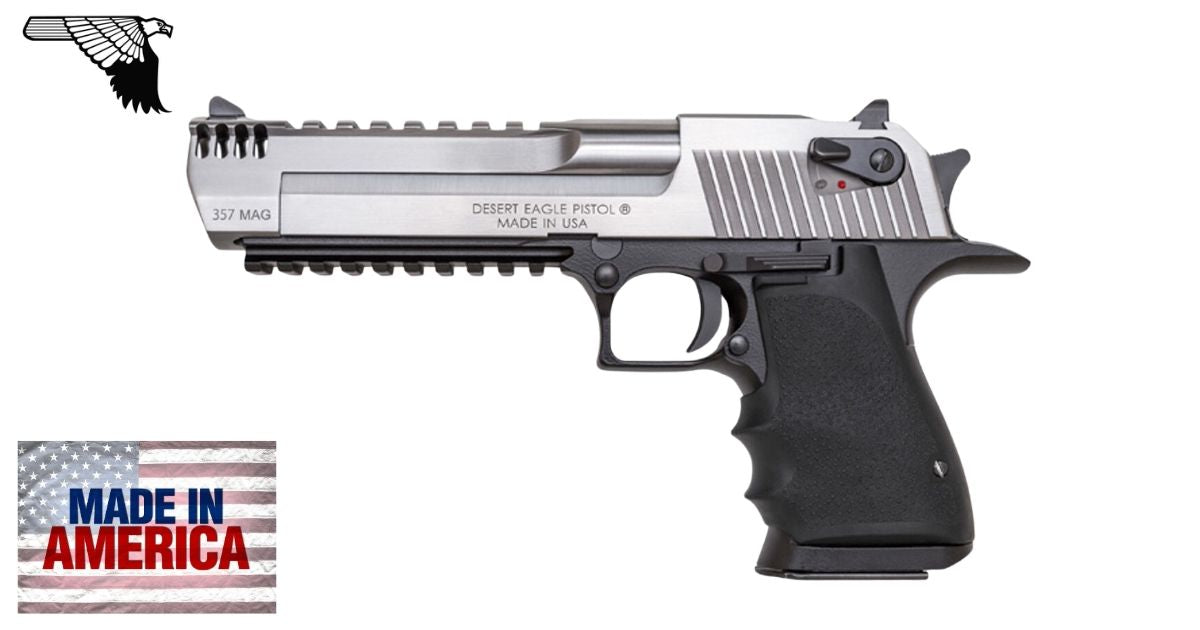

Unveiling the 357 Desert Eagle: A Blend of Power and Precision
Few handguns carry the kind of name recognition that the Desert Eagle commands. Whether you first spotted it in a Hollywood action film or heard about it at your local range, the Desert Eagle has earned a reputation that sits somewhere between myth and machine. But strip away the cinematic glamour and what remains is a genuinely fascinating piece of firearms engineering — particularly in its .357 Magnum configuration.
This article breaks down the Desert Eagle's history, its unique gas-operated mechanism, the differences between its caliber options, real-world specs, practical applications, and what you should know before firing one at the range. If you have been curious about what makes this pistol tick, read on.
A Brief History of the Desert Eagle
The Desert Eagle's origin story is more complex than most shooters realize. Development began in 1979 with Magnum Research, Inc., a company based in Minneapolis, Minnesota. The original concept came from three individuals — Jim Skildam, Harold Beal, and a team of engineers who wanted to create a semi-automatic pistol capable of firing magnum revolver cartridges. That alone was a tall order. Magnum revolvers existed for good reason — the pressures and case dimensions of cartridges like the .357 Magnum and .44 Magnum had historically been the domain of revolvers with their robust cylinder-based designs.
The first working prototypes appeared in the early 1980s. In 1983, Magnum Research partnered with Israel Military Industries (IMI) — now known as Israel Weapon Industries (IWI) — to refine the manufacturing process. IMI brought significant production expertise and military-grade quality control to the table. The .357 Magnum version was the first to reach the commercial market in 1985, followed by the .44 Magnum variant in 1986.
The .50 Action Express (AE) model arrived in 1991, and that caliber option is largely responsible for the Desert Eagle's outsized cultural footprint. But for shooters who prioritize controllability and practical shooting, the .357 Magnum version has always been the most balanced option in the lineup.
Today, the Desert Eagle is manufactured by IWI in Ramat HaSharon, Israel, and by Magnum Research (a subsidiary of Kahr Arms) in Pillager, Minnesota. The Mark XIX is the current production model, and it allows barrel and bolt swaps between calibers on the same frame — a genuinely useful feature for owners who want versatility.
Understanding the Caliber Options
The Desert Eagle is available in three calibers, each offering a different balance of power, recoil, and practicality.
.357 Magnum
The .357 Magnum was the original Desert Eagle caliber and remains the most shootable. It produces muzzle energies in the range of 500 to 600 ft-lbs depending on the load, with muzzle velocities around 1,400 to 1,500 feet per second from the Desert Eagle's 6-inch barrel. The 9-round magazine capacity (the highest of the three calibers) gives you more rounds before reloading. Recoil is firm but manageable, especially given the pistol's weight.
.44 Magnum
Step up to the .44 Magnum and you get muzzle energies approaching 900 to 1,000 ft-lbs. The magazine holds 8 rounds. Recoil is noticeably sharper than the .357, but the gas-operated system absorbs a significant portion of the energy. This is the caliber that Dirty Harry made famous (albeit in a revolver), and it hits hard enough for medium to large game hunting at reasonable distances.
.50 Action Express
The .50 AE is the headliner — the caliber that made the Desert Eagle a cultural icon. It pushes 300-grain projectiles at around 1,475 fps, generating roughly 1,400 to 1,500 ft-lbs of muzzle energy. The magazine holds 7 rounds. Recoil is substantial, and this is not a caliber most people would choose for extended range sessions. Ammunition cost is also significantly higher — expect to pay $1.50 to $2.50 per round or more.
For shooters looking for the best combination of power, shootability, and ammunition availability, the .357 Magnum variant hits a practical sweet spot. Ammo is widely available, comparatively affordable, and the recoil allows for reasonable follow-up shot accuracy.
The Gas-Operated Mechanism: What Makes the Desert Eagle Unique
Here is where the Desert Eagle truly separates itself from virtually every other semi-automatic pistol on the market. The vast majority of semi-auto handguns use one of two operating systems: blowback or short-recoil operated (like the Browning tilting-barrel design found in Glocks, 1911s, SIGs, and most modern pistols). The Desert Eagle uses neither.
The Desert Eagle uses a gas-operated, rotating bolt mechanism — the same fundamental operating principle found in rifles like the M16/AR-15 family and the AK-47. Here is how it works:
- Firing: When the cartridge is fired, propellant gases push the bullet down the barrel.
- Gas port: A small port near the muzzle end of the barrel diverts a portion of these gases into a gas cylinder located beneath the barrel.
- Piston movement: The diverted gases push a piston rearward, which drives the bolt carrier assembly back.
- Bolt rotation: The bolt rotates to unlock from the barrel extension (similar to an AR-15 bolt), extracting and ejecting the spent case.
- Return: The recoil spring pushes the bolt carrier forward, stripping a fresh round from the magazine and locking the bolt back into battery.
This system is necessary because magnum cartridges generate far too much pressure for a standard blowback system, and the cartridge dimensions do not lend themselves well to the short-recoil tilting-barrel designs that work so well with pistol-specific cartridges like 9mm and .45 ACP.
The gas system also provides a tangible benefit: felt recoil reduction. Because the gas system spreads the recoil impulse over a longer time period (similar to how a gas-operated rifle recoils less sharply than a bolt-action rifle firing the same cartridge), the Desert Eagle's recoil feels more like a firm push than a sharp snap. This is especially noticeable in the .357 Magnum version, where the combination of the gas system and the pistol's weight makes shooting remarkably comfortable for a magnum handgun.
Specifications and Weight: The Numbers
The Desert Eagle Mark XIX in .357 Magnum has the following specifications:
- Overall length: 10.75 inches (with 6-inch barrel)
- Barrel length: 6 inches (10-inch barrel also available)
- Height: 6.25 inches
- Width: 1.25 inches
- Weight (unloaded): Approximately 4 lbs 7 oz (about 71 ounces) — this varies slightly with finish
- Magazine capacity: 9 rounds (.357 Mag)
- Trigger: Single-action only
- Sights: Combat-type fixed sights with drift-adjustable rear (Picatinny rail on newer models for optics mounting)
- Frame material: Carbon steel or stainless steel (aluminum frame versions have been discontinued)
- Finish options: Black oxide, brushed chrome, stainless, Cerakote, case-hardened, titanium gold, and various custom shop finishes
That weight figure deserves emphasis. At nearly 4.5 pounds unloaded, the Desert Eagle weighs roughly three times what a Glock 19 weighs. This is not a handgun you carry concealed. It is not a handgun designed for duty use. The weight is, however, a functional feature — it absorbs recoil and makes the pistol shootable in calibers that would be punishing in a lighter platform.
Practical Uses vs. Hollywood Mythology
Let us address the elephant in the room. The Desert Eagle's pop-culture presence has created expectations that do not align with reality.
What Hollywood Gets Wrong
In films and video games, the Desert Eagle is typically portrayed as a dual-wielded, one-handed combat weapon used to dispatch enemies with casual efficiency. The reality is quite different:
- One-handed shooting is impractical. At nearly 5 pounds loaded, holding a Desert Eagle steady with one hand for any sustained period is extremely fatiguing. Two-handed shooting is essential for accuracy.
- Dual-wielding is pure fiction. Two Desert Eagles weigh close to 10 pounds unloaded. Add magazines and ammunition and you are holding over 12 pounds of metal. Accuracy would be nonexistent.
- It is not a combat weapon. No military or law enforcement agency issues the Desert Eagle as a standard sidearm. It is too heavy, too large, and the calibers are overpowered for anti-personnel use where over-penetration is a serious concern.
- Magazine capacity is limited. Seven to nine rounds depending on caliber — well below modern duty pistols that hold 15 to 20 rounds of more practical ammunition.
What the Desert Eagle Actually Excels At
Strip away the mythology and the Desert Eagle has genuine practical applications:
- Handgun hunting: In .44 Magnum and .50 AE, the Desert Eagle is a legitimate hunting handgun. The semi-auto action allows for faster follow-up shots than a revolver, and the weight helps manage recoil during extended hunting sessions. Several states allow handgun hunting for deer and larger game, and the Desert Eagle in .44 Mag is well-suited for this at distances under 100 yards.
- Metallic silhouette competition: The .357 Magnum version with its excellent inherent accuracy and manageable recoil has found a niche in silhouette shooting.
- Range shooting and collection: For many owners, the Desert Eagle is simply a fun, unique range gun. There is genuine satisfaction in shooting a well-engineered firearm that operates on a mechanism unlike anything else in the handgun world.
- Wilderness defense: In bear country, the .44 Magnum and .50 AE versions provide meaningful stopping power as a backup wilderness handgun, though purpose-built revolvers like the Ruger Super Redhawk or Smith & Wesson Model 629 are generally preferred for this role due to their simpler manual of arms and better reliability with hard-cast lead bullets.
Shooting the .357 Desert Eagle: Range Experience Tips
If you are planning to shoot a Desert Eagle at the range — whether you own one or are renting — here are practical tips to make the experience enjoyable and safe.
Hearing and Eye Protection Are Non-Negotiable
The .357 Magnum generates approximately 164 dB from a handgun, which is well above the 140 dB threshold where a single exposure can cause permanent hearing damage. According to NIOSH, any exposure above 140 dB impulse noise requires hearing protection. For magnum calibers, doubling up with both earplugs and earmuffs is strongly recommended.
TradeSmart Safety's shooting earmuff kits with NRR 28-rated earmuffs paired with their NRR 33 foam earplugs provide excellent combined protection. For magnum shooters who still want to hear range commands clearly, the TacticalEdge electronic earmuffs offer NRR 24 protection with sound amplification — pair them with foam plugs underneath for the best of both worlds.
ANSI Z87.1-rated safety glasses are equally critical. The Desert Eagle's gas system can occasionally direct small amounts of carbon fouling or gas toward the shooter, and polycarbonate safety lenses protect against this as well as any unexpected debris.
Grip and Stance
The Desert Eagle's size and weight demand a firm, high grip. Place your dominant hand as high on the backstrap as possible, and wrap your support hand firmly around your dominant hand with thumbs stacked or pointed forward. A slightly forward-leaning isosceles or modified Weaver stance provides the best platform for managing recoil.
Do not limp-wrist the Desert Eagle. Because it is gas-operated, it is less susceptible to limp-wristing malfunctions than many semi-autos, but a firm grip still produces better accuracy and faster follow-up shots.
Ammunition Selection
For range practice with the .357 Magnum Desert Eagle, 158-grain FMJ loads from reputable manufacturers like Federal, Hornady, or Sellier & Bellot work well. The Desert Eagle can also fire .38 Special with a simple magazine swap (some sources report mixed reliability with .38 Special — use .357 Magnum ammunition for best results).
Avoid ultra-light bullet weights (110 grain and below) in the Desert Eagle. The gas system is tuned for standard-weight projectiles, and light bullets may not generate enough gas pressure to cycle the action reliably.
Cleaning and Maintenance
The gas system adds cleaning steps that most semi-auto pistol owners are not accustomed to. After each range session, you should:
- Disassemble the bolt assembly and clean carbon deposits from the bolt face and locking lugs
- Clean the gas piston and gas cylinder thoroughly — carbon buildup here will cause cycling issues
- Inspect and clean the gas port in the barrel
- Lubricate all moving parts according to the manufacturer's specifications
If you are new to firearms maintenance, TradeSmart Safety's free Range Confidence Course (included with every product purchase) covers fundamentals that apply to all firearms, including cleaning basics.
Range Etiquette with Magnum Handguns
Be mindful that the Desert Eagle is loud — significantly louder than the 9mm pistols most of your lane neighbors are likely shooting. The muzzle blast and concussion from magnum calibers can be startling to shooters on adjacent lanes, particularly in indoor ranges. If your range allows it, choose a lane at the end of the firing line rather than in the middle. A brief heads-up to neighboring shooters is a courteous gesture. For a full guide on range behavior, read our article on gun range etiquette.
Is the .357 Desert Eagle Worth Buying?
The Desert Eagle Mark XIX typically retails between $1,800 and $2,200 depending on finish, with custom shop and special edition models commanding significantly more. That is a substantial investment for a handgun with a narrow practical application window.
Here is an honest assessment of who the .357 Desert Eagle is for:
- Firearms enthusiasts and collectors who appreciate unique engineering and want something genuinely different in their collection
- Handgun hunters who want a semi-automatic option (though the .44 Magnum version is generally preferred for hunting)
- Competition shooters in metallic silhouette and similar disciplines
- Range shooters who want a fun, conversation-starting range gun that offers a unique shooting experience
If your primary need is self-defense, home defense, or concealed carry, the Desert Eagle is not the right tool. A modern striker-fired or hammer-fired pistol in 9mm will serve those needs far better at a fraction of the cost.
But if you understand what the Desert Eagle is — a specialized, beautifully over-engineered piece of firearms history — the .357 Magnum version is arguably the best way to experience it. More controllable than the .50 AE, more affordable to shoot, and still unmistakably a Desert Eagle.
What to Bring to the Range
Before heading out to shoot your Desert Eagle (or any magnum handgun), make sure your range bag is properly stocked. At minimum, you need quality ear protection and ANSI-rated eye protection. TradeSmart Safety's shooting range kits bundle NRR-rated earmuffs with ANSI Z87.1+ safety glasses and a protective carrying case — everything you need in one package, backed by a 10-year warranty and free shipping. Every kit also includes their free Range Confidence Course, which is particularly valuable if you are new to magnum handguns or firearms in general.
For more guidance on preparing for the range, check out our article on what to wear to a gun range and our breakdown of the four rules of gun safety.
Frequently Asked Questions
Is the Desert Eagle .357 Magnum good for beginners?
The Desert Eagle .357 Magnum is not ideal as a first handgun. Its size, weight (approximately 4.5 pounds unloaded), and single-action-only trigger make it a poor choice for learning fundamental marksmanship. Beginners are better served starting with a full-size 9mm pistol and working up to magnum calibers after developing proper grip, stance, and recoil management skills. That said, the .357 Magnum version is the most beginner-friendly Desert Eagle caliber if you are determined to try one.
Can the Desert Eagle .357 fire .38 Special ammunition?
Technically, .38 Special cartridges will chamber in a .357 Magnum Desert Eagle since .38 Special is dimensionally shorter than .357 Magnum. However, .38 Special generates significantly less gas pressure than .357 Magnum, and the Desert Eagle's gas system may not cycle reliably with these lighter loads. For consistent function, use full-power .357 Magnum ammunition. If you want to shoot .38 Special for reduced recoil practice, a .357 Magnum revolver is a better platform for that purpose.
How accurate is the Desert Eagle .357 Magnum?
The Desert Eagle is surprisingly accurate for its size and caliber. The fixed barrel (unlike the tilting barrels in most semi-autos) contributes to consistent shot placement. Many shooters report 2 to 3-inch groups at 25 yards with quality ammunition, and skilled marksmen have achieved even tighter groups. The 6-inch barrel provides a longer sight radius than most handguns, which aids in precision aiming. The 10-inch barrel option improves accuracy potential further at the cost of additional weight and length.
What kind of hearing protection do I need for shooting a .357 Magnum?
The .357 Magnum produces approximately 164 dB of noise, which exceeds the 140 dB threshold for immediate hearing damage identified by NIOSH. At minimum, you need hearing protection with an NRR (Noise Reduction Rating) of 28 or higher. For optimal protection, doubling up with both earmuffs and foam earplugs is recommended. This combination can achieve an effective NRR of approximately 36, providing substantially better protection than either device alone. Never shoot magnum calibers without proper ear protection.
How does the Desert Eagle compare to a .357 Magnum revolver?
The Desert Eagle .357 offers several advantages over revolvers in the same caliber: higher magazine capacity (9 rounds vs. 6-7 in most revolvers), faster reloads via detachable magazine, reduced felt recoil due to the gas-operated system and heavier weight, and a fixed barrel that aids accuracy. Revolvers counter with simpler operation, greater reliability with a wider range of ammunition types (including .38 Special), lighter weight options, easier maintenance, and significantly lower cost. A quality .357 Magnum revolver costs $600 to $1,000, while a Desert Eagle runs $1,800 to $2,200.
Is the Desert Eagle reliable?
The Desert Eagle's reliability depends heavily on two factors: ammunition selection and maintenance. With full-power ammunition from reputable manufacturers and a properly cleaned gas system, the Desert Eagle is generally reliable. However, it is more maintenance-sensitive than simpler semi-auto designs. Carbon fouling in the gas system can cause cycling failures if the pistol is not cleaned regularly. Using underpowered loads, ultra-light bullets, or running the pistol dirty will increase the likelihood of malfunctions. Keep the gas piston and gas port clean, use quality ammunition, and the Desert Eagle will run well.




Leave a comment (all fields required)