








What Makes Electronic Ear Protection Different?
Standard passive earmuffs and foam earplugs work by blocking all sound equally. They're effective at reducing decibel levels, but they also muffle the sounds you actually need to hear: range commands, hunting partners, approaching wildlife, and your own situational awareness.
Electronic ear protection solves this problem using three core technologies working together:
- External microphones capture ambient sound around you in real time, picking up voices, environmental cues, and range commands.
- Digital Signal Processing (DSP) analyzes incoming audio thousands of times per second. Safe sounds (below 82-85 dB) are amplified through internal speakers, while dangerous sounds (like a gunshot at 140-175 dB) are instantly compressed or cut off.
- Sound compression circuitry reacts in milliseconds, clamping harmful impulse noise down to safe levels before it reaches your eardrums. The best electronic models achieve attack times under 2 milliseconds — fast enough to clip even the sharpest muzzle blast.
The result: you hear conversations at normal or even enhanced volume, but the moment a shot goes off, the electronics suppress the blast to a safe level. According to NIOSH, any noise above 85 dB requires hearing protection, and a single gunshot above 140 dB can cause immediate, permanent hearing damage. Electronic protection gives you the full NRR-rated noise reduction of passive earmuffs plus the ability to stay connected to your environment.
If you're still weighing whether electronic models are worth the investment over standard gear, our detailed comparison of passive vs. electronic earmuffs breaks down exactly when each type makes sense.
Key Specs to Evaluate Before You Buy
Not all electronic ear protection is created equal. These are the specifications that actually matter when choosing a model, ranked by importance for shooters.
NRR (Noise Reduction Rating)
The NRR is the EPA-mandated measurement of how many decibels a hearing protection device blocks. For shooting, you want an NRR of at least 22-24 for electronic models. Higher is better, but understand that electronic earmuffs typically have slightly lower NRR ratings than passive models because they need space for microphones and speaker drivers inside the ear cups.
To estimate real-world protection, the common OSHA formula is: (NRR - 7) / 2 = estimated dB reduction. So an NRR 24 earmuff provides roughly 8.5 dB of estimated real-world reduction. This is why many experienced shooters double up on ear protection — combining earmuffs with earplugs for maximum safety.
Sound Amplification Level
This spec tells you how much the microphones boost ambient sound, measured in decibels. Most quality electronic muffs amplify safe sounds to between 18-22 dB of gain. Higher amplification is useful for hunting (hearing distant game movement) but less critical at an indoor range. Look for models with adjustable volume so you can dial amplification up or down depending on the situation.
Frequency Response
Frequency response tells you the range of sound the microphones can reproduce, measured in Hertz (Hz). Human speech falls roughly between 300 Hz and 3,000 Hz, so any quality model should cover at least that range. Better models extend from 100 Hz to 8,000 Hz or wider, giving you more natural-sounding audio and better ability to localize where sounds are coming from.
Battery Life
Electronic earmuffs are powered devices, and a dead battery means you're relying on passive protection alone (still safe, but you lose all electronic features). Budget models running on AAA batteries typically last 200-350 hours. Premium rechargeable models may offer 40-80 hours per charge. Either way, look for models with auto-shutoff to prevent battery drain and a low-battery indicator so you're never caught off guard.
Weight and Comfort
You're going to wear these for hours at a time. Electronic muffs are inherently heavier than passive models because of the electronics, batteries, and speakers. Most fall between 10-16 ounces. Padded headbands and pressure-distributing ear cushions make a significant difference on long range days. If you wear glasses, pay attention to ear cup depth and seal — shallow cups can break the seal around your glasses frames and reduce the effective NRR.
Electronic Earmuffs vs. Electronic Earplugs
Electronic hearing protection comes in two form factors, and each has distinct advantages.
Electronic Earmuffs
Pros:
- Higher NRR ratings (typically NRR 22-28)
- Easier to put on and take off quickly
- More room for features: larger speakers, better microphones, Bluetooth modules
- Better seal consistency — less dependent on proper insertion technique
- Visible from a distance (range safety officers can confirm you're wearing protection)
Cons:
- Bulkier — can interfere with rifle cheek weld or shotgun mounting
- Heavier, especially over long sessions
- Trap heat around the ears in warm weather
- May not seal properly under hats, helmet straps, or glasses frames
Electronic Earplugs
Pros:
- Extremely compact and lightweight
- No interference with cheek weld, hats, or helmets
- More comfortable in hot weather
- Less conspicuous for concealed carry training or hunting
Cons:
- Lower NRR (typically NRR 14-22)
- Effectiveness depends heavily on proper insertion — correct earplug technique is essential
- Smaller batteries mean shorter battery life
- Easier to lose or drop on the range
- Limited space for advanced features like Bluetooth or directional microphones
- Higher price point for equivalent features compared to earmuffs
Bottom line: For most shooters, electronic earmuffs offer the best combination of protection, features, and value. Electronic earplugs are best suited as a secondary option for hunters who need minimal profile interference or competition shooters who pair them with passive earmuffs for dual protection.
Feature Breakdown: What's Worth Paying For
The electronic ear protection market has exploded with features in recent years. Here's which ones deliver real value and which are marketing fluff.
Directional Microphones
Worth it: Yes, especially for hunting and outdoor shooting.
Stereo directional microphones — one on each ear cup — let you perceive where sounds are coming from, not just that they exist. This is critical for hunters tracking game movement and useful on the range for identifying which direction commands are coming from. Models with a single mono microphone flatten all sound into one channel, eliminating your ability to localize. Always choose stereo directional microphones if your budget allows.
Bluetooth Connectivity
Worth it: Situational.
Bluetooth lets you stream music, take phone calls, or connect to communication devices through your earmuffs. For recreational shooters, this is a convenience feature. For law enforcement and tactical training, it can be essential for maintaining comms while protected. The downside: Bluetooth adds cost, drains batteries faster, and adds another potential failure point. If you don't need it, don't pay for it.
Wind Noise Reduction
Worth it: Yes, for outdoor shooting and hunting.
Wind hitting external microphones creates a rushing noise that can drown out the very sounds you're trying to hear. Quality models include foam windscreens over the microphones and/or DSP-based wind noise filtering. If you primarily shoot outdoors, this is a feature worth prioritizing. Indoor-only shooters can skip it.
Auto-Shutoff
Worth it: Yes, always.
This is a battery-saving feature that powers down the electronics after a set period of inactivity (usually 2-4 hours). Since forgetting to turn off electronic muffs after a range session is practically universal, auto-shutoff prevents the frustration of dead batteries on your next visit. Most quality models include this feature standard.
Audio Input Jack (3.5mm AUX)
Worth it: Situational.
A wired audio input lets you connect to radios, phones, or other audio sources without Bluetooth. It's a low-cost feature that adds versatility. Useful for shooters who want audio connectivity but don't want to pay the premium for Bluetooth or deal with wireless pairing issues.
Price Tiers: What You Actually Get at Each Level
Electronic ear protection spans a wide price range. Here's what to realistically expect.
Budget: $30-$60
At this price point, you'll find basic electronic earmuffs with mono microphones (non-directional), NRR ratings around 22, and AAA battery power. Sound quality is functional but not natural — voices may sound tinny or robotic. Compression circuits at this level tend to have slightly slower response times, though they're still fast enough for impulse noise protection. Comfort features are basic: thinner padding, less adjustability.
Best for: Occasional range shooters on a tight budget who want the core benefit of hearing range commands while protected.
Mid-Range: $60-$150
This is the sweet spot for most recreational shooters. Mid-range models typically offer stereo directional microphones, NRR 22-26, better DSP for more natural sound reproduction, independent volume controls for each ear, and improved comfort with thicker padding and adjustable headbands. Many models in this range include a 3.5mm audio jack and some offer basic Bluetooth. Battery life is solid at 300+ hours on AAA or 50+ hours on rechargeable.
Best for: Regular shooters who want reliable electronic features with good sound quality and comfortable all-day wear.
Premium: $150+
Premium models deliver the best sound fidelity — voices sound nearly natural, and spatial awareness approaches what you'd experience without any ear protection at all. Expect advanced DSP with multiple listening modes (indoor, outdoor, wind reduction), Bluetooth 5.0+, rechargeable batteries with USB-C charging, slim-profile ear cups for better rifle clearance, and premium comfort materials like gel ear cushions and memory foam headbands. Some high-end models offer smartphone apps for customizing frequency response curves.
Best for: Serious shooters, hunters, competition participants, and professionals who demand the best audio clarity and feature set.
Situational Guide: Matching Protection to Your Shooting Style
The best electronic ear protection depends on how and where you shoot. Here's what to prioritize for each scenario.
Hunting
Hunters need maximum situational awareness with minimum bulk. Prioritize:
- Stereo directional microphones — essential for tracking game movement by sound
- High sound amplification (20+ dB gain) — hear footsteps, branch snaps, and bird calls at distance
- Wind noise reduction — you'll be outdoors in variable conditions
- Low-profile design — slim cups that don't interfere with shouldering a rifle or shotgun
- Long battery life — you may be in the field all day with no opportunity to recharge
For hunters, noise-canceling earmuffs with electronic amplification provide the ideal balance between protection and awareness.
Indoor Range Shooting
Indoor ranges are the loudest shooting environment. Gunshots reverberate off walls and ceilings, and you're exposed to muzzle blast from neighboring lanes. According to the CDC, indoor range noise levels routinely exceed 160 dB. Prioritize:
- Maximum NRR — NRR 24+ for your electronic muffs, and consider doubling up with foam earplugs underneath
- Good voice clarity — you need to hear range safety officer commands clearly through the amplification
- Comfortable seal — indoor sessions can run long, and a poor seal means reduced protection
- Auto-shutoff — because you'll forget to turn them off after the session
Understanding how long hearing damage can last after shooting is a strong reminder of why doubling up at indoor ranges is worth the minor inconvenience.
Competition Shooting
Competition shooters need protection that doesn't slow them down or interfere with communication. Prioritize:
- Clear voice reproduction — hearing stage commands and timer beeps accurately is essential
- Bluetooth or audio input — for connecting to communication devices or hearing stage briefings
- Low-profile design — minimize interference with shooting positions and transitions
- Reliable compression — fast attack time so you're protected during rapid strings of fire
- Secure fit — muffs must stay in place during movement-intensive stages
The Combination Approach: Maximum Hearing Protection
Here's what experienced shooters, military personnel, and range safety officers know: single-layer protection often isn't enough, especially indoors.
The combination approach pairs electronic earmuffs over properly inserted foam earplugs. This dual-protection method doesn't simply add the two NRR ratings together, but it does provide significantly more protection than either device alone. According to OSHA's estimation method, dual protection can achieve an effective NRR of approximately 36 — reducing even the loudest gunshots to levels well below the damage threshold.
Here's how it works in practice:
- Inner layer (foam earplugs, NRR 33): Blocks the bulk of dangerous impulse noise through direct ear canal occlusion. High-quality NRR 33 foam earplugs provide the foundation of protection.
- Outer layer (electronic earmuffs, NRR 24): Adds additional noise reduction while the electronics allow you to hear amplified conversations, commands, and environmental sounds through the speakers.
The electronics in the outer earmuffs compensate for the sound-blocking effect of the inner earplugs by amplifying ambient sound through the speakers. You get the protection of dual-layer coverage with much of the situational awareness that electronic amplification provides.
When to double up:
- Indoor range shooting (reverberant noise from multiple lanes)
- Shooting large-caliber firearms (.44 Magnum at ~164 dB, 12-gauge shotgun at ~165 dB)
- Extended shooting sessions (cumulative noise exposure adds up)
- Any time you're positioned next to shooters firing magnum or rifle calibers
Recreational shooters are 4 times more likely to develop hearing loss than non-shooters, according to research published by the National Institute on Deafness and Other Communication Disorders (NIDCD). Roughly 40 million Americans aged 20-69 already have noise-induced hearing loss, and approximately 25 million experience tinnitus, per the American Tinnitus Association. The combination approach is the single most effective way to protect your hearing at the range.
TradeSmart Safety's Electronic Ear Protection
TradeSmart Safety builds shooting protection gear designed for real-world range use — not gimmicky features, but reliable performance backed by a 10-year warranty and free shipping on every order.
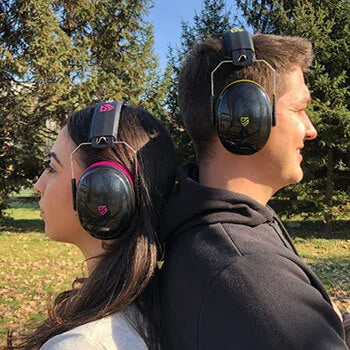
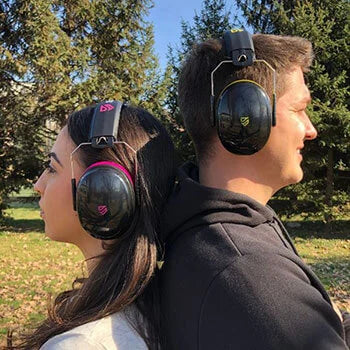
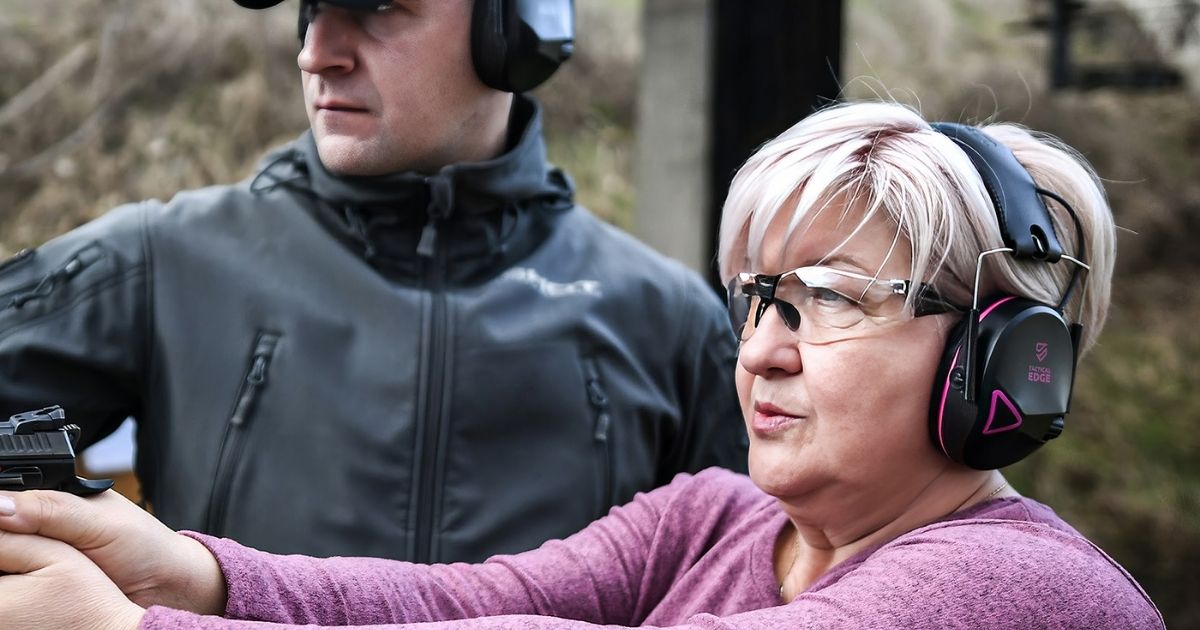
TacticalEdge Electronic Earmuffs
The TradeSmart TacticalEdge electronic earmuffs deliver the features that matter most to active shooters:
- NRR 24 protection — solid noise reduction for both range and field use
- Stereo directional microphones — hear where sound is coming from, not just that it's there
- Sound amplification — ambient sounds are boosted to clear, natural-sounding volume so you never miss a range command or hunting cue
- Fast compression circuitry — dangerous impulse noise is clamped to safe levels in milliseconds
- Padded headband and cushioned ear cups — built for extended wear without pressure points
- 10-year warranty — TradeSmart stands behind the TacticalEdge for a full decade
The TacticalEdge sits squarely in the performance range where most shooters get the best return on investment: reliable electronics, quality sound reproduction, and proven NRR-rated protection without paying for features you don't need.
Electronic Ear and Eye Protection Kit
For shooters who want a complete electronic protection setup in one purchase, the TradeSmart Electronic Ear and Eye Protection Kit pairs the TacticalEdge electronic earmuffs with ANSI Z87.1+ certified safety glasses — impact-resistant polycarbonate lenses with anti-fog coating.
Every TradeSmart kit includes the free Range Confidence Course, an online firearms fundamentals program that covers safety, marksmanship, and range etiquette. It's a resource built for new shooters and a solid refresher for experienced ones.
Whether you're building your first range kit or upgrading from passive earmuffs, TradeSmart's electronic options give you hearing protection that keeps you aware, comfortable, and safe.
Frequently Asked Questions
Are electronic earmuffs safe for shooting?
Yes. Electronic earmuffs provide the same passive noise reduction as standard earmuffs (measured by their NRR rating) with the added benefit of sound amplification for safe-level sounds. Even if the batteries die or the electronics malfunction, the physical ear cups still block noise at their full rated NRR. You're never unprotected. For the loudest environments, pair electronic earmuffs with NRR 33 foam earplugs for dual-layer protection.
What NRR rating do I need for electronic ear protection?
For shooting, look for electronic earmuffs with an NRR of at least 22. An NRR of 24-26 is ideal for most range and field applications. Remember that real-world noise reduction is typically estimated at (NRR - 7) / 2 using OSHA's standard formula, so higher ratings provide a meaningful safety margin. For indoor ranges or large-caliber firearms, doubling up with foam earplugs under your electronic muffs is strongly recommended.
How long do batteries last in electronic earmuffs?
Battery life varies significantly by model and usage. AAA-powered electronic earmuffs typically run 200-350 hours, while rechargeable models offer 40-80 hours per charge. Features like Bluetooth drain batteries faster. Models with auto-shutoff prevent battery waste when you forget to power them down. Carry spare batteries or a charging cable in your range bag as a backup.
Can I wear electronic earmuffs with glasses?
Yes, but fit matters. Glasses frames create a small gap in the ear cup seal, which can slightly reduce the effective NRR. Look for electronic earmuffs with thick, soft ear cushions that conform around glasses temples. Gel-filled ear cushions generally seal better around glasses than foam. TradeSmart's kits pair earmuffs with safety glasses specifically designed for range use, with slim temple profiles that maintain a quality seal.
What's the difference between electronic and noise-canceling earmuffs?
These are often confused but work differently. Electronic earmuffs use microphones and speakers to amplify safe sounds while compressing dangerous impulse noise. Noise-canceling earmuffs use active noise cancellation (ANC) to generate anti-phase sound waves that reduce constant low-frequency noise (like engine hum or HVAC). For shooting, electronic earmuffs are the correct choice — ANC-only headphones are not designed to protect against impulse noise from gunfire and should never be used as shooting ear protection.
Do electronic earmuffs work well for hunting?
Electronic earmuffs are excellent for hunting. The sound amplification lets you hear game movement, bird calls, and rustling at distances beyond your natural hearing range, while the compression circuitry protects your ears the instant you fire. Choose models with stereo directional microphones for spatial awareness, wind noise reduction for outdoor conditions, and high amplification gain (20+ dB). A slim-profile design prevents interference with rifle and shotgun shouldering.
Can I use electronic ear protection for purposes other than shooting?
Absolutely. Electronic earmuffs are used in construction, heavy machinery operation, motorsports, lawn care, and any environment where you need hearing protection but also need to hear conversations or warning signals. The same technology that lets you hear range commands while blocking gunshots works equally well for hearing coworker communication while blocking industrial noise.
Should I choose electronic earmuffs or electronic earplugs?
For most shooters, electronic earmuffs are the better choice. They offer higher NRR ratings, better sound quality, more features, and don't depend on perfect insertion for effectiveness. Electronic earplugs are best for situations where earmuff bulk is a problem — under helmets, with heavy winter hats, or for long-rifle shooters who need zero cheek weld interference. Some competition shooters use electronic earplugs as the inner layer of a dual-protection setup with passive earmuffs over them.
Protect Your Hearing Without Losing Your Awareness
Electronic ear protection lets you stay connected to the sounds that matter while blocking the ones that cause permanent damage. Whether you're at an indoor range, in the field hunting, or running competition stages, the right electronic earmuffs keep you safe, aware, and comfortable.
TradeSmart Safety's TacticalEdge Electronic Earmuffs and Electronic Ear and Eye Protection Kit deliver NRR 24 electronic protection with directional microphones, a padded headband, and the confidence of a 10-year warranty. Every kit ships free and includes access to the Range Confidence Course.





Leave a comment (all fields required)